


Review: NEXT TO NORMAL at The DCPA Theatre Company
A passionate pop-rock musical evoking mistrust in mental health care
Brilliant musicianship, soulful performances, and expert craft make Next to Normal at the Denver Center for the Performing Arts deeply identifiable. Unfortunately, the pathos it creates through these immense talents may cast more doubt on mental health care than broker clarity surrounding mental illness.
Originally premiering in 2009, Next to Normal tells the story of a middle-aged woman, Diana Goodman (beautifully voiced and tenderly performed by Aléna Watters), grappling with diagnosed bipolar depressive disorder and her family that tries to “keep the plates all spinning” while Diana’s illness threatens to derail her family’s “normal” suburban life. While the musical paints deep-hearted portraits of each family member dealing, in their own way, with the impacts of this disease, it fails to give as much grace to its mental health practitioners (who are played by the same actor, Randy Guiaya) who come off as unempathetic dolts torturing an ailing woman with progressively invasive treatment modalities.
Mired with medications, ineffective talk therapy, hypnosis, and even electroconvulsive therapy, Diana queries, “I wonder which is worse, the sickness or the cure.” Seventeen years after its conception, in a social context that derides the value and expertise of medical practitioners, it’s hard to hear that question, and the musical that holds it at its heart, as anything other than an indictment of the science of medicine.
At the play’s onset, Diana is seeing a psychopharmacologist who prescribes “a million meds” to Diana who experiences a barrage of negative symptoms from weight gain to low sex drive. Finally, after many dose changes, Diana reports, “I don’t feel like myself.
I don’t feel anything.” To which the doctor responds, “Patient stable” to an unsettling musical button. In consultation for this review, Licensed Clinical Social Worker Emma Miles, who has been working as a therapist for the past eight years, weighs in on whether this kind of therapeutic response is common in the profession. “That’s certainly not a common therapeutic response,” she told me in our conversation. “{Diana’s response} would be concerning – I think they should ask more questions.
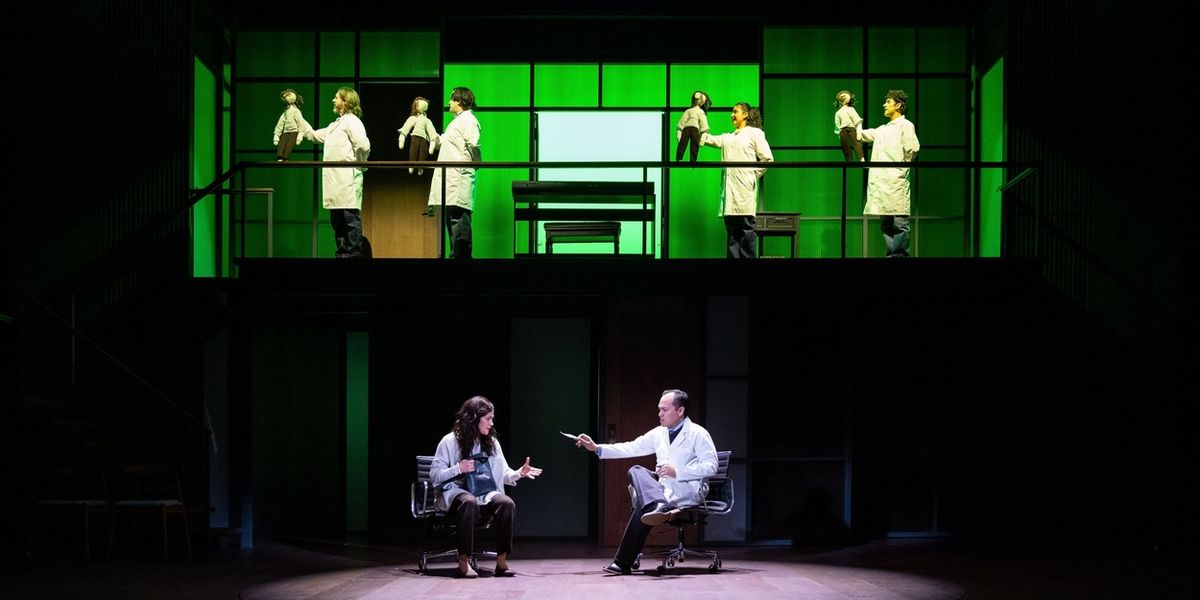
It doesn’t sound like she’s stable – It sounds like she feels different.” However, the musical’s doctor responds with a profound lack of empathy, and the moment reinforces a pervasive anxiety around psychiatric medication— that it will hollow out the self—casting the psychopharmacologist as an antagonist rather than a caregiver. This is more than spelled out in the direction which sees characters puppet-ing tiny doll versions of Diana, twisting her limp body this way and that as the medication wreaks havoc on her psyche.
And yet, where the musical’s depiction of care feels reductive, its portrait of the family is strikingly nuanced. Aléna Watters’ Diana is never self-pitying. She’s sarcastic, bright, and brave. Moreover, the feeling of being puppet-ed through a health care journey is one that’s very clearly felt and reported by this population, and while the production’s literalization of that image flattens its broader implications, it resonates powerfully as an expression of Diana’s interior life.
Watters’ beautiful, folksy voice captures both Diana’s outward presentation of a competent matriarch as well as her internal anxiety. Diana’s husband, Dan, played by James D. Sasser, ties his identity and masculinity to his relational role of caregiver and stalwart support. Sasser plays the role with swagger and confidence, taking up a lot of space as he paces about the house with a mane of hair, tatted arms, and a tank top, but barely masking the deep insecurity and grief beneath.
Sasser’s vocal ability may fall slightly below his skilled acting performance but was perfectly serviceable, especially as an element of the group’s harmonies which were utterly scrumptious. Ethan Peterson’s Gabe (the Goodman’s son,) on the other hand, is more than capable of vocal and physical gymnastics his role demands, bringing charisma and explosive energy to the role.
On the other hand, this portrayal of Gabe vacillates between menacing and empathetic without clear pathos between the switches – A clearer, stronger choice may have been appreciated in this regard. Angélica Concepción’s Natalie (the Goodman daughter) is a standout performance. Her voice brought Natalie’s neuroticism and passion to life and her performance perfectly captured teenage snark with deep feeling underneath.
Across the board performances were emotional, vocally brilliant, nuanced, and complex. The rich live music, performed by a five-piece rock orchestra, drove the show’s energy and lent robust musicianship to the performance. These musical’s characters were deeply compelling and felt like real people – a major win for the production.
Technically, the show’s set, costumes, lighting, and blocking all worked in service of the fast paced, fluid movement of the show. Klara Zieglerova’s scenic design, composed of two stories rich copper walls, and wavy plexiglass framed in LED embedded metals, was able to slide its paneled walls along the horizontal axis, giving scenes movement and energy and implying changing spaces without physical shifts.
Particularly effective were moments when lights cast shadows of performers against the plexiglass, allowing on stage performers to interact with shadows beyond the veil. Meghan Anderson Doyle’s costuming (especially for Natalie) was strong, giving each character a lived-in feel and a clear sense of style. Colorful LED’s and moving lights by Paul Whitaker helped the show feel like a rock concert while also conveying the emotion of certain moments. Blinding the audience with moving lights on sick guitar riffs throughout the show, however, may have been a tad too much. Director Nancy Keystone shines in her fast-paced movement and smooth blocking.
Especially effective moments are Diana’s surprise appearance at the beginning of the second act and Gabe’s movement through beyond the second story railing and through “impossible” corridors. On the whole, the technical aspects of the show are sleek and work well in tandem with the storytelling.
In a theatrical landscape that often seeks to balance accessibility with relevance, it is worth considering what stories are chosen and how those choices resonate beyond the stage. Large regional theatres do not simply present work—they curate it, and those choices shape how stories are understood in a given cultural moment.
In selecting Next to Normal now, this production invites audiences to revisit a story about mental illness that remains emotionally powerful, but whose framing of care feels increasingly complicated. In the show’s finale, Diana chooses to forgo mental health treatment and try to understand herself without the help of practitioners.
She comes on stage, bathed in golden light, clutching a thermos and a book, ready to embark toward her new horizons. Who can blame her. After overmedication, manipulative therapeutic practices, and electroconvulsive therapy resulting in profound memory loss, who wouldn’t distrust mental health care. LCSW Emma Miles weighs in, “It doesn’t seem like {therapists} have been doing her any good. I wouldn’t trust a therapist after all that stuff. We may need to report this therapist to the board!”
Indeed, the musical makes mental health care out to be terrifying, pseudoscientific nonsense. Miles explains it well, “It sounds like this musical is trying to make people think mental health care is snake oil – that it’s full of wacky woo woos.” Mental health care, however, isn’t snake oil. Many, many people have benefitted from psychotropic medications, talk therapy, and engagement in mental health modalities. It’s a practice with years of evidence-based practice and a history of success. In a moment when public trust in medical expertise is already under strain, choosing to amplify that skepticism—however unintentionally—feels like a consequential misstep.
Sign up for all the news on the Fall season, discounts & more...
|
Stranger Sings The Storyteller Theater (10/31-11/14) |
|
Dr. Seuss’s The Cat in the Hat – Live on Stage! PACE Center (2/10-2/10) |

|
The Gruffalo PACE Center (4/15-4/15) |
|
Disney's Beauty and the Beast Buell Theatre (10/20-11/07) PHOTOS |
|
The Book of Mormon Buell Theatre (1/05-1/17) PHOTOS |
|
CMF & CMA Concert Series: Pianist Michael Davidman Center for Musical Arts (1/29-1/29) |
|
Five 5ths: Beetlejuice Band of Toughs: A Theatre Collaboratory (10/28-10/28) |

|
Colorado New Play Summit Helen Bonfils Theatre Complex (2/20-2/21) PHOTOS |

|
Ali Stroker in Concert Lone Tree Arts Center (11/14-11/14) |

|
Mothman: A Ludicrous Love Story (Staged Reading) Indigo Theatre Company, LLC (1/09-1/09) |

Reader Reviews
To post a comment, you must register and login.