


Review: BORROWING FUNNY at Wounded Cobra Theatre At The Clocktower Cabaret
A promising premise gets lost in an increasingly implausible comedy
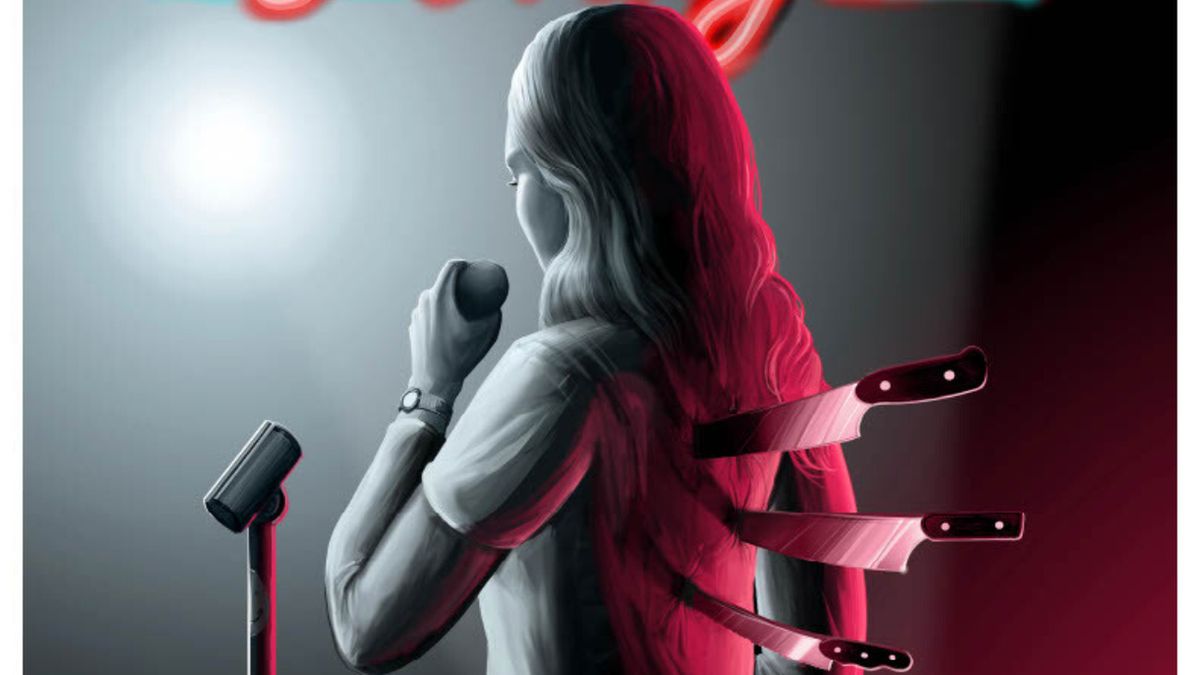
The advertisements for Matt Wexler’s Borrowing Funny pose an interesting question: Who owns a joke?
It’s a shame the play never really asks that question.
The world-premiere comedy from The Wounded Cobra Theatre takes place in a 1990s comedy club, where local comedian Jacey Weisz (Lexi Wilson) discovers that national headliner Tennille Kincaid (Katy White) has stolen another comedian’s material. But there is no ambiguity about influence, parallel thinking or the murky ownership of observations drawn from shared experience. Tennille asks local comedians to perform their sets for her as an audition, specifically tells them not to use the material while opening for her, and then performs their jokes herself.
She stole them. Case closed.
That might still be the beginning of an interesting play. What does a comedian do when someone more powerful steals their work? What recourse exists in an art form without many formal protections? What happens when the thief can reach an audience the original writer cannot? But Borrowing Funny largely leaves those questions behind, replacing them with an increasingly elaborate plot that requires more suspension of disbelief than either the writing or production can support.
There is a version of this story that might work as outright farce. The circumstances certainly become absurd enough for one. Comedy club owner Reuben Wyatt (Jeff Jesmer), desperate to salvage his weekend, eventually pits comedians against one another in a head-to-head “comedy kumite,” while Officer Jill Hail (Jordan Hull) becomes embroiled in deciding who should actually face arrest. At one point, comedic ability effectively becomes part of the calculus of who goes to jail.
Played within a sufficiently heightened world, that is a joke. Here, the production instead spends considerable time trying to provide plausible explanations for fundamentally implausible behavior. The result lands in an uncomfortable middle space: too unbelievable to accept on its own terms, but never broad enough to make disbelief part of the fun.
It doesn’t help that the characters have very little interior life to anchor them. Byron Keithly (Darius Cade) is broke and has recently been fired from a video store, two facts from which both the character and Tennille’s comedy sets draw an extraordinary amount of material. Jacey is primarily aggrieved, Officer Jill angry and Reuben opportunistic. Jesmer’s comparatively understated performance gives Reuben some welcome texture, but the actors are largely working with characters defined by a few traits repeated at increasing volume.
Tennille is the most difficult case. The play appears to expect her charisma or comic talent to complicate our response to her behavior, but gives White little opportunity to establish either beyond an aggressively crass persona. Tennille lies, steals, fights and manipulates with such consistency that when the plot eventually requires another character to trust her, the choice feels less like a moral complication than a violation of what the play itself has established.
There is also a brief suggestion that Tennille experienced sexual exploitation on her way to fame. It is potentially enormous information about this character, introduced and then left largely unexplored. Rather than complicating her, the suggestion hangs uncomfortably beside a character the play otherwise renders in broad strokes.
That thinness becomes particularly damaging in the climax. Jacey makes a choice that seems intended to compromise her own moral position and perhaps suggest that the distance between these comedians is smaller than it first appeared. But the groundwork isn't there. After watching Tennille repeatedly demonstrate exactly who she is, Jacey's decision requires her to suddenly abandon judgment the play has given her every reason to possess.
The production itself is similarly rough around the edges. Luke Sorge’s scenic design adequately establishes the comedy-club setting, with a neon sign providing its strongest visual element. Other choices feel more utilitarian. A collection of seemingly random books sits conspicuously on a shelf until Jacey finally needs something to throw during an angry breakdown—Chekhov’s dictionaries, apparently.
The frustrating thing about Borrowing Funny is that its advertised premise contains more complexity than the play ultimately allows. Joke theft really can raise difficult questions about authorship, ownership, power and artistic ethics. But this particular theft doesn't. Tennille takes material she knows belongs to someone else and performs it anyway.
Without ambiguity in that central conflict, Borrowing Funny needs something else to sustain the evening: characters complicated enough to make their responses surprising, a comic world heightened enough to make its escalating absurdity exhilarating, or consequences that reveal something unexpected about the people involved. This production never quite finds that second engine.
Sign up for all the news on the Fall season, discounts & more...


|
bogfriends Singleton Theatre (1/15-2/21) PHOTOS |

|
Hadestown Buell Theatre (6/08-6/13) |

|
Stories on Stage presents “Chance Encounters” Su Teatro (10/18-10/18) |

|
Pianist Michael Davidman at Center for Musical Arts Center for Musical Arts (1/29-1/29) |

|
Colorado Jazz Repertory Orchestra Presents Jazz de Paris Dazzle (10/25-10/25) |

|
The Wild Party The Storyteller Theater (9/18-10/04) |

|
Buena Vista Social Club Buell Theatre (4/27-5/09) PHOTOS |
|
Legally Blonde - The Musical Buell Theatre (2/05-2/07) PHOTOS |

|
Pianist Jean-Baptiste Doulcet at Center for Musical Arts Center for Musical Arts (10/02-10/02) |
|
The Snowy Day & Other Stories PACE Center (10/06-10/06) |

Reader Reviews
To post a comment, you must register and login.