

Season 2, Episode 5: Behind every summer is a community that keeps Fire Island alive. This episode explores the history of the beloved Pines Pantry through the eyes of its iconic Pantry Girls, alongside the volunteer firefighters of The Pines and Cherry Grove who protect the island from fires, hurricanes, beach erosion, and an uncertain future.
Review: South Coast Repertory Presents BLIND RUNNER
Poignant and arresting yet at times purposely slow-burning, Amir Reza Koohestani's intriguing 2-person play makes its West Coast debut in the OC.
By: Michael Quintos
By the time of this writing, the United States is, unfortunately, still involved in an ongoing war with the nation of Iran, with neither side willing to cease their mutual operations.
And because of that, it's understandable that many of the creative people involved in the making of the thought-provoking play BLIND RUNNER—now on stage at OC's South Coast Repertory in Costa Mesa through November 8, 2026—were not able to come to the US to oversee its West Coast debut production, including its own playwright and director Amir Reza Koohestani. With his visa to travel to the US revoked, Koohestani was forced to supervise SCR's planned mounting from afar via online video conference calls.
One could not help but notice that this bit of backstage intrigue seems to have eerie parallels to the narratives that unfold in the play, placing quite a reverberating punctuation on a drama that focuses on the physical and mental borders that keep us as human beings from freely going from point A to point B to express who we are and what we believe.
Luckily for audiences who have already experienced the play at SCR during its initial week of previews and its subsequent, post-Opening Night shows, the resulting production still retains its poignant messaging and powerful, minimalist staging that audiences from previous presentations of the play (it first premiered in Brussels, Belgium in 2023) have already experienced first-hand.
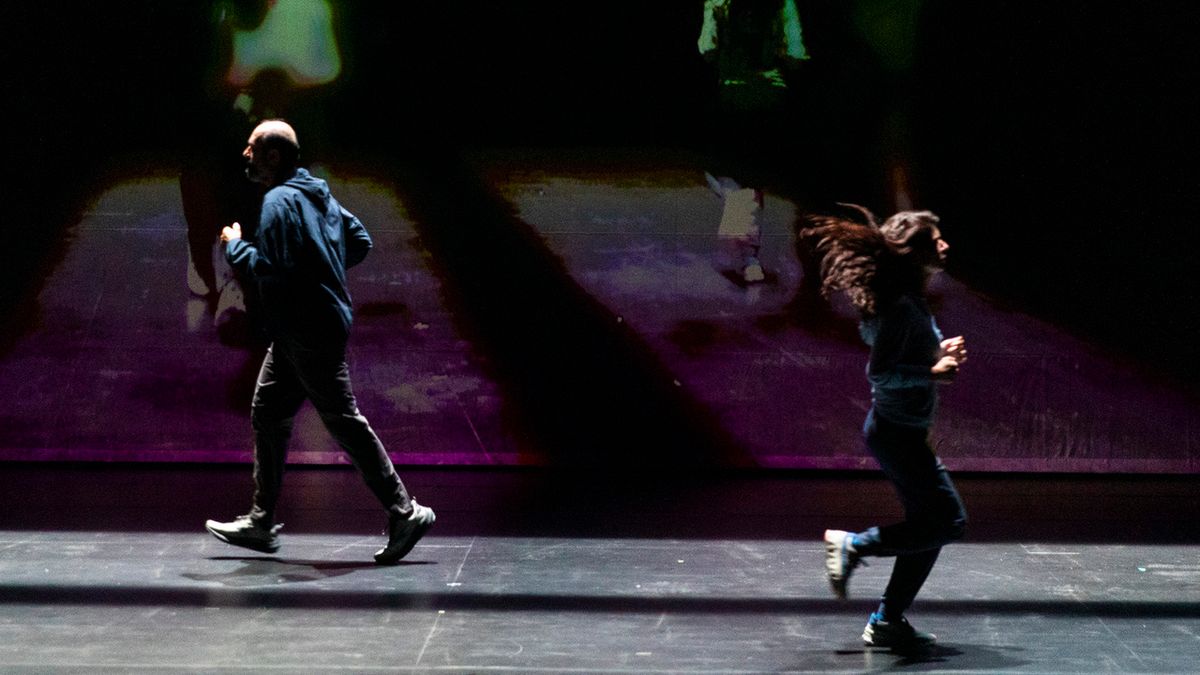
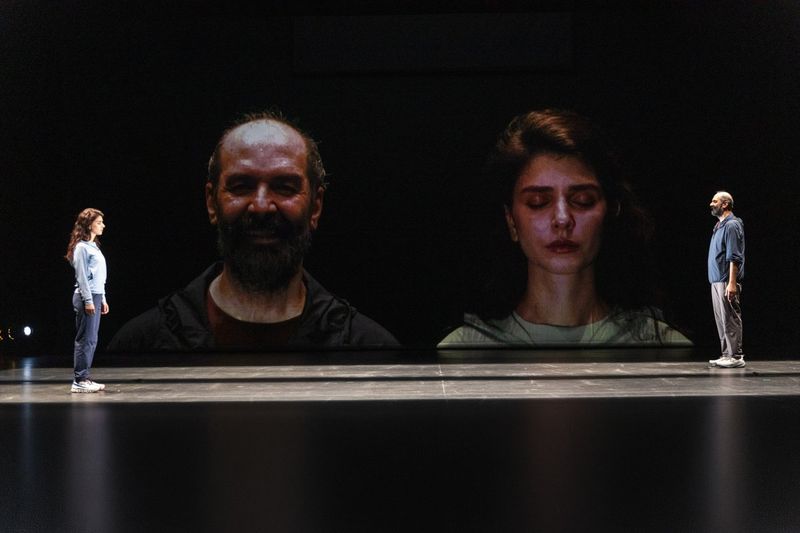
Its purposely brutalist staging—relying heavily on meticulously concealed live cameras while often bathing the stage in stark darkness—is certainly the play's striking machination, but embedded in its very essence is a quietly unsettling play that takes the act of running as an extension of defiant, resilient resistance.
Here, the sheer nature of being able to move becomes much more than a just a physical feat that most take for granted. At its very core, running becomes not only an expression of freedom, but also as a means to enact a protest against the injustices of the world, and, perhaps, even a desperate attempt to reclaim a life that circumstances beyond one's control have cruelly and unfairly put on hold.
A deceptively subtle yet thematically ambitious theatrical work, BLIND RUNNER merges an intimate human drama with the larger geopolitical expanse of political repression, asking audiences to consider what freedom actually means when the people who need it most are the very ones frequently denied the ability to pursue it—many times putting their very existence(s) at risk when they seek to do so.
While, admittedly, I was a bit intimidated walking into the play with the prospect of having to spend the evening reading a play (via supertitles) since all of its dialogue is entirely spoken in Farsi, rather than just watch the play acted out, listening in on characters' conversations in their own comfortable native language while simultaneously giving us translated visual insights on what they are expressing, we too feel like voyeuristic surveillance cameras monitoring the activities unfolding before us.
The thing is though—we as an audience aren't privy to everything either.
And therein lies both the play's searing mystery and its slight hindrance. Blink too slowly or turn your gaze to the actors even for a slight moment, and you risk missing vital translations of an exchange that flash in an instant.
Granted, the pair of actors tasked to portray these characters are certainly compelling in their own right, but there's just so much they could do with a subtle facial expression here or a change in cadence there. For the most part, though, the performers' physical expressions and vocal rhythms provide enough contextual layers of meaning, despite trying to follow projected captions that may occasionally divide one's attention between the stage and the screen. But alongside video footage shown side by side with live actors on the same stage, the play becomes an intriguing, riveting hybrid of theatrics and modern technology.
Overall, the play does achieve its goal of presenting a compellingly arresting piece of theater.
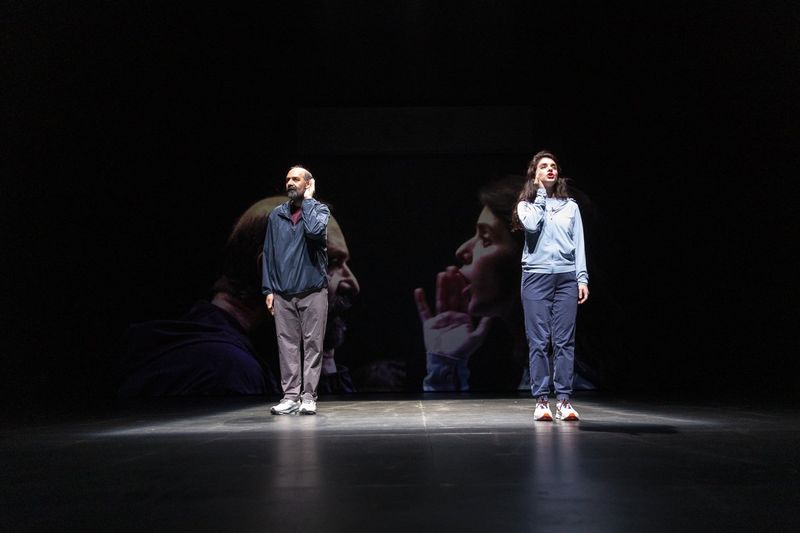
Set against the harsh, political realities of modern-day Iran, the play—which runs just about an hour with no intermission—first introduces us to a married couple played with palpable yet understated intensity by Mohammad Aghebati and Ainaz Azarhoush. When we meet them, the couple's relationship in its present state seems to have been profoundly and forever altered by the wife's imprisonment as a political dissenter. In a country that sees anti-government speech as dangerous, such a punishment isn't a surprise to even those unaware of the country's specific policies.
Their brief, monitored visits continue to reveal a marriage struggling to survive under such extraordinary circumstances, exacerbated by chats that have to be disguised and somewhat stripped of outright meaning lest they want to incriminate themselves in front of the prison's observant jailers hidden behind all those strategically placed security cameras.
Yet, even their most ordinary conversations—sprinkled with moments of both flirtation and frustration—become one exercise after another in stilted caution, as the couple navigates a world where their privacy is virtually nonexistent, and where their words can carry dangerous consequences. Although the husband is physically free to leave the prison, his wife's confinement makes his own semblance of freedom feel somewhat incomplete.
Along the way, we soon learn that the pair both have enjoyed the sport of running in their previous lives, and did it quite a lot right before she was incarcerated. The idea that she can no longer enjoy something as simple as running because of her situation isn't lost on her husband who still has that freedom to participate in the activity in the outside world.
As time passes, the husband—at his wife's insistent urging—reluctantly agrees to help a young blind woman named Parissa (also played by Azarhoush) to prepare for a running competition in Paris. The idea seems simple enough: the race Parissa wants to participate in requires her as a blind woman to have a sight-abled guide tethered to her at all times. In essence, she may be the one running the race, but her guide pretty much has to match her step-for-step, essentially making him an active participant in the race as well.
What initially seems like a straightforward athletic undertaking that the husband can rekindle once more while also fulfilling a request from his wife, the task gradually becomes something far more complicated—and, well, dangerous.
The blind runner and her guide soon develop a layered partnership that explores trust, dependence, and the delicate negotiation required when one person must rely on another to navigate an unfamiliar world.
But, as it turns out, the race is just the beginning of a much larger goal.
Following the competition, the running pair must then confront an even more perilous challenge: they are planning to traverse the 38-kilometer Channel Tunnel (roughly 23.6 miles) between France and England on foot, that is, before the first train of the morning makes its way through the passage—creating a potentially fatal consequence for civilians who are occupying the same narrow tube not meant for pedestrian traffic. Suddenly, running is no longer simply about athletic achievement—it becomes a desperate gamble to attain liberty, freedom, and survival.
On the surface, a theater piece about political imprisonment, voyeuristic surveillance, and a potentially fatal race for life would seem to possess all the ingredients for considerable dramatic tension.
For the most part, BLIND RUNNER gets there, but it also mostly does so by doling out these attributes only a little at a time—a surprising thing to experience for a play that runs just under an hour. Rather confidently, writer/director Koohestani frequently chooses understatement over escalation. Conversations unfold at a measured pace. Information arrives incrementally. And, often, the audience must sit with uncertainty rather than receive instant gratification of a clearly defined conflict moving toward a conventional dramatic climax.
There is certainly artistic justification for this approach, which I genuinely admired in its audaciousness right from the start.
Life under oppressive circumstances does not necessarily unfold like a suspense film, with every scene delivering a new revelation or further intensifying the danger. Waiting, repetition, and the exhaustion of seemingly uneventful days can themselves be examples of painful, psyche-damaging suffering. So, in that sense, BLIND RUNNER's restrained rhythms does evoke that experience with considerable nuance and sensitivity.
However, intention and execution don't always line up in exacting beats, which, for me, is a my minor objection with the play. To be honest, there were times when I felt the experience becomes more intellectually compelling than dramatically engaging.
Some audience members—myself included—may find that the play's deliberate, drag-it-out pacing occasionally diminishes the very urgency its subject demands, particularly with just an hour for all of it to play out. The political circumstances are alarming, the emotional stakes are significant, and the proposed tunnel crossing introduced later is genuinely perilous. Yet with its dramatic progression remaining too muted, the audience may not fully grasp the seriousness of the situation without fully experiencing it with a modicum of haste.
To be fair, some of the most affecting dramatic experiences from other plays are similarly built around stillness, hesitation, and the unbearable weight of things left unsaid. The question then becomes whether each palpable pause in BLIND RUNNER reveals something new. Or, perhaps, whether each conversation changes our understanding of the characters. Or, perhaps, whether the accumulation of those moments creates a sufficiently powerful-enough emotional trajectory.
For me, I interchangeably found myself both appreciative of the play's integration of the personal and the political, but also aching, in some spots, for its storytelling to break out of moments that feel too lethargic to sustain the necessary tension. Sure, its formal restraint is integral to its identity, but restraint should not become an excuse for things to come to a dramatic halt when it's finally time to unveil something. A play can be enigmatic without being opaque, meditative without becoming inert, and intellectually challenging without leaving its audience emotionally stranded.
But, thankfully, there's enough meat in BLIND RUNNER for these minor hiccups to seem minuscule in its grander vision.
The most compelling achievement of Koohestani's narrative is the way he makes this deeply personal story feel inextricable from the larger political realities surrounding it. Rather than reducing his characters to symbols of oppression or resistance, he focuses on the smaller, more intimate consequences of living under a suppressive, authoritarian system, which arrive in the form of a conversation that cannot be completed, a thought that cannot safely be expressed, or in a portrait of a marriage struggling to maintain its central pair's emotional connection despite the physical distance imposed upon it.
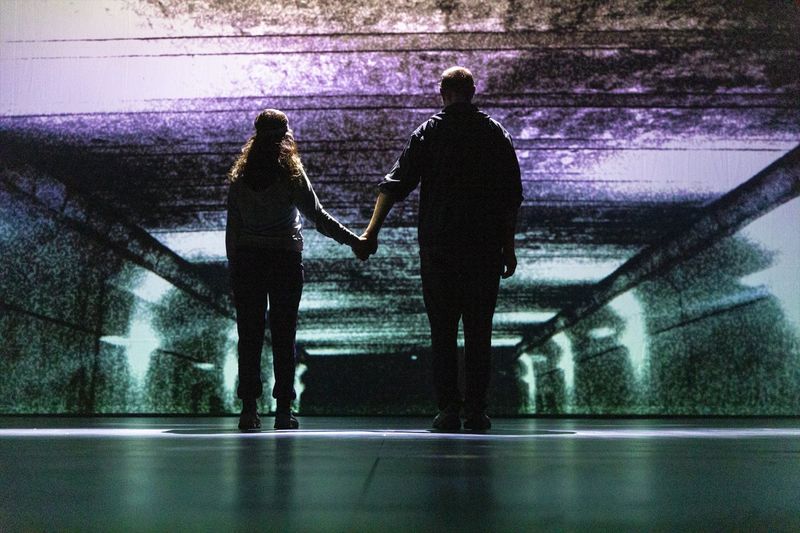
The wife—stuck in jail for following her convictions—is not simply a tragic figure awaiting rescue. And nor is her husband—himself stuck in his own kind of limbo—presented as an uncomplicated hero. Their relationship has its own frustrations, uncertainties, and emotional complications. Koohestani understands that oppression does not simply restrict physical movement, it gradually reshapes the way people communicate, love, and relate to one another. Funny enough, it is in these palpably quieter moments that the play finds much of its emotional resonance, even if sometimes they feel like a slow burn.
Running, meanwhile, becomes the production's most intriguing metaphor—and, frankly, a visual respite from all that stilted talking that, admittedly, can cause some audiences to drift. The very sight of seeing the characters run and huff and puff suggests forward motion, personal achievement, and the possibility of leaving something behind.
But in BLIND RUNNER, the action of movement is never quite that simple. The imprisoned wife is confined by circumstances she cannot control. Parissa must place her trust in another person to navigate a course she cannot see. And the husband finds himself caught between two women, each struggling to reclaim some measure of independence via proxy. This criss-crossing keeps the play intriguing as it trudges along to its conclusion.
And the title itself carries multiple meanings.
There is an old adage that claims that if one of the senses is lessened or eliminated, the others become even more heightened and attuned somehow. Here, we witness that visual impairment is not simply a physical condition, nor is having sight necessarily equivalent to understanding. The husband may see the world around him, but can he truly comprehend his wife's experience or her everyday emotional reactions to her incarceration? Can Parissa really trust the person guiding her on a correct path? And can any of these characters confidently anticipate what lies ahead when their lives are shaped by forces beyond their control? These are provocative questions, and Koohestani wisely avoids offering easy answers—or, well, an ending that will satisfy everyone.
But above all else, the play's unconventional theatrical presentation is arguably its most intriguing draw.
For SCR's West Coast premiere, the collaboration between Koohestani and his international creative team is central to the production's DNA. Deserved kudos go to Éric Soyer for his lighting and "scenography," designer Negar Nobakht Foghani for his mostly monochromatic costumes, Yasi Moradi and Benjamin Krieg for their Orwellian video designs, and Phillip Hohenwarter and Matthias Peyker for their eerie atmospheric music.
This minimalist visual approach is particularly well suited to a play concerned with incarceration and confinement. A realistically detailed setting might establish the physical circumstances, but this play's purpose-driven abstraction allows the production to emphasize the psychological effects of those circumstances. Space becomes something the characters must negotiate rather than merely occupy. Elsewhere, lighting can establish boundaries without requiring physical walls, projected video can simultaneously evoke both intimacy and distance, while music and silence can shape the tension between characters' internal experience and the external world that restricts it.
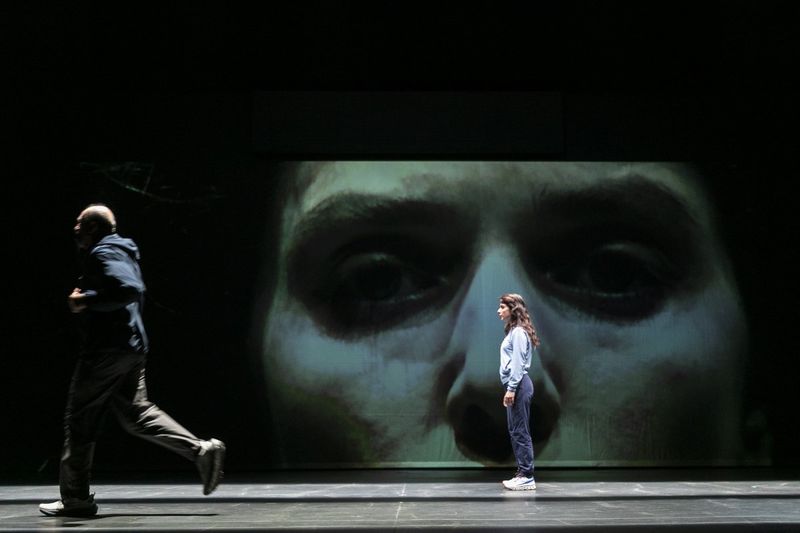
Rather than relying on elaborate scenery or traditional realism, Koohestani employs bleak, minimalist visuals in which physical space, sinister surveillance, and emotional isolation are communicated through images as much as dialogue.
This multi-media approach—think Apple's award-winning 1984-inspired ad for the Macintosh—is particularly effective in reinforcing the play's dark, resonating themes. Cameras and projected images evoke the constant observation surrounding the imprisoned wife, while simultaneously creating moments of unexpected intimacy, as if certain close-ups offer a magnifying glass to one's inner workings. There is an interesting contradiction at work here: being watched is not necessarily the same as being understood. A camera may record every movement, but it cannot always capture the emotional truth behind it. These multiple contrasting dichotomies is what makes BLIND RUNNER such a provocative theater piece.
As spectators watching from the fourth wall, we observe the characters closely, yet remain aware that we cannot fully understand everything they experience. This interplay between visibility and concealment becomes an extension of the story's central concerns.
Its minimalist aesthetic also places considerable responsibility on the pair of performers who are on stage for the entirety of the play, requiring them to communicate emotional complexities through restraint, physical precision, and subtle shifts in expression rather than conventional theatrical grandstanding.
Both Aghebati and Azarhoush are incredible in their respective roles, effortlessly balancing the personal and political dimensions of the story. Aghebati believably conveys being caught between loyalty to his imprisoned wife and the unexpected responsibility of guiding another woman toward an uncertain future. Meanwhile, Azarhoush's distinctive dual roles convey very different experiences of vulnerability and independence without allowing their respective circumstances to define them entirely.
In the end, the play's final premise provides a genuinely powerful image that comes as jolt, but also not entirely unexpected. The Channel Tunnel crossing transforms the notion of freedom into something both tangible and absolutely terrifying. The passage represents a threshold between one existence and another, but reaching the other side is hardly a guarantee of safety either. The characters must depend on timing, trust, physical endurance, and circumstances that, frankly, they cannot entirely control. It is a fitting culmination of the play's central metaphor: freedom is not simply something waiting to be claimed. Sometimes, it is something people must risk everything in order to pursue.
Overall, BLIND RUNNER is a genuinely thoughtful and intriguingly adventurous dramatic work that demonstrates how a seemingly modest story—using minimalist aesthetics—can still manage to stir up questions of enormous political and philosophical consequence. Its greatest achievement is the way it connects the intimate and the political without treating either as secondary. Here, the imprisonment of a wife in Iran becomes a universally-relatable story about the fragility of human connection, while also highlighting that not everyone in the world has the same freedoms as we do. Later, the training of a blind athlete becomes an exploration of interdependence. And a dangerous race through a tunnel becomes a meditation on what people are willing to risk when freedom is no longer something that they can just take for granted.
Although I feel that its restrained storytelling and occasionally elusive pacing may not appeal to every theatergoer, Koohestani's work undeniably offers something considerably more substantial than a conventional evening of theatrical entertainment: it challenges audiences to look beyond the literal circumstances of its characters and consider the universal desire to move beyond the limitations imposed upon us.
For Southern California audiences, SCR's bold production provides an opportunity to experience an internationally-acclaimed piece of theater—apparently unchanged from its previous iterations—that approaches familiar questions from a distinctly different cultural and theatrical perspective. BLIND RUNNER may not always be as dramatically propulsive as its premise suggests, but it is undeniably driven, visually compelling, and admirably enriched with ideas worth examining, particularly in our current times.
In a world increasingly determined to limit how far its citizens can go, perhaps the act of continuing the journey is, in itself, a form of brave defiance.
** Follow this reviewer on Bluesky / Instagram / Twitter X / Threads: @cre8iveMLQ **
-----
Photos by Matt Stasi, courtesy of South Coast Repertory.
BLIND RUNNER is presented by Mehr Theatre Group in association with University of California, Irvine Claire Trevor School of the Arts. Performances of BLIND RUNNER at South Coast Repertory continue through November 8, 2026. Tickets can be purchased online at www.scr.org, by phone at (714) 708-5555 or by visiting the box office at 655 Town Center Drive in Costa Mesa.
Broadway news in your inbox
Weekly top stories - unsubscribe anytime.
Weekly top stories - unsubscribe anytime.
Popular episode

|
The Cottage North Coast Repertory (10/28-11/22) |
|
Woof Odyssey Theatre (10/03-11/08) |

|
‘Romeo and Juliet: Time Enough for Love’ Atwater Village Theatre (11/13-12/19) |
|
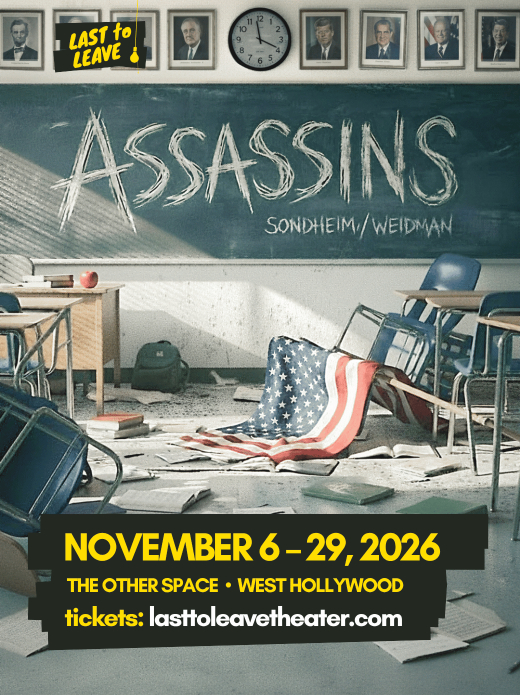
Assassins The Actors Company — The Other Space (11/06-11/29) |

|
Marlonius Jazz Orchestra & Vocalist Mara Kaye Pay Tribute to Billie Holiday Sierra Madre Playhouse (11/08-11/08) |

|
PlayGround Twisted Holiday Festival PlayGround LA (12/04-12/20) |
|
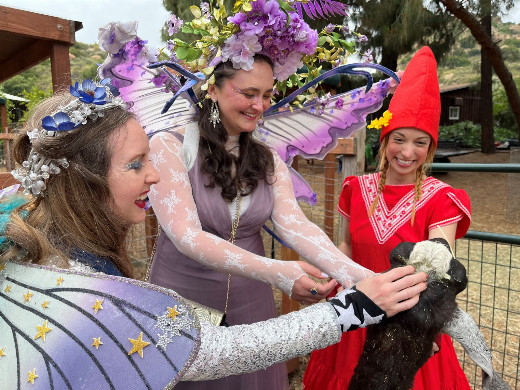
A Faery Hunt and Their Animal Friends Kindred Spirits Care Farm (11/08-11/08) |

|
“Young Americans”: The Music of Living American Composers St Francis Episcopal Church (4/30-4/30) |

|
White Christmas Morgan-Wixson Theatre (11/07-12/06) |
|
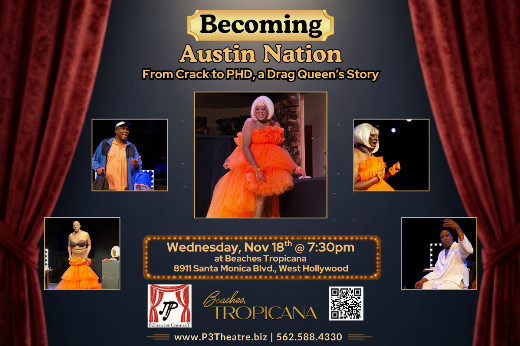
Becoming Austin Nation: From Crack to PhD: A Drag Queen’s Story Beaches Tropicana (11/18-11/18) |
Reader Reviews
To post a comment, you must register and login.