


Review: REFUGEE RHAPSODY at Contemporary American Theater Festival
Shaggy Doggery Amidst Musings on Wealth, Privilege, Immigration, Celebrity Culture, and Violence
Refugee Rhapsody, by Yussef El Guindi, now part of a rolling world premiere at the Contemporary American Theater Festival, is kind of funny. You may consider that an odd trait for a play about violence, racism, immigration and the dangerous effects of celebrity culture, but it happens to be true. In our media environment we are frequently confronted by enormities that leave us very undecided about how to react, and in such an environment, Refugee Rhapsody, about several different kinds of enormities, just slides in and makes its sardonic wit at home.
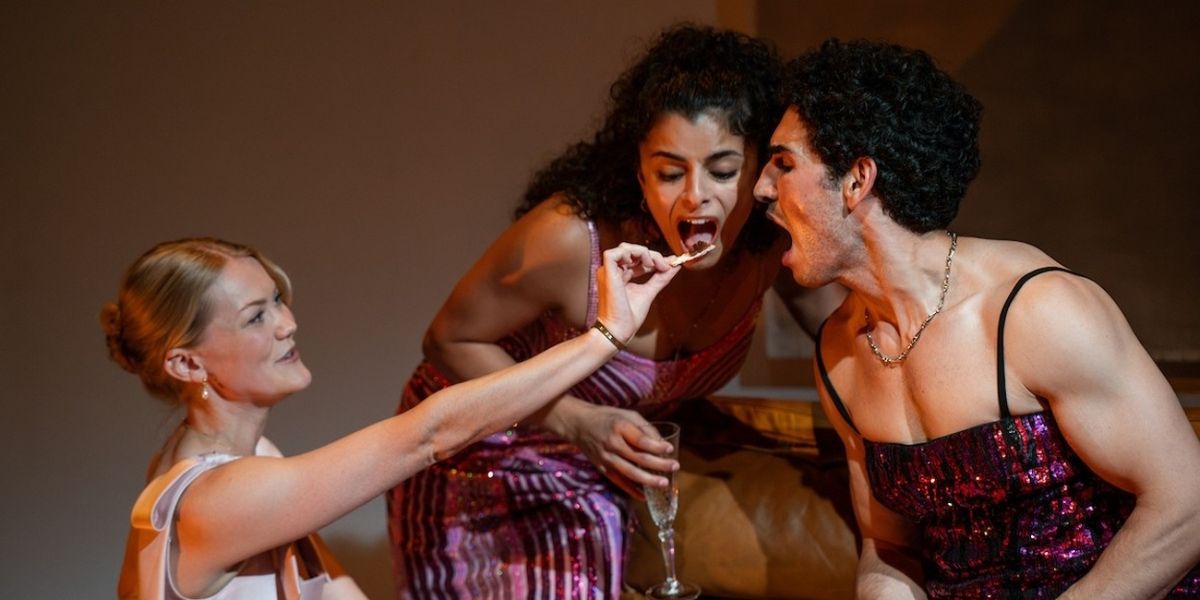
The first kind of wit is of the Shaggy Dog variety. Consider this: the play starts with Sakinah (Ellena Eshraghi), in jail, being held for crime not yet revealed to the audience, as she is interviewed by Jenny (Jada Alston Owens), a head doctor of some sort, who is working up an evaluation to be used for purposes also not yet revealed, but evidently at the request of Sakinah’s lawyer, from which one may conclude that an insanity defense is in the works. Jenny’s husband Richard (Joshua David Scarlett), an executive who wrestles with the psychic toll of often being the only Black person in the room at work, accidentally discovers what Jenny is working on, and warns her that it’s more toxic than Chernobyl. Meanwhile, in a flashback to how Sakinah’s unnamed crime began, we’re presented with Sakinah and her boyfriend Fouad (Revon Yousif) lightheartedly helping themselves to some castoff celebrity couture at a thrift shop. (Well, at least they think it’s couture; it actually comes from Macy’s, but they don’t know that yet.) Fouad, though not even a little bit queer, is excited to be dressing up in drag with the gown he scores. And both of them get more excited, nay, smitten, when they encounter the donor of the gowns, Emily (Shelby Alayne Antel), a formidably wealthy and dazzlingly glamorous philanthropist, who, though very White and privileged, is devoted to advocating for refugees of Mideastern origins (Sakinah and Fouad both proceeding from such origins). Emily invites them to her palatial home, where she feeds them champagne and caviar (see the attached production photo). In Emily’s bathroom is an 1832 genre picture of a shipwrecked slave, who in due course will come alive (Joshua David Scarlett again) and talk to Sakinah, and, no longer posed gesturing to the heavens in suppliant despair, turn out to be possessed of offensively enormous aplomb.
Got all that? Obviously, this is an exceptionally shaggy Shaggy Dog Story firing up. In addition, the play features some exceptionally droll dialogue. Here, for instance, is Sakinah recounting what it feels like to hear Emily talking about Mideastern folk in a world where such folk are so often stigmatized:
... [Y]ou’re so used to feeling like the gazelle the lion is about to pounce on. But now instead it's like the lions have all gathered and said, “You know: gazelles aren't so bad. We don't have to eat them. We should all learn to talk to our food. And let's dine on possums for a change.” And you're like, “Yes! Thank you! Finally I’m being seen! And fuck the possums!”
And so forth. Accordingly, whatever else is going on, and however serious it may be, part of this play is a comedy.
The next part of the play is a bit more serious: some sustained dialogues concerning the morality of the consumption styles of the rich and famous – and of Sakinah and Fouad enjoying it as Emily’s guests, as visitors in that world. Again, this is susceptible to being presented with a light and comical touch. It can be justified as a mere harmless embrace of the moment (a one-day pass for Sakinah and Fouad to the world of caviar and champagne) or as completely selling out, and the tension between these perspectives makes for some charming comedy, as does Emily’s effort to transcend the limitations, moral and perceptual, imposed by her ineluctably moneyed status.
Nonetheless, there is some more serious business lying ahead. While both Sakinah and Fouad are captivated by Emily, Fouad transfers his romantic allegiance from Sakinah to Emily, rendering all of the relationships unstable. Sakinah tries not to be possessive, but that is difficult. And Emily tries not to drive Sakinah away. Out of these struggles, internal and external, violence erupts, a violence that chimes with things happening in Jenny and Richard’s lives, and wreaks ruinous changes in Sakinah’s, Fouad’s and Emily’s lives and psyches.
Tragedy, in other words, though born from comedy. And yet, not definitely tragedy. In prison still, Sakinah is visited by Waleed, the former slave in the picture. He provides some advice, the gist of which is that in some way Sakinah must not “fade away.” Having unburdened himself, Waleed leaves for a fundraising dinner for a climate change nonprofit, whose speaker will be Emily. And he seems unlikely to appear again to Sakinah. He’s saying goodbye.
What his lapidary advice might mean to Sakinah – or us – is unclear. Unless Jenny can keep her out of it, Sakinah is going to prison. And prison will deprive her of most forms of agency. And if not fading away means, for instance, being present on social media, it’s not clear how she would do that, as prisoners are pretty universally denied access to social media. But perhaps what Waleed is saying is that he and Sakinah have essentially changed places; we can see that she ends up holding the same posture he did in the painting. Perhaps he’s suggesting that she take care not to lose the very kind of physical embodiment within a painting that Waleed had previously occupied. (Frozen in carbonite, as it were.) But what would she have to do with it? Neither paintings nor their subjects have any independent agency over what happens to them. Nor, so far as anyone knows, does the subject of a painting have any subjectivity. In the magical realism of the play, perhaps Waleed has been yearning to be free of his role as the subject of other people’s gazes; the playwright suggests something like this in an interview linked to in the program. But even that magical infusion of subjectivity into Waleed, if that’s what’s intended, still doesn’t make Waleed’s advice to Sakinah meaningful. The playwright has said he was writing toward that ending from early in the project; but it’s hard for me to see why, when there’s so much better stuff in the play.
Perhaps best just to call the play’s conclusion a Shaggy Dog ending and not look too deeply at it, the way one doesn’t press Alice in Wonderland for practical explanations. The thing is, the flippancy of the ending distracts and detracts from the seriousness of the concerns that animate the rest of the play, even allowing for the many light and comic touches used to convey those concerns. This ending effectively says “well, never mind all that.” It’s hard to see how it does anything but undermine what had gone before. If Alice had been the last 10% of a Charles Dickens novel, that novel would have suffered too.
Fortunately, pace the author himself, this need not be regarded as a play where the ending is the point. The rest of the play has been an entertaining ride. The cast is superb. The direction (by Zi Alikhan) is superb. The scenic design by Afsoon Pajoufar, with a large rolling panel in the middle that does many different things, is a lot of fun. And there’s a lot of fun in Shaggy Doggery overall.
As an audience member, I simply chose to write off the ending, together with a bit of stage business with which it was presented, that seemed pointless to me.
Perhaps you’ll see it the same way. But do see it. It definitely holds the attention.
Refugee Rhapsody, by Yussef El Guindi, directed by Zi Alikahn, presented by Contemporary American Theater Festival through August 2, at Studio 112, 92 W. Campus Drive, Shepherdstown, WV. Tickets $45-$75 at 681-240-CATF (2283). Adult language and situations.
Production photo by Seth Freeman.

|
Curtains Robert E. Kauffman Theater - Anne Arundel Community College (7/10-7/19) |
|
The Wizard of Oz Toby's Dinner Theatre (3/20-6/07) |

|
Sleeping Beauty: The Time Traveler Adventure Theatre MTC (6/18-8/23) |
|
SWAN LAKE by The United European Ballet Company The Maryland Theatre (10/22-10/22) |
|
DC Comedy Club Takeover - Live at McGinty's Public House | Stand Up Comedy McGinty's Public House (7/18-9/05) |
|
Hamilton (Angelica Company) France-Merrick Performing Arts Center (3/09-3/28) |
|
Toby''s Dinner Theatre Presents: Summer - The Donna Summer Musical Toby's Dinner Theatre Columbia (8/28-11/01) |

|
10 Minute Play Festival The Colonial Players of Annapolis (7/17-7/26) |
|
Into the Woods Maryland Ensemble Theatre (9/11-10/04) |
|
The Dinner Detective Murder Mystery Dinner Show The Dinner Detective Baltimore (9/12-9/12) |
Reader Reviews
To post a comment, you must register and login.