


Review: THE SMOKER at Contemporary American Theater Festival
Not a Seriously Wrong Dude, But Still Not Good Enough
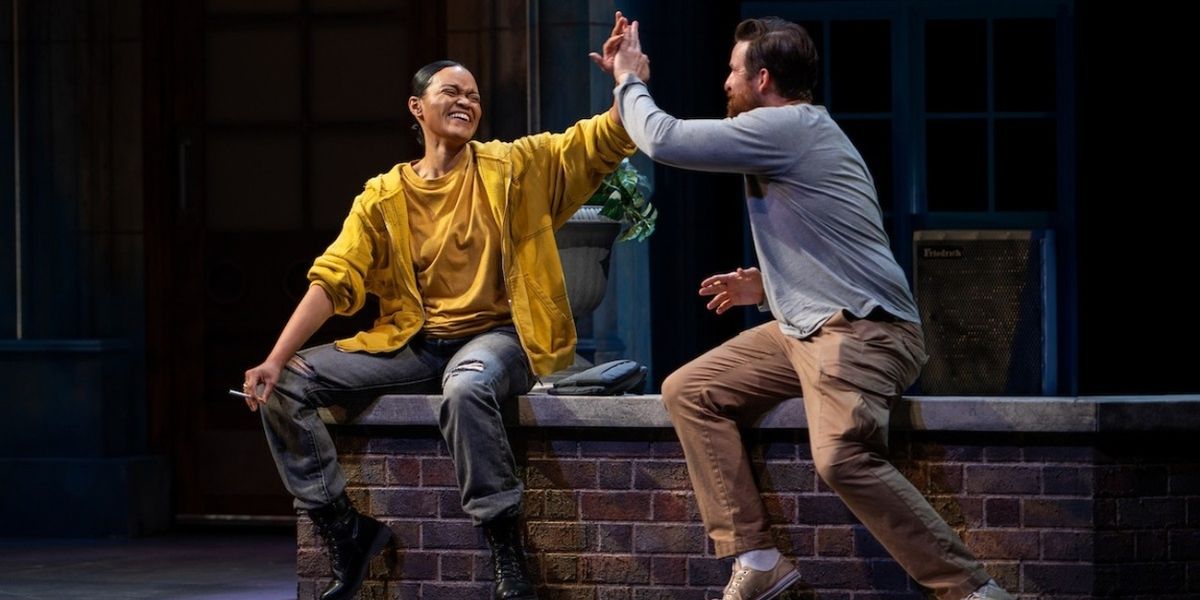
After reading the logline in publicity for The Smoker, now gracing the boards at the Contemporary American Theater Festival, you could be pardoned for expecting a rather different kind of play than you’ll actually encounter if you go. “A chance gathering of cigarette seekers on a New York street corner becomes a funny, moving portrait of unexpected friendship and human connection.” Well, yeah, that’s all true. But the show is more fundamentally an attack on a certain way of being White and male. Whether the attack is deserved or not is another issue, but an attack it is.
Playwright Lisa D’Damour is forthright about this in an interview for the theater program, describing the central character, identified only as The Smoker, as “a certain kind of privileged white man who can sneak his way out of things with family money or a wife who is providing his health insurance.” And she adds that all this “is invisible to the man himself.”
So don’t go expecting something like The Time of Your Life (which celebrates a bar full of lovable misfits). This is not identical to but more like The Iceman Cometh (where a bar full of misfits harbor a seriously wrong dude in their midst). The Smoker is not a seriously wrong dude, exactly, but he will not do what the times call for, which is look out, in more than superficial ways, for himself and for those who depend upon him. Because these are such economically stressful times, the show suggests, those on the margin must look out for themselves and each other, and The Smoker doesn’t. And that makes him something close to seriously wrong.
D’Amour fleshes this thesis out in painstaking detail; there is hardly a moment in the play when we in the audience are not learning more about the characters and their backstories. Much of this exposition is carried out in admirably sneaky ways that I didn’t even notice when it was happening, but I realized when rereading the script that the exposition never stops.
These characters are, as just noted, economically marginal people. Foremost among them are three smokers who take smoke breaks together in front of the apartment building where the action is centered (in Marble Hill, legally speaking part of Manhattan, but geologically part of the Bronx, lying north of the Spuyten Duyvil Creek, which, together with the Harlem River, separates the rest of Manhatttan from the mainland). Besides The Smoker himself (Brad Fleischer) a White man in his mid-40s, there’s Roberto (Orlando Arriaga), a slightly younger Mexican man with a wife whose dowry included a green card, and Tonya (Danielle Davenport), Black, female or gender non-conforming, the same age. Not a smoker, but part of the circle at moments, is Kim (Regina Gibson) a White opera-trained singer who subsists primarily on a job at Trader Joe.
All members of this circle except for The Smoker are quietly bettering themselves. Roberto looks after his wife (who becomes seriously ill), and also the three daughters in their blended family, goes to church and tries to rope The Smoker into coming with him, and (unlike the Smoker) has internalized the new rules for diplomatic treatment of the other sex. (You don’t pay compliments, for instance, unless there’s consent.) He works hard on an assembly line, in a job with health benefits, and sacrifices a day off to take his daughter on a school trip. In short, Roberto’s a mensch.
Tonya, while newer to the fight for survival, has gotten themself certified in the healing art of Jin Shin Jyutsu. They have focused on providing this service to people’s animals, which sounds a little out there, but by the end of the play, they’ve actually provided this service to at least four clients, so there may be something to it. They channel their experience and insight gained as a feminist and member of a historically unprivileged minority (their characterization) into poetry, reciting a show-stopping poem they’ve written about how the historically privileged members of society want Black women to appear. (Giving credit where due, the poem’s actually by Sunni Patterson.)
Kim (Regina Gibson) has entered into her low-paid lifestyle with her eyes open, having been told from the very first that her operatic singing will take everything she’s got, and having known from the first that the odds don’t favor her succeeding in the field (other than landing occasional gigs as “extra chorus” at the Met).
And even street person Ruthie (one of three roles played by the versatile Vivia Font) is trying to recover from the mental illness that has plagued her, though she faces the almost insuperable problem of there not being nearly enough social workers to keep her falling through the safety net again.
Everyone, in short, is trying with some degree of success to hold his or her end up.
The Smoker would claim to be one of them too. He’s a prostate cancer survivor, and, as he points out during a stressful moment, he’s saved up a small war chest, he shows up for work on time, and he takes care of his daughter Lulu when she’s around. It’s not nothing, but, as Tonya immediately notes when he points out these things: “That’s some baseline shit.” Nor does the picture he tries to paint hold up well to scrutiny. He got through the cancer on his estranged wife’s health insurance. (It seems she is holding off divorcing him so he can stay insured.) He had started a business, a gym, but apparently to make a place for a 22-year-old trainer whom he had an adulterous affair with, and while he named the gym after Lulu, his daughter, the name he gave it guaranteed that most potential customers wouldn’t recognize the name as belonging to a gym, not to mention that he drastically undercharged for memberships. He now also has to work for Trader Joe. Apparently in consequence of all this, he begins the play three years delinquent on his state taxes. His grand plan for resolving his problems is to go hat in hand to a younger brother from whom he’s been estranged, and ask him to forgive an earlier loan to start the gym, and to tender a new loan to stake The Smoker to tuition for business school. (And his brother agrees.)
It isn’t shocking that The Smoker is truly bad at accepting responsibility. When the proverbial shit hits the fan, i.e. when the State of New York garnishes his war chest because of the unpaid taxes, he resorts to an orgy of blaming others: ““Fuck ... the State of New York! And my mother for doing the taxes which meant my dad never taught me a goddamn thing! Fuck Miranda [his ex-wife] for being a cold bitch taking the entire tax credit for Lulu for herself. And [the above-mentioned trainer] and her 22-year-old Brazilian Waxed pussy.” Not exactly taking responsibility, in other words.
Nor are his shortcomings merely financial. His care for his daughter is under par, let us say. Despite what he claimed to Tonya, he isn’t always there when she’s around, and other characters do have to care of her sometimes. His passion for smoking has also led him accidentally nearly to set afire a teddy bear he had gotten her. Likewise The Smoker has failed, where Roberto succeeded, in navigating developing mores where women are concerned. When the smoking crew are partying, he yells at Tonya to “twerk that junk!,” Tonya tells him he can’t say that. The Smoker protests that they are friends. She responds that it’s about the power differential between them, and when The Smoker comes back that he has no power over her, she properly tells him that this is a very complex statement that they need to unpack “SOME OTHER TIME.” Yet in a sense she does unpack it with the poem she shortly afterwards declaims.
Obviously, the status of smoking as a health issue also has to be significant in a play like this. I can’t fully address it because of plot points that it wouldn’t be fair to reveal, but it goes without saying that cigarettes are terrible for smokers and not wonderful for the people around them. When smoking becomes the very glue that both creates and holds together a circle of friends, smoking is therefore a problem. Significantly, Roberto and Tonya are trying to stop (with varying degrees of success), while The Smoker forges nonchalantly ahead. He justifies it on the grounds that “life without cigarettes would be hour after hour of crippling anxiety.” He (and Roberto, echoing him) call it “harm reduction.”
And on this score, it seems that Tonya might agree with them, at least in part. Late in the play, she gives voice to another poem, part of which reads:
Breathing in
this this industry
that depends
on our stress
relies
on our anxiety
and me shelling out $75 a week
to soothe my anxiety.
Industry enmeshed
in a rat’s nest of industries
that feed on us
So Tonya, always the character with the most clear-sighted grasp of the truth, concurs that a cigarette is a way to address anxiety. It is also a forger of bonds among the smokers, even extending as far as non-smoker Kim, whose first moment onstage is devoted to criticizing the smoking circle, before she allies herself with it if not its addictions. But the manufacture of cigarettes is still a cynical and profit-driven enterprise, in a way that The Smoker has seemingly not acknowledged. And it is not accurate to call it harm reduction, for all the social benefits it provides in this play.
The ambivalence the play permits around smoking also extends to The Smoker himself. People see him for what he is. But they seem to like and forgive him, including his ex (also Vivia Font). Like smoking itself, The Smoker seems to be a tolerable pleasure, even with the bad karma the character brings with him.
The cast and the direction (by Shelley Butler) are all fine in this production, and I really liked the set by Michael Raiford, although I don’t see much in common between the real-life building at the address where the play supposedly takes place and the facade we witness. Raiford, interviewed in the dramaturgy packet, indicated he was going for a mystical, somewhat magical look, and agreed that he emphasized windows, not walls. So the set is interesting and stimulates the playgoer’s imagination, but isn’t likely to conjure up anyone’s reminiscences of Marble Hill.
And finally, one problem I’d hope the production would address. At many times, Tonya’s accent was so thick as to render her words incomprehensible, at least to these Anglo ears. And, as I’ve indicated, when Tonya speaks, what she says is generally true. Genuinely a pithy truth, at that. Worth hearing, in other words. So the dialect coach may wish to take note.
In the end, this is not so much of a takedown of one specific person as of a way of being a person. To shrink down to that person’s size is to lose out on life. In this good and carefully-written play, D’Amour makes that clear.
The Smoker, by Lisa D’Amour, directed by Shelley Butler, presented through August 2 by The Contemporary American Theater Festival, at the Frank Center, 260 University Drive, Shepherdstown, WV. Tickets $45-$75 at catf.org and at 681-240-CATF (2283). Adult language and situations.

|
Curtains Robert E. Kauffman Theater - Anne Arundel Community College (7/10-7/19) |

|
Footloose Cockpit in Court (7/24-8/02) |
|
Key City Improv Maryland Ensemble Theatre (8/07-8/07) |
|
An Evening with Mike Masse: Epic Acoustic Classic Rock Cultural Center at the Opera House (10/02-10/02) |

|
SWAN LAKE by The United European Ballet Company The Music Center at Strathmore (1/19-1/19) |
|
The Dinner Detective Murder Mystery Dinner Show The Dinner Detective Baltimore (9/19-9/19) |
|
How to Train Your Dragon, the Musical, Jr. Maryland Ensemble Theatre (7/30-8/02) |

|
That's What She Said Maryland Ensemble Theatre (7/17-7/17) |
|
Hamilton (Angelica Company) France-Merrick Performing Arts Center (3/09-3/28) |
|
Little Shop of Horrors 40th Anniversary Tour with Ellen Greene (the Original Audrey) M&T Bank Exchange (9/26-9/26) |
Reader Reviews
To post a comment, you must register and login.