


Review: ALIBI: DEAD AIR, Theatre Deli
Inspired by the viral jubensha format, Alibi: Dead Air is immersive detection with a killer edge.
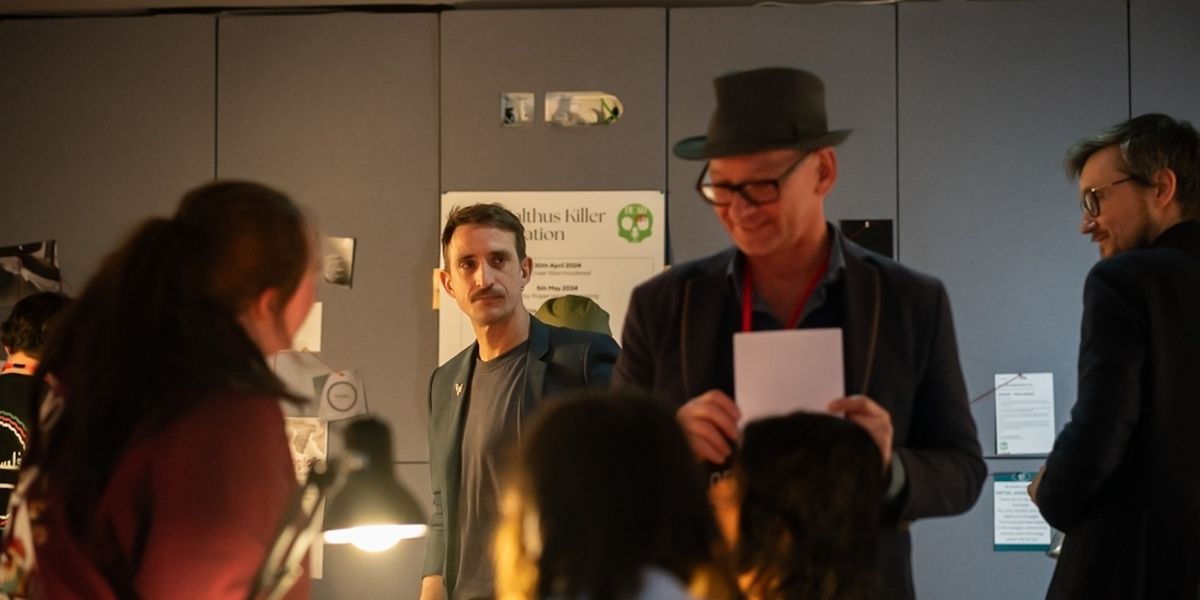
 With yet another highly-anticipated series of The Celebrity Traitors on the horizon, entire streaming channels dedicated to murder mysteries and absolutely no shortage of true crime podcasts (and shows about true crime podcasts), it appears we live in a nation completely insatiable when it comes to death and deceit. The jubensha-inspired Alibi: Dead Air, then, is perfectly timed as it invites audiences to step inside a story with secrets, subterfuge and a serial killer on the loose.
The setup is deceptively simple: within a spacious meeting room, each of the twelve members of the audience finds themselves both suspect and detective in the murder of podcaster Gloria Carpenter. And the mechanics are also super-easy to dive into. A booklet gives each person the background and motives for their particular character, one of which has murdered poor Gloria. On one wall of post-it notes and photos has the lowdown on what has been surmised thus far and a guide called Mr Blue (Luke Booys) brings us up to date on where we are.
Gloria’s show Dead Air has focussed on the Malthus Killer who has taken the lives of three victims, each time leaving a signature sheaf of wheat. At the end of the second season, the apparent assassin Morgan had been exonerated thanks to evidence dug up by the Dead Air team but just after Gloria discovers the real identity of the Malthus Killer, she is found dead. Beside her still-cooling corpse, a sinister sight: a sheaf of wheat.
.jpeg?format=auto&width=800)
So who did the dirty deed? Was it the Malthus Killer or a copycat? Was it Gloria’s ambitious co-host Daisy? Or maybe rival podcaster Theo who was the first to draw attention to the serial killer? Do Dead Air’s sound engineer George or producer Laura know more about what happened to their colleague than they are telling? Then there are the friends and relatives of the previous victims, each with their own dirty laundry that they are keen to conceal. With only 90 minutes on the clock, it is a race against time to separate the wheat-obsessed slayer from the chaff of red herrings.
Even in that short timespan, it is fascinating to see how the investigation flows as new information about blackmail, infidelity and dolphins appears, secret motives emerge and fingers are pointed in surprise directions. There’s an element of LARPing here in the way we are asked to inhabit the characters but this is strictly light touch and no cosplay is required.
There is considerable freedom to adopt different styles of gameplay. Budding Philip Marlowes can take the initiative, tackling the most obvious perpetrators with wry wit and pointed posers. Fans of Miss Marple can listen in to see who doth protest too much while Columbo devotees can go around the room asking one more question. Rub your temples in exasperation like Inspector Montalbano, spit out some dry Morse quips or go the full Cassie Stuart and peer very hard at the evidence board as the information comes in.
.jpeg?format=auto&width=800)
This latest slice of twisted detection is the brainchild of two luminaries of immersive theatre. During lockdown, Tom Black (with Joe Ball, Edward Andrews and Ellie Russo) created the popular Jury Games, an interactive trial that started off online through Zoom during the pandemic and has since evolved ihto a permanent fixture at Theatre Deli; more recently, he took on the role of COO of the multi-million pound space adventure Bridge Command. His co-creator Dean Rodgers is one of the founders and creative director of The Crystal Maze Live Experience and now works with Studio Secret Cinema.
Alibi: Dead Air is inspired by jubensha, a game format relatively new to the UK but which has been a hit in Asia. Jubensha literally translates to the accurate-but-clunky “script murder” with participants reading out pre-written sections during a playing time of six to eight hours. With their show in its third iteration, Black and Rodgers have trimmed the length down to a zippy hour-and-a-half while maintaining all the essential qualities.
As with Jury Games, the gameplay revolves around piles of evidence — police reports, bar tabs, computer printouts — which are doled out as we go along. The major difference with this particular game is that most of the evidence is in the hands of the people around us: what we choose to reveal about our characters (and when) while digging into the lives of those around us is what makes Alibi: Dead Air a fascinating ride. What is a wild theory one minute can become fact in the next. In the words of Oscar Wilde, the truth is rarely pure and never simple.
Alibi: Dead Air ultimately works best when approached in the spirit it invites: part puzzle, part performance, part social experiment. It may flirt with the tone of a corporate awayday, but —- despite never being deep or long enough to truly immerse us —- the pleasure lies in watching how quickly strangers become allies, rivals and then allies again once the game gets underway. If modern true crime has taught us anything, it’s that everyone thinks they could crack the case. Here, at least, you’re given the chance to prove it.
Alibi: Dead Air continues until 16 May
Photo credit: Kiki Tabizel
Prefer BroadwayWorld in Google Search?
Add us as a preferred source so our stories show up more often in Top Stories and Google’s AI answers — for you.
Sign up for all the news on the Fall season, discounts & more...
.jpg?format=auto&width=300)






Reader Reviews
To post a comment, you must register and login.