

Interview: Jonathan Moscone of PICTURES FROM HOME at Marin Theatre
Moscone directs the West Coast premiere of Sharr White's exploration of family mythology, running through May 31st in Mill Valley
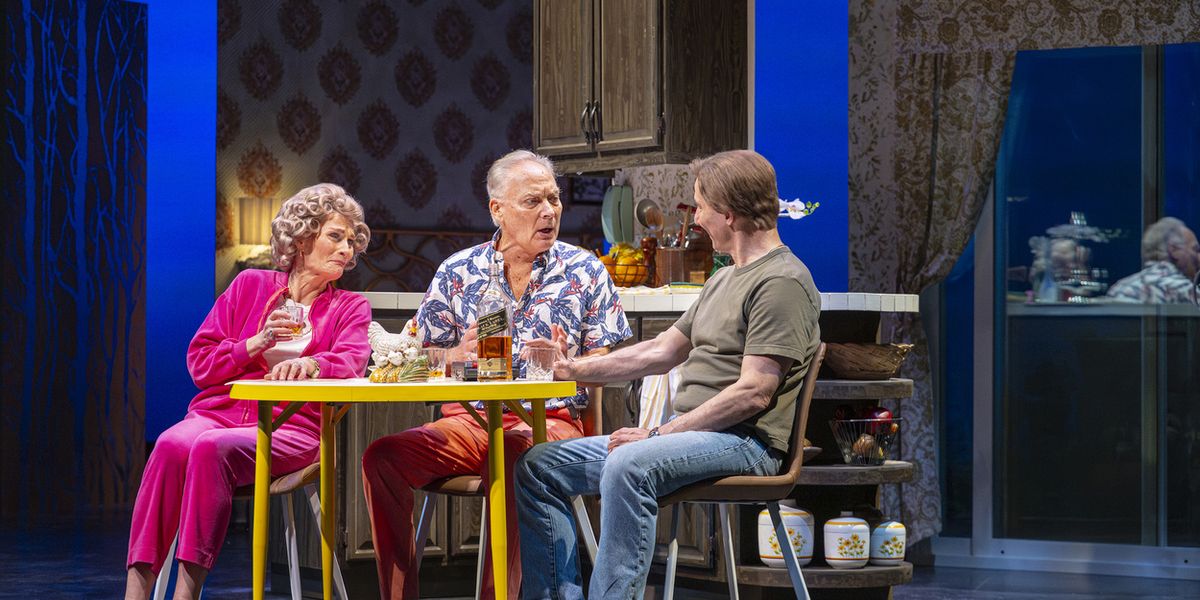
Do we ever really know our parents? Is such a thing even possible? Those questions lie at the heart of Sharr White’s comedic drama Pictures from Home, currently in its West Coast premiere at Marin Theatre, directed by Bay Area theater titan Jonathan Moscone. In this moving and theatrically inventive play, White transports late Marin photographer Larry Sultan’s landmark photo memoir of the same name to the stage, wrestling with generational differences to shed new light on the past. Seeking to understand his family mythologies, Sultan turns his lens on his parents in their stylish San Fernando Valley tract home, aiming to capture their true essence.
Moscone would seem to be the perfect director for this particular play, having grappled with similar issues – albeit from a very different angle - ever since the murder of his father George, then the mayor of San Francisco, when Jonathan was an adolescent. The younger Moscone grew up to have a multi-faceted career in the theater, including working as Joe Papp’s assistant at The Public Theater in the late 80s. He went on to hold a variety of prominent positions, most notably the 15 years he spent as Artistic Director of California Shakespeare Theater, all the while directing scores of productions throughout the Bay Area and beyond.
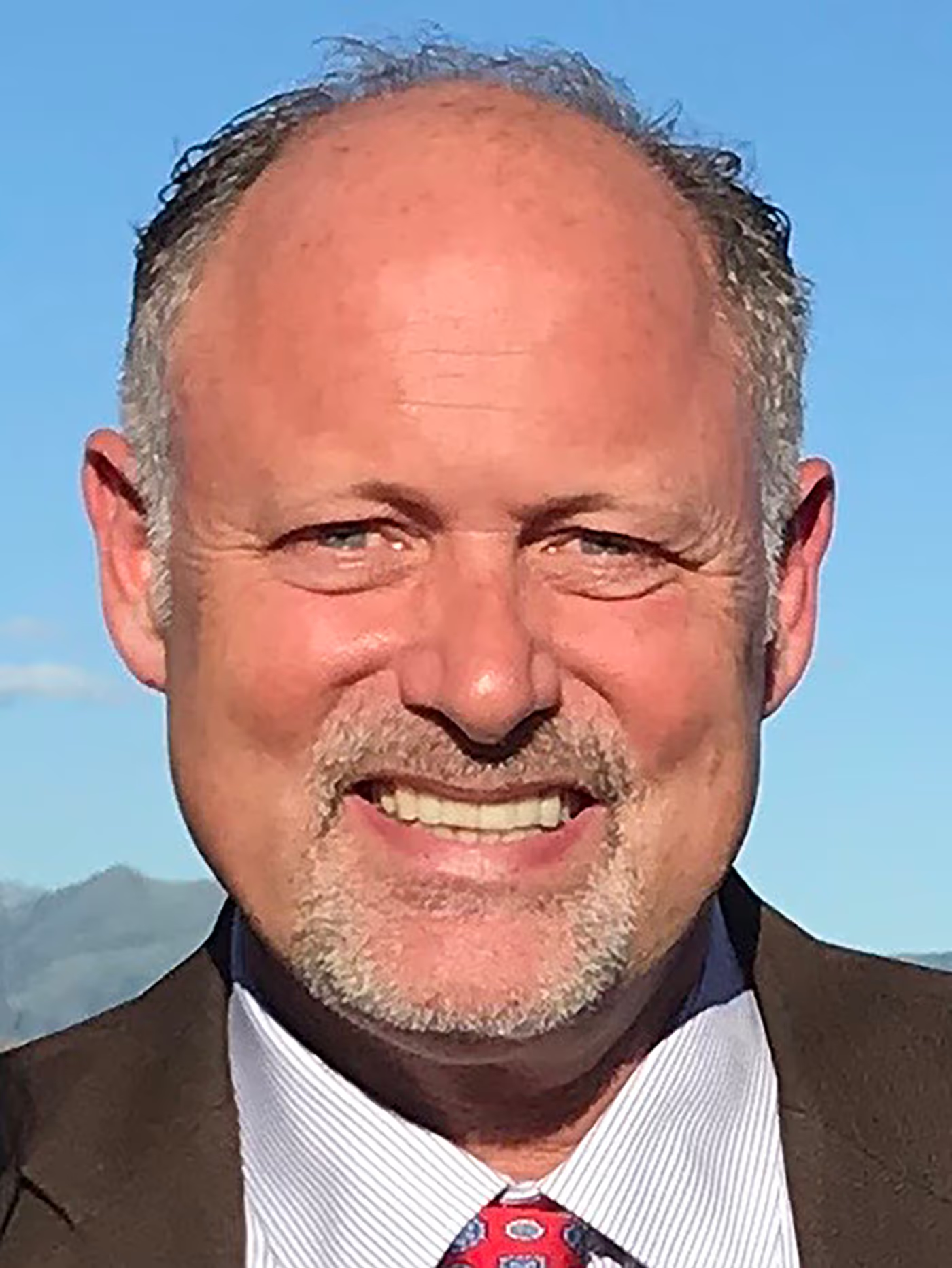
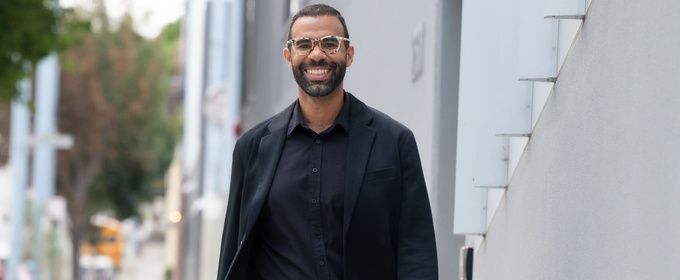
Director Jonathan Moscone
(photo courtesy of Marin Theatre)
I spoke with Moscone by phone earlier this week, just a few days before Pictures from Home began performances. We delved into why this work resonates so deeply with his own experience and how playwright White transformed a photo essay into a piece of theater. I also asked him for his thoughts on how the still-ailing regional theater scene might be able to regain its footing in the cultural landscape, and he talked about an intensely personal new play that he’s writing and performing to address his own family legacy. The following has been condensed and edited for clarity.
How did this project come to you?
Lance Gardner, the artistic director of Marin Theatre, and I had met about my desire to work for him, because I have a great respect for him. And then he called me up and asked me if this play would be of interest to me. So I read it, and I think it carries a lot of similarities to my own story about my artistic identify colliding with the identity of a very powerful man. I think there’s a relationship between my story and my dad George’s with the story of Larry and his father, Irv. They don’t follow the same track, Irv was not a politician, but there was a kind of Venn diagram that I think Lance saw in that, so he thought I might be the right guy to direct the play.
When I look at Larry Sultan’s photographs, I think “Wow, he knew his parents way better than I knew mine.” Or maybe that’s just grass-is-always-greener thinking. As someone who lost your dad when you were an adolescent, do you have any thoughts on that?
Yeah. I mean, they had a very long relationship, and he spent a good deal of time in their lives with the book Pictures from Home. His relationship to his parents was very intimate, and I think the tension of the play, the drama and also in the comedy of it, is that he’s trying to find something in these photos that goes beneath what he knows or what he sees. He’s trying through these photos to find that other narrative, the deeper subterranean or subcutaneous life of both his father and his mother, but especially his father. He keeps talking about wanting to see beyond the frame, and I think that’s his attempt to know more about his parents than he sees.
And he feels that that’s what his artistic journey is in general, but specifically it ties deeply to his relationship to his father and his being a father himself with two boys, and wanting to understand his own internal life through this process of shooting these photos of his parents. At the same time, all the photographs are posed, so they’re not real. He says, “I’m trying to find a truer version of you” and the dad says, “Yeah, but these are all fake photographs.” So it’s a kind of journey that doesn’t necessarily answer the question. It’s more about him getting closer and closer and closer. It’s his way of loving his parents and it’s his way of holding onto his parents, a way of staving off the inevitable loss of them. I think he comes to learn that as the play goes on.
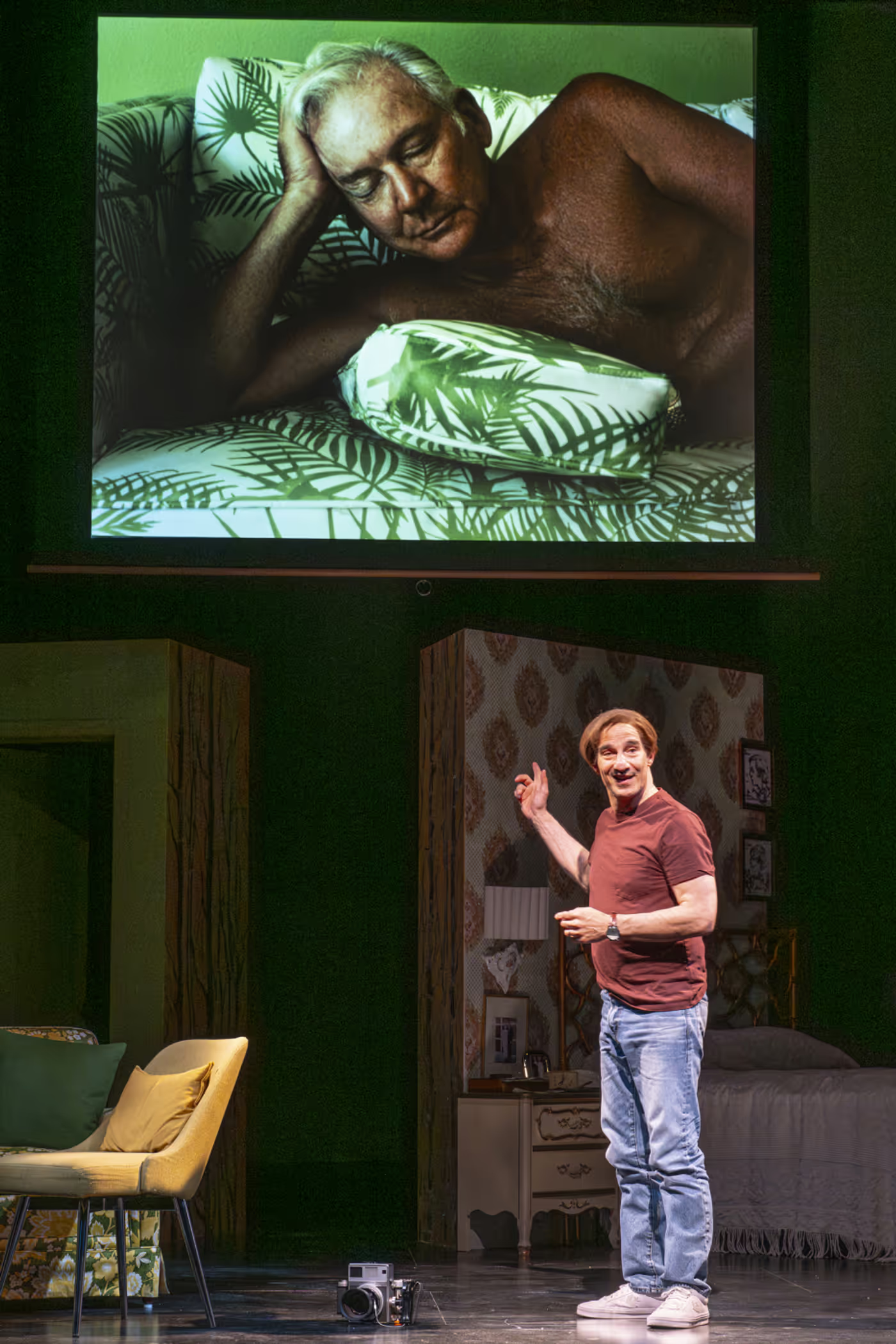
Daniel Cantor as Larry talks about a favorite photo
in Pictures from Home at Marin Theatre
Would you say that’s the central action of the play? Because the photographs are incredibly evocative in and of themselves, but they’re not a play.
It’s exactly that. His father’s like “What are you trying to get at?” And you realize the relationship between them all is the play. There’s definitely a plot, but the plot really gives way to these discoveries and debates about what is he looking for. It really boils down to the fact that he’s looking to keep them alive. It starts as a kind of academic journey, but it turns into a very emotional one. And the photographs are one thing, but if you read the book, the narrative that Larry writes… he was as much a writer as he was a photographer. So he does try to tell a story [in the book], and I think this play is attempting to find the story inside of this journey of capturing his parents.
And it’s about trying to get an acknowledgement from your parents of the kind of artistic work that you’re doing. They’re also just trying to live their lives, and at the same time are kind of turned on by the idea that their son wants to take photos of them. It’s just so multi-faceted, the play. Larry says at one point, “It’s really quite remarkable how my dad can mock and participate at the same time.” They both kind of hate it and then it becomes a big success and the parents are so proud, all the resistance that his father puts up throughout the play turns into nothing but pride. It’s the story of what it’s like to be the artistic child of people who have very strong identities and personalities - and very much about what it feels like to be a man, and for a woman to have endure that journey, because she keeps the family alive through her work.
Larry Sultan lived in the Bay Area for much of his life. Did you ever happen to meet him?
I met him once many, many years ago but did not really know him at all. He was very good friends with two of my dear friends. His widow, Kelly, I got to know after Larry had passed away because she’s in a relationship with a friend of my family’s. So I know Kelly and she’s been an incredible resource - an emotional resource and a historical resource and just really generous sharing stories about Irv and Jean and Larry. It really helps enrich the way the play is done.
Wow, that’s incredibly serendipitous.
Right?
Are you incorporating Larry Sultan’s actual photographs into the stage design?
Yes, it’s built into the play that the photos are displayed, but it’s up to the director and the designer to decide how that happens. We have basically what looks like just parts of the house that are disconnected from each other, that are like little photographs, these like almost Cornell boxes of parts of the house. And then above it all, in this big framed projection screen hovering over the set, is the place where the photos get shown. So they’re in this house that isn’t a house, they’re in a realistic play that isn’t a realistic play. They talk to the audience all the time, they talk to each other. He mixes so many theatrical genres and so your job as the director is to kind of embrace that and make sense of it, but not try to naturalize it too much because otherwise you’re wondering well what’s going on here? How are they in a house and looking at photos at the same time? They are, they just are.
And the set is designed in very strong relationship to all the details in the photos. It’s not exact because we can’t find all the exact stuff, but you can feel the relationship very strongly.
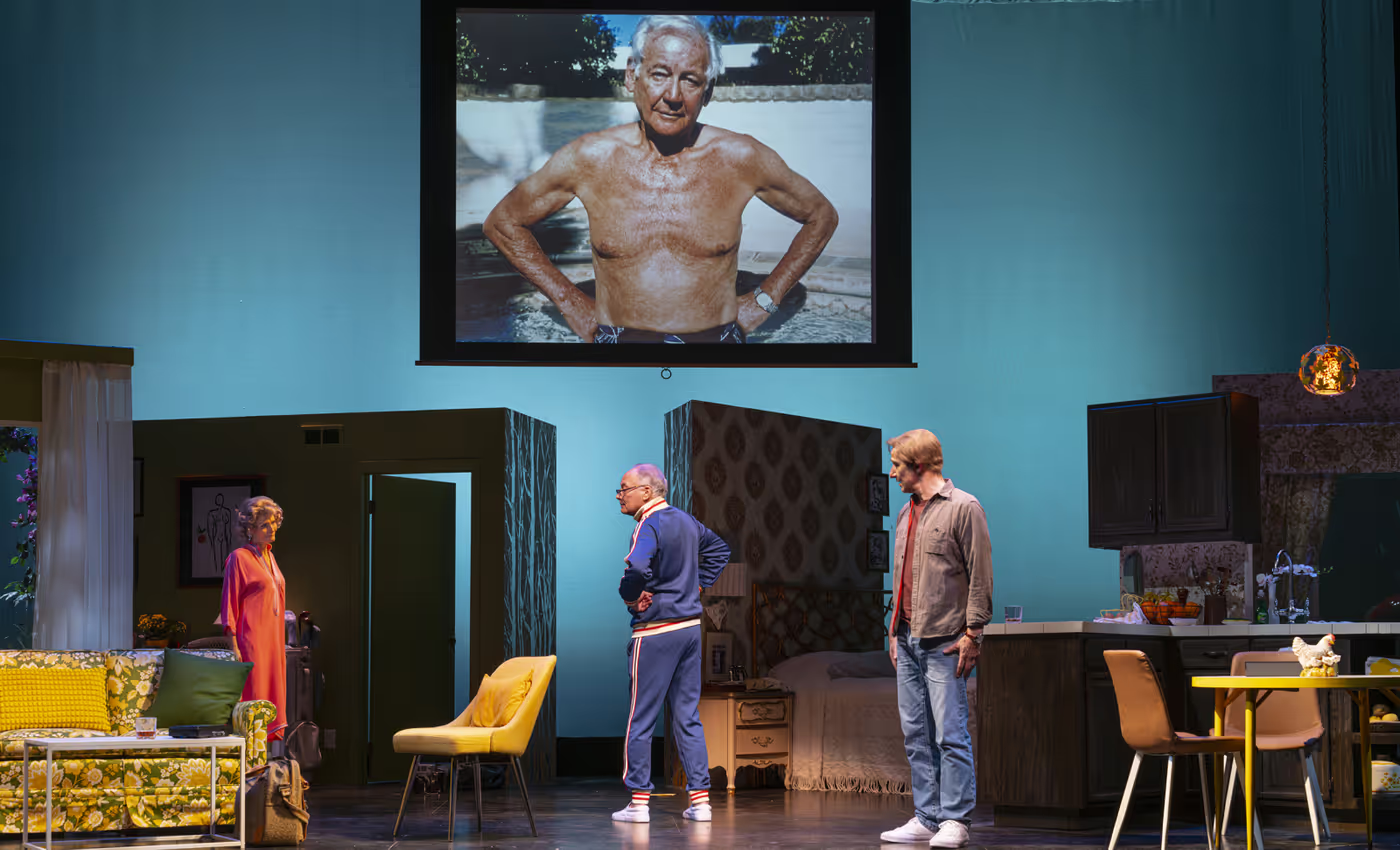
L to R: Susan Koozin as Jean, Victor Talmadge as Irving and Daniel Cantor as Larry
in Marin Theatre's production of Pictures from Home
The play has only three actors, but you’ve assembled quite a team of heavy hitters. Had you ever worked with any of them before?
Many, many, many years ago when I was just starting out I, worked with Victor Talmadge. But otherwise, no, this is the first time for all of them and they had to become really close, they had to become really a family in a very short amount of time. I very much lucked out with the fact that I had a group of people who just got along. You can feel their relationship onstage really, really strongly. So I’m just lucky. That doesn’t always happen, you know?
You’re a native San Franciscan. Is it true that your dad took you to the theater as a kid?
Yeah, Christmas Carol at A.C.T. when I was a child. I remember seeing a bunch of plays at A.C.T. We’d go to the opera, my dad loved the opera, so I remember going there, and the ballet. Ballet for us was Nutcracker, so you kind of dug it cause you saw all these kids your age up there onstage and that was fun, that was an event, you know? It wasn’t like we did it all the time. It was something they felt was important for us to experience. Now, not everyone in our family goes to the theater a lot, but I do and one of my sisters does. But they gave us a lot of that opportunity, and also with sports. I mean, we’d go to games all the time – baseball, football, basketball. So we were just sort of brought up on sports and art.
I believe you worked as Joe Papp’s assistant back in the late 1980s?
I did – it was from ’86 to ’90 (or something like that?).
What was that like?
It was wild. He was a huge, huge personality, bigger than life, and at the same time he was dying of cancer. I didn’t know that for some time, and when I was let in on it, we couldn’t talk about it to other people because it was important to Joe that he remained a powerful figure. We worked very close together, he was like a dad to me, he was very dear to me. He was a tough man, he fought his way to the top and he was not easy to get along with, but he was unbelievably smart, incredibly charismatic and he treated me so well. It was so lucky to have that at the beginning of my professional career.
You’ve held several high-level leadership positions in theater, such as Artistic Director of California Shakespeare Theatre for 15 years. They sadly went defunct a number of years after you stepped down, part of that sort of post-COVID wave of devastation. Do you see a world where something like Cal Shakes could ever come back – or do you think we’re just headed toward a completely different model when it comes to regional theaters?
I think for things to come back they will have to be different. There has to be a much broader sense of what the experience is for audiences, diversifying what is made, how it’s made. Not everything is gonna be six, seven plays a year. Some things might just be experiences that are more immersive or more musical or more standup. I think we want to start blending ourselves into a broader sense of what it means to be in a room together having an experience. But it’s not always gonna be a play. That’s what I believe.
I don’t think every theater will go this way, but sometimes that’s gonna be the case, and I know that’s what’s happening at Cal Shakes. The people who took over the building, the grounds, are doing that exact thing. They want to bring back Shakespeare, but they want music, they want comedy, they want events. That’s a really interesting model. It’s not gonna be the same, we can’t go backwards, there’s no such thing. But I think we can move forward and revive a lot of the spirit, and maybe the form is more expanded, just a little less of one type.
I came of age just after these theater companies that I thought of as permanent institutions had been formed, and it never occurred to me that my parents didn’t grow up with those theaters. So I don’t know why I’m surprised that they don’t all last forever.
I agree, and I think that there is going to be an opportunity, if not potentially a necessary path, for some organizations to come together and merge. Because there are only so many people to give money to these places. So you might see some changes in the number of organizations, but instead of them dying perhaps they can merge and become something new, together.
It costs money to do this work, and the money to coming in from donations and contributions and ticket sales is just not what it was. So how do you maybe bring the worlds together, bring the voices together, bring the vision together? That’s gonna be really hard because these boards care about their one organization, this artistic leader has a vision for their company. So it’s gonna be really hard for organizations to consider it, but I do think it is what is going to be needed, or for some things to go away so that the field gets stronger.
There has to be a game plan, and right now I don’t see one. I only see people struggling. We gotta get past the struggle and figure out a way. If anyone can do it, it’s the Arts. Because the Arts are creative. If they can’t creatively solve it, then it’s not solvable.
You’re also a playwright. Do you currently have any new works in the pipeline?
I am developing a play at the Ground Floor, which is Berkeley Rep’s summer residency. It’s a one-person play about the story of me and my dad that I keep trying to tell, and different ways of telling it and what am I trying to get at. It’s called The Story I Keep Telling. It’s just in its nascent stages right now.
I assume this a play for an actor other than yourself?
No, I wrote it for me. I’ve always written things about my life through other people, and I want to try doing it through myself. I’m looking forward to delving into it. But it’s going to be scary.
Well, it’s always scary when you try to make something good.
Exactly. Would that were not true!
[All Pictures from Home production photos by David Allen]
---
Pictures from Home performs through May 31, 2026 at Marin Theatre, 397 Miller Avenue, Mill Valley. Tickets are available at MarinTheatre.org or by calling 415-388-5208.


|
The Secret Garden Warren Theater at Sonoma State University (6/12-6/28) |
|
|
West Side Story—Film with Live Orchestra Davies Symphony Hall (7/09-7/10) |

|
The Still Point: An Immersive Experience SOMArts Cultural Center (7/16-7/25) |

|
The Tragedy of Hamlet, Prince of Denmark SPARC (7/03-7/26) |

|
An Evening with a Mentalist: Jay Alexander's Mind Tricks Live San Francisco Magic Theater (w/Jay Alexander) at the Marrakech (7/31-8/02) |

|
Ah Ha! Circus Bella (6/03-7/26) |

|
Broadway Under the Stars - Radio Recall: The Soundtrack of Your Life Transcendence Theatre Company (7/10-7/12) |

|
Based on a Totally True Story City Lights Theater Company (1/21-2/14) |

|
Comedy Oakland at Elbo Room Sat June 27 7pm Elbo Room Jack London (6/27-6/27) |

|
Hadestown (Non-Equity) Orpheum Theatre San Francisco (1/07-1/10) |