


Review: INTO THE WOODS at Her Majesty’s Theatre, Adelaide Festival Centre
Sondheim's take on Grimm's fairytales.
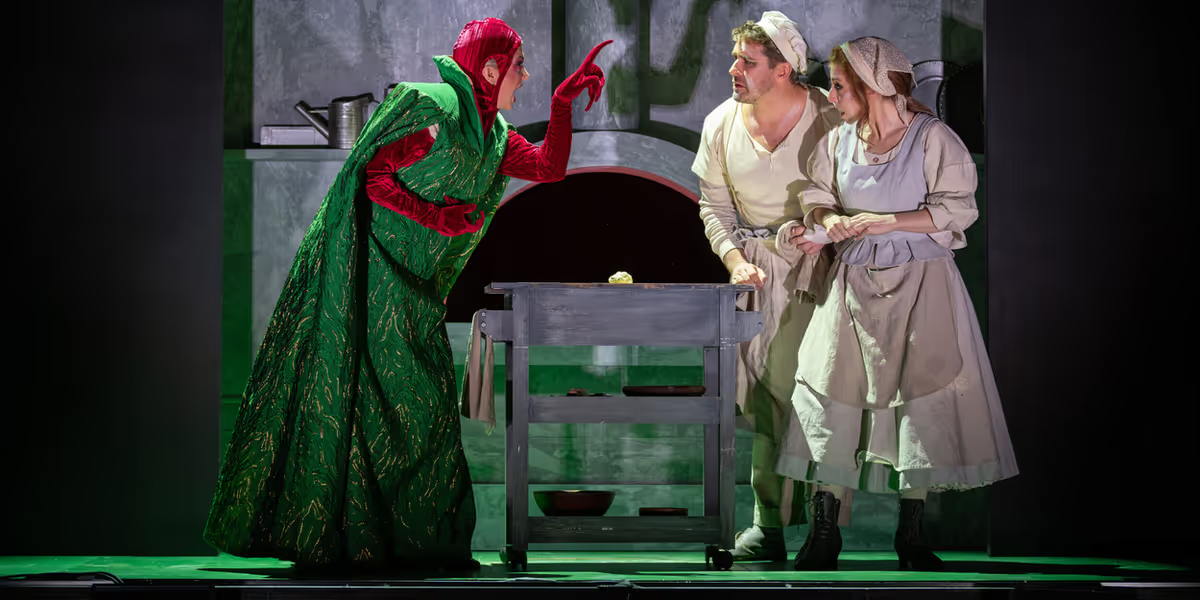
Reviewed by Barry Lenny, Saturday 22nd August 2026.
State Opera South Australia’s double bill of Brothers Grimm fairytales continues its Golden Jubilee Season with Stephen Sondheim (music and lyrics) and James Lapine’s (book and original director) 1986 musical, Into the Woods, following on from Hansel and Gretel last night. Rather than just one fairytale, Sondheim and Lapine cleverly combine numerous tales into a related whole, with a narrator and a mysterious man helping to move the narrative forward.
Forty years later, this musical is still as popular as ever. Quality lasts. The production is in the same hands as Hansel and Gretel, with direction by Constantine Costi, set and costumes by Jonathon Oxlade, and lighting by Bernie Tan-Hayes. For this musical, though, Anthony Hunt is the conductor. It features an all South Australian cast, including some who have come to live here, and some returning from interstate and overseas.
The Baker and his wife want a child, but he is the subject of a Witch’s curse. He discovers that he had a sister, Rapunzel, taken by the Witch in retribution for the transgressions of the Baker’s father. Jack sells his cow, Milky-White, to the Baker for five magic beans. Jack climbs the beanstalk, obtains riches, and slays the Giant. Greedy Little Red Riding Hood collects food for her grandmother from the Baker, eating twice as much again without paying, and later meets the Wolf en route to her Grandmother’s cottage. Cinderella wants to go to the ball to meet the Prince, hampered by her Stepmother and her two daughters, Lucinda and Florinda.
The Baker’s quest, the central theme of the production, is to bring the Witch a cow as white as milk, a cape as red as blood, hair as yellow as corn, and a slipper as pure as gold. These will make a potion to enable the Witch to become young and beautiful, in exchange for which she will lift the curse.
Everything is drawn together and, as the first act ends, it seems that everybody is going to live happily ever after, BUT… - along comes Act 2, in which we are reminded of that old saying, “be careful what you wish for”.
It all begins with Nicholas Lester as the Narrator, a largely non-singing role, introducing the core characters, their backgrounds, and their wishes. He is a commanding presence. Lester also plays the dual role as the Mysterious Man, who speaks to the Baker in riddles.
Hugh Sheridan plays The Baker, with Johanna Allen as his Wife. Sheridan presents a vulnerable man, overwhelmed by the pressure placed on him to complete the tasks, a very human character with flaws and insecurities, but eventually discovering his own inner strength in the face of adversity. Allen’s Wife steps up as the stronger, supportive marital partner, encouraging her husband and guiding him towards their goal. They are a superb pairing.
As Little Red, Eliza Brill Reed brings an energetic performance and plenty of cheekiness to the role, providing plenty of laughter, until becoming rather homicidal in the second act. Rosie Hosking is a powerful force as The Witch, changing dramatically in the second act when she discovers what her transition fully entails. She has none of the elaborate makeup of the 1987 production, and there is no instantaneous change from the ugly old crone to the young beauty, just a costume change offstage. It is all left to her wonderful performance.
Joey Haenen give a three dimension characterisation to the role of Jack, well beyond the surface level of a simpleton whose best friend is a cow. He shows his character growing in strength and sense as the second act progresses. As Jacks Mother, Catherine Campbell brings her experience in both opera and musical theatre to bear on the role. Her frustration with Jack is coupled with her motherly affection for him in a nicely balanced interpretation.
Cinderella is played by Jessica Dean, neatly negotiating the difference between her dream of going to the festival and meeting the Prince, with the reality of who and what the Prince actually is. She shows all of the indecision of her character as she moves towards the eventual acceptance of marriage, and her independence in the aftermath.
Cinderella’s Stepmother, Cherie Boogaart, and her daughters, Lucinda, Eleanor Brasted, and Florinda, Michaela Burger are a great comic trio, lording it over Cinderella, and intimidating her ineffectual, doddering old Father, a gift of a role for Mark Oates, who makes the most of every moment. The size of the cast reduces considerable amidst the “boom, squishing” in the second half as the Giantess, voiced by Cherie Boogaart, seeks the murderer of her husband.
Jessica Mills brings a nice level of madness to the role of Rapunzel, her mind damaged by being locked in a tower for her entire life with no human contact other then occasional visits from the Witch. She also provides the guiding voice of Cinderella’s deceased Mother
Cinderella’s Prince, played by Nicholas Cannon, and his brother, Rapunzel’s Prince, played by Andrew Crispe, provide much comedy to the performance, particularly in their duets. The laughs come quickly as they lament marriage and contemplate extra-marital affairs with slumbering damsels, Millicent Brake as Snow White and Gianna Guttilla as Sleeping Beauty, who appear briefly later in the performance. Rod Schultz camps it up, adding plenty of comic moments as the Steward.
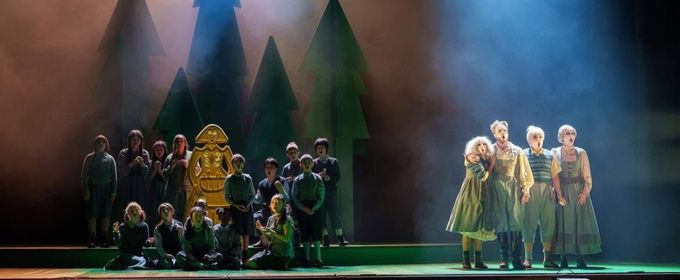
In a clever bit of recycling, Jonathon Oxlade used the same set as he did for Hansel and Gretel last night, right down to the enormous articulated red hands (see my other review here). That definitely deserves a hearty pat on the back as it also continues the storybook feel across both productions, further linking the fairytales of The Brothers Grimm. Bernie Tan-Hayes again provides a comprehensive range of atmospheric lighting.
Anthony Hunt leads the Adelaide Symphony Orchestra through Sondheim’s complex score with great skill and, as always, the orchestra gives a marvellous performance. We are fortunate to have such an ensemble in Adelaide.
For some inexplicable reason, head mics were used, perhaps because that seems to be inevitable with musical theatre nowadays, but it brings the usual complaints of occasional missed cues, or levels sometimes a little too low, losing the voice below the music. An awkward moment, though, was a very late entrance, leaving a few of the cast standing silently onstage, waiting for the missing person. I suspect that the director will be asking questions before the next performance.
It was no surprise, of course, to see a good many familiar faces from the thriving Adelaide amateur musical theatre scene filling the theatre. Sondheim is always a major draw-card. It is rated for ages from fourteen so, like Hansel and Gretel, this is a great opportunity to introduce young folk to musical theatre. Don’t take that suggested age too rigidly, though. In the row in front of me, right in Row A, were two children who were well short of that age and who sat silently, attentively, totally absorbed in the performance. To quote a song from the show, Children Will Listen. If you don’t already have tickets, book quickly. Take the whole family.
Photography, Andrew Beveridge.
Sign up for all the news on the Fall season, discounts & more...
|
The Heartbreak Choir State Theatre Company South Australia (11/20-12/05) |

|
Vanya and Sonia and Masha and Spike Little Theatre (10/09-10/18) |

|
Log Boy State Theatre Company South Australia (10/01-10/10) |
|
The Shawshank Redemption Her Majesty's Theatre (4/01-4/11) VIDEOS |

Reader Reviews
To post a comment, you must register and login.