


Review: GIULIO CESARE, The Grange Festival
Odd staging decisions overshadow excellent singing
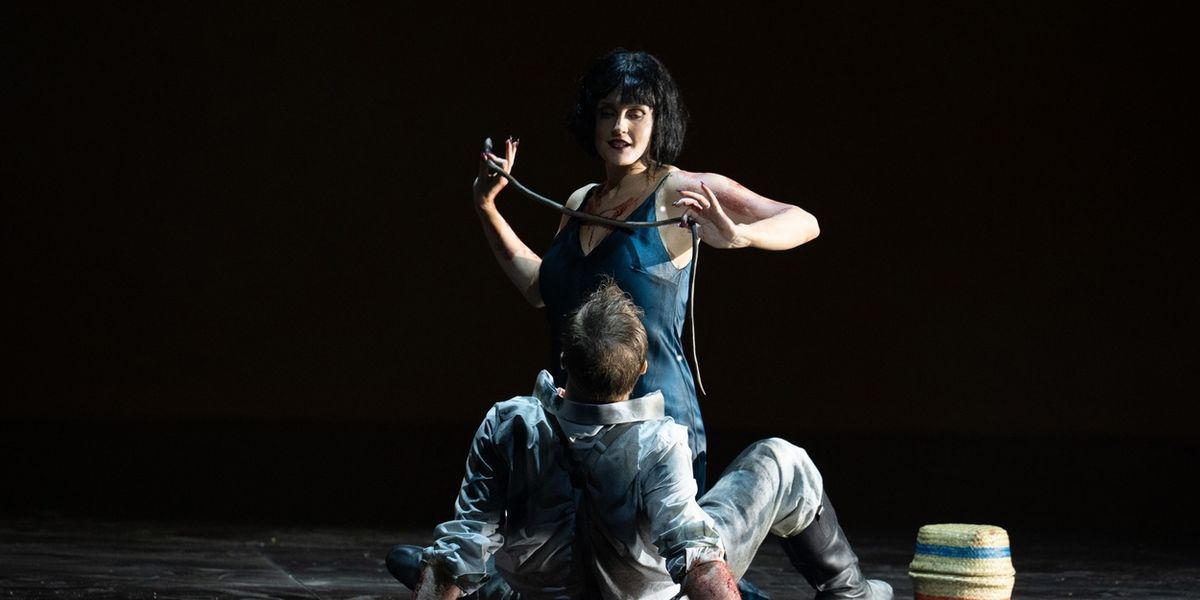
 A new version of Handel's 1724 opera Giulio Cesare is always an exciting prospect. The love story between Julius Caesar and Cleopatra, with the backdrop of war with Egypt, political ambition and domestic unrest is ripe for reinterpretation. Indeed, Handel and his librettist the librettist Nicola Francesco Haym, wrote the opera as a tragi-comedy, but David Alden's new production at The Grange Festival piles on the slapstick to such a extent that it undermines some of the excellent vocals in display.
First the positives, which includes stunning performances from the cast and an assured appearance from Christian Curnyn, conducting the period orchestra Early Opera Company in their Festival debuts.
Countertenor Tim Mead never feels like a strutting, overbearing Giulio Cesare and loses some authority as a result. However, Mead shows great agility and charm as when he becomes enraptured by Cleopatra and has gorgeous vocal tone throughout.
.jpg?format=auto&width=800)
Photo Credit: Richard Hubert Smith
Irish soprano Sarah Brady shows off wonderful coloratura as Cleopatra, in her Louise Brooks-style sharp black bob. Her aria, “V’adoro, pupille” simply sparkles and “Piangerò” is deeply heartfelt and emotive. Cleopatra is a huge challenge to sing for any soprano, but Brady handles the rigors of Handel's composition effortlessly.
Jess Dandy’s rich contralto has a smooth and deeply dark quality as Cornelia, with nice connection to Zheng Jiang’s as son Sesto, particularly in the deeply evocative duet “Son nata a lagrimar”. James Atkinson’s muscular baritone creates an Achilla with a permanent glint in his eye and Hugh Cutting’s Tolomeo quickly convinces as a dangerous psychopath.
The opera has seen some radical interpretations, with clashing themes and timelines. The benchmark for Giulio Cesare remains David McVicar's Glyndebourne production, which is a remarkable combination of Bollywood-meets-baroque.
Alden's production fails to meld too many contrasting themes and ideas together, which ultimately distracts from the music. Along with Jon Morrell's design, the result is a mash-up of time periods and dissonant themes, as though hundreds of thematic ideas were thrown in the air to see what stuck. As a result the production has something of an identity crisis.
.jpg?format=auto&width=800)
Photo Credit: Richard Hubert Smith
Achilla appears in modern military uniform, while Caesar’s general Curio sports a Roman centurion costume. Sesto arrives in 1950s school shorts and cap, looking too much like Just William to take entirely seriously, before putting on an American footballer's shoulder pads and smearing his face with black lines to avenge his father. Bandaged mummies appear from a sarcophagus, black-clad ninja assassins somersault the stage and comedically fake snakes entwine around various characters, looking more like children's sock puppets than venomous reptiles.
The consistently slapstick take becomes tiresome. A diplomatic game of musical chairs becomes deadly as an servant dies after tasting a drink, but loses its impact when two more do the same. Cleopatra first appears as a black-clad goth, sporting heavy chains around her neck, then pretending to be servant Lydia, giving off Benny Hill-vibes with her overly suggestive use of a feather duster.
Some design decisions are more successful. The pile of rubble that Caesar recovers upon after nearly drowning has a starkly dystopian feel and Cleopatra performs “Se pietà“ on a boat steered by Anubis, which creates real drama and foreboding shadows.
A beautiful sounding production, performed with aplomb. It's a shame the visuals do not quite match up.
Giulio Cesare is at The Grange Festival on 13, 19, 25 June
Photo Credits: Richard Hubert Smith
See more BroadwayWorld in Google
Our stories show up more often in Top Stories and Google’s AI answers.
Breaking Broadway alerts by text
Get the biggest stories sent straight to your phone.
Sign up for all the news on the Fall season, discounts & more...






Reader Reviews
To post a comment, you must register and login.