


Review: FENCES, Leeds Playhouse
August Wilson's 20th cemtury masterpiece blazes in the 21st
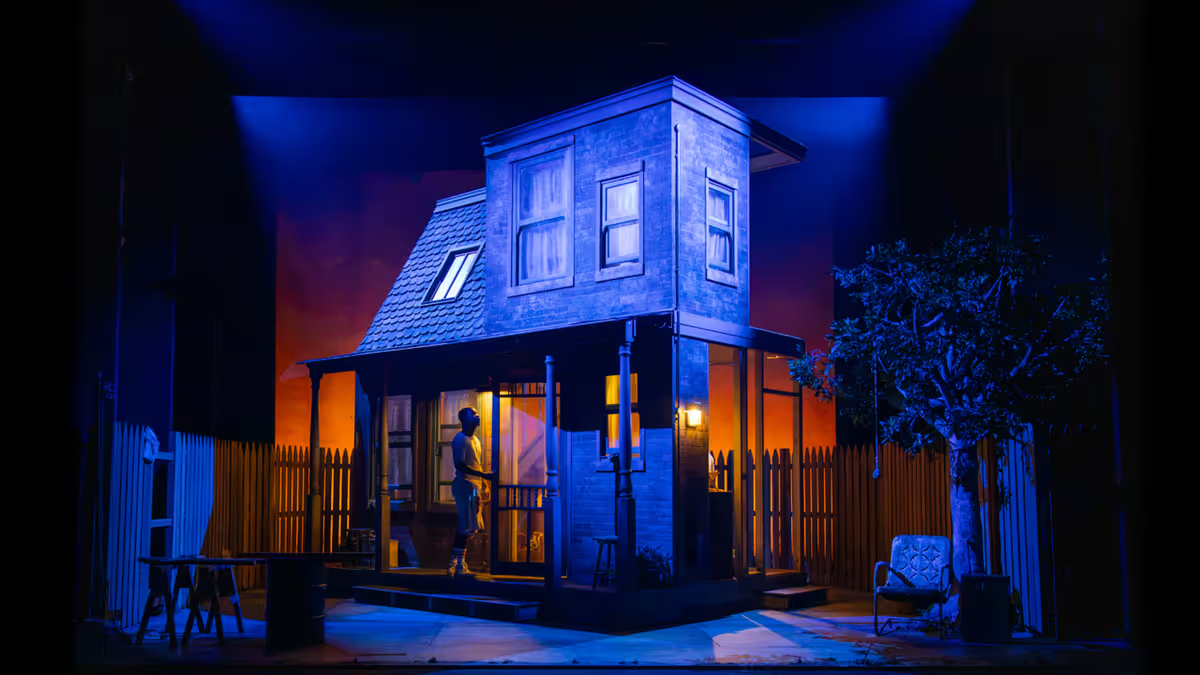

Sometimes the best and, if you’ll forgive an element of hyperbole in the adjective, bravest approach a director can take with a classic is to allow his actors, his designers and, most of all, his writer to tell their story. There’s no reimagining, no stunt casting and no video backdrops in Daniel Bailey’s masterful staging of August Wilson’s modern tragedy, one of the most important plays of the 20th century.
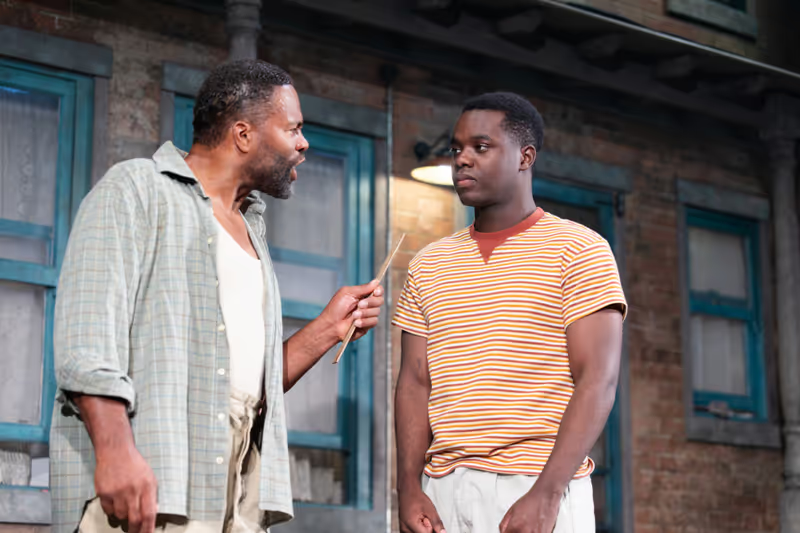
We, dare I even say, get the fear on, the first time we meet Troy, the Pittsburgh garbage man who is all rippling muscle, well-founded pre-civil rights resentment and with a stare that could break rocks on a chaingang. We later find out that he did time for homicide and that’s where he met his avuncular buddy, Bono, a man who has made his accommodations with prejudice and settled for what he has. Troy respects Buddy because he sees a better (at least a happier) version of himself in his lifelong friend - he doesn't respect anyone else.
Bono's willingness to roll with the punches is also adopted by Troy’s wife, Rose, who has a decent home to keep - one paid for by the war pension handed to Gabe, Troy’s mentally incapacitated brother, who, trumpet in hand, speaks smilingly of Judgement Day.
Not so for Lyons, Troy’s son from his marriage before his 15 years inside, who wants to be a musician and, especially so, of Cory, his and Rose’s teenage son, very bright and with the chance of a football scholarship and a route out of not quite poverty, but not much more than that. Lyons more reticently and Cory more forcefully, refuse to be bound by their father's limitations, keen to build their own lives in a world shifting rapidly below Troy's feet.
In creating these tensions within the family set against wider social forces and in analysing psychology with such ruthless acuity, I was reminded of Anton Chekhov's four great works. The great playwright's influence is there too in Troy’s self-knowledge - he knows he’s doing wrong by the people he loves, but he’s so trapped by his own past and the stories he has told himself in order to get from yesterday to today and on to tomorrow, that he can do nothing about it. Bono can see it too, but he half-knows he can’t do anything about it without capsizing his own life and half-knows it wouldn’t make any difference anyway. This is revealed in a small scene in the second half that is in the ‘blink-and-you’ll-miss-it’ category, but demonstrates that this is a work of many words in which none are wasted.
On Lily Arnold’s gorgeous set comprising a revolve to show (sparingly) the interior of the house behind the stoop and the yard where the action takes place, and where the eponymous fence is built, Roy Fearon prowls and preens as Troy. He is the proud patriarch who provides for his family and cannot but see that as a transactional relationship. From his wife, he expects sex, from his sons, Lyons and Cory, obedience and from himself - well, that’s the hard bit. It eats away at him that it was Gabe’s settlement from Uncle Sam that put the roof over their heads and it eats away at him that the black man is not given a fair shake in a racist polity. He wants more, but what that more is won’t resolve in his mind - until it does, with tragic consequences.
Fearon holds Troy’s violence just about in check, but nobody is in any doubt that it’s there to be called upon. He seethes through gritted teeth, invades personal space and has improvised weaponry all around him (a baseball bat, saws, wooden planks).
Nevertheless Fearon avoids making him a monster, a mere avatar of toxic masculinity. He is a product of the forces that have worked on his psyche since he was born and, though that is hardly an excuse, it is surely inevitable that so dysfunctional a society will produce dysfunctional individuals. Troy is less a bad man and more a man made bad.
So strong a lead as a character and performance could easily dominate the stage, but the ensemble around Fearon are hugely impressive. Madeline Appiah grows in the second half from a Rose who is initially a sunny housewife happy enough to rub along, into a woman who stands up for what she knows to be right and, poignantly, finds love in a hopeless place.
Michael Ahomka-Lindsay delivers some beautifully judged saxophone breaks, as well as playing Lyons, Khalil Madovi’s jazz lending both authenticity to the world-building, but also a plaintive soundtracck to Troy’s life, one spent as metaphorically out of sight as the cellar bars in which Lyons plays.
The New Man, boy really, is Cory, born in wartime so only aware of a world of hope and possibilities, the ones to be articulated by Martin Luther King Jnr and others a decade or so into the future. Everal A Walsh’s shoulders alone tell us of the lad’s interior life, a masterclass in how acting on stage can be the accumulation of tiny movements. He sees his father’s resentment at the opportunities his talent has opened up for him and, though he knows they were denied to Troy (by, but not exclusively so, segregation) he does not accept those limitations. Your heart goes out to the lad, because you know he’s right - mostly - and you know that so many of the barbs that he has to take from his father are really self-directed. Troy has his son in front of him, but he’s talking to himself, angry, angry, angry with the man in the mirror.
So many of these socio-political, personal and psychological themes are still roiling in an increasingly febrile USA and beyond almost 40 years after Fences' first Broadway production. I find it hard to believe that the play has been realised with such sensitivity and such power in those four decades since.
Fences at Leeds Playhouse until 26 September and then is on tour
Photo images: Tyler Fayose

Sign up for all the news on the Summer season, discounts & more...
|
Powered by

|

.jpg?format=auto&width=365)





Reader Reviews
To post a comment, you must register and login.