Guest Post: Ajay Chowdhury on Dogs, Destiny And Directing DOG MOM At Southwark Playhouse
'The beauty of Tate’s writing made me decide that, after more that after more than a decade away from directing, I had to come back. '

I am a person who wears multiple hats - tech entrepreneur (I co-founded Shazam), crime writer (I write the Kamil Rahman series of crime novels) and theatre director (I am currently directing and co-producing Dog Mom at the Southwark Playhouse). This is one reason that I am suspicious of career plans. Life takes you in unexpected directions and you have to be open to them.
For instance, I became a crime and thriller writer because my wife saw a tweet. It was about a competition for first-time crime writers, and she suggested I enter. I had an idea about a disgraced Kolkata cop working in an East End restaurant, but no particular intention of becoming a novelist. To my amazement, I won. Six books in the series later, I’m very glad she was paying attention.
But the one common thread through these disparate strands of my life has been the pleasure of making something that didn’t exist before and seeing people respond to it.
Which brings me to a woman whose plans are wrecked by a dog.
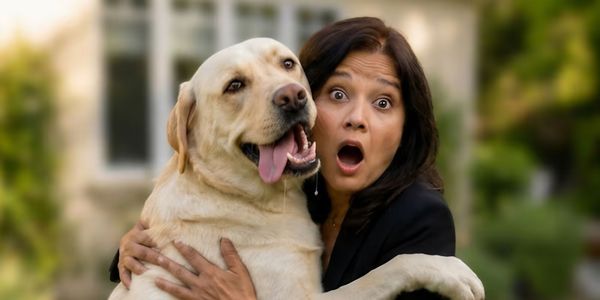
Dog Mom, by Tate Elizabeth Hanyok, follows Sarita, a recently divorced Indian-American woman in her fifties, trying to rebuild her life in Brooklyn. She wants independence, order and no responsibility for anyone else. Then she reluctantly fosters an older stray. It’s a temporary arrangement, as far as she’s concerned. The dog has other ideas.

The play made me laugh, then caught me off guard with how moving it was. The beauty of Tate’s writing (added to the fact that actors play both the people and the dogs, and the dogs get some of the best lines) made me decide that, after more than a decade away from directing, I had to come back. After all, who wouldn’t want to see dogs that philosophise, analyse their owners and swear at cats. Anyone who has ever wondered what their pet is thinking may regret finding out.
I’ve been directing for more than forty years and writing thrillers for only six. Coming back into rehearsals while still working on a novel—deadlines are deadlines—has made me notice how much the two have in common.
On the page, you’re constantly deciding what to reveal and what to leave the reader to work out. In rehearsals, a pause or a look can tell us something a character is desperately trying not to say. Both depend on the audience’s imagination. And neither works unless you care about the people.
Technology has taught me something useful here too: bring together good people, know what you’re trying to achieve, and listen when someone has a better idea. In a rehearsal room, you get to see that idea tested immediately. An actor tries something and a moment you thought you understood suddenly becomes much more interesting.
For London, one of our biggest decisions was to change who sits at the centre of the story. In the US production, the lead was a white American woman in her mid-thirties. Our Sarita is Indian-American and a couple of decades older.
That changes the questions we ask. What does independence mean after a longer marriage? How much of the life she’s trying to escape was chosen, and how much was expected of her?
Working with Tate on that shift, I’ve been able to bring my own South Asian perspective to those questions. I’m interested in the particular pressures Sarita might feel around marriage, family and being seen to cope. But she also needs room to be herself: stubborn, funny, contradictory and occasionally unreasonable. Nobody should have to represent an entire community while also dealing with a dog.
Our multicultural cast brings further perspectives into the rehearsal room. Between the cast and crew, we also own ten dogs and one cat. There is plenty of advice available on canine behaviour. The cat’s views have not been sought.
We’ve also moved away from the literal Brooklyn apartment of the US staging. Sean Cavanagh’s set uses 56 video screens, giving us vivid images that work alongside the action and leave room for the audience to imagine the world beyond it.
One of the greatest things I ever saw was Peter Brook’s nine-hour Mahabharata in Glasgow. Simple, yet epic. Indian, yet universal. I still think about how much theatre can ask an audience to imagine, and how willingly we do it.
That’s part of the joy of Dog Mom. You know you’re watching an actor. Then you recognise a movement, an enthusiasm, that complete lack of embarrassment about wanting to be loved—and you see the dog.
I hope audiences laugh a great deal and perhaps shed a tear. And I suspect a few dogs will get an extra cuddle when their owners get home.
Dog Mom runs at Southwark Playhouse Borough from 14 October - 7 November

See more BroadwayWorld in Google
Our stories show up more often in Top Stories and Google’s AI answers.
Breaking Broadway alerts by text
Get the biggest stories sent straight to your phone.
Sign up for all the news on the Fall season, discounts & more...
|
Powered by

|