


Review: CAT ON A HOT TIN ROOF at The Gamm Theatre
The Tennessee Williams' classic is now playing through June 21 at The Gamm Theatre.
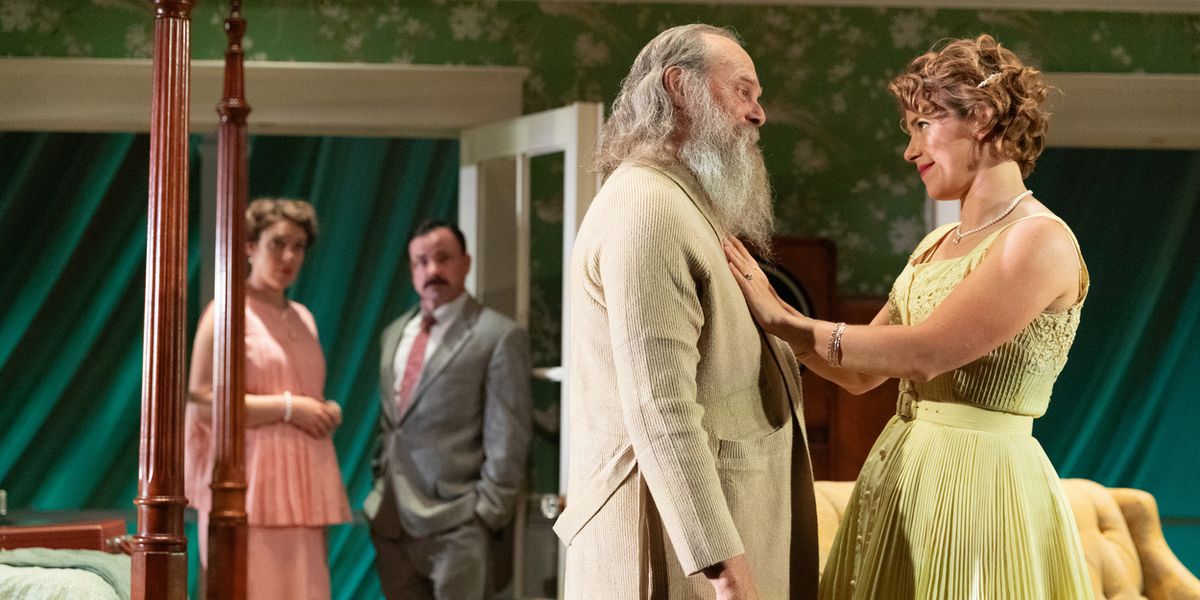
As I am writing this for the Rhode Island section of Broadway World, I feel as though I am uniquely equipped to talk about Tennessee Williams, or at least the world that so often lives inside his work, being that I am a Southerner who has now spent roughly thirteen years in New England.
I grew up surrounded by “bless your hearts,” pimento cheese, boiled peanuts and summers so oppressively hot that I had an actual panic attack when I found out my first Rhode Island apartment didn’t have central air.
Because of that, when I was given the opportunity to review Cat on a Hot Tin Roof at The Gamm Theatre, I jumped at the chance.
At its core, Cat on a Hot Tin Roof is a story about family, wealth, grief, marriage, friendship, inheritance, repression, silence, and what it means to live in a world where saying the thing you most need to say often feels impossible. It is also, whether directly or indirectly, a play about queerness in the South, masculinity, shame, and the impossible pressure of expectation.
And still, I found myself wondering throughout: what does Tennessee Williams mean in 2026? Yet, before I could even fully wrestle with that question, the performances themselves repeatedly pulled me back in.
First, we have Nora Eschenheimer as Maggie, and the only word I can think of to describe her, though I do not feel it fully does her justice, is powerhouse.There are actors who command a stage because they are loud, flashy, or intentionally pulling focus, and then there are actors who command a stage because they simply exist on it in a way that feels magnetic.
Nora falls firmly into the latter category.
I found myself completely enraptured by her performance. If she was in a scene with multiple actors, my eyes instinctively returned to her. What is Maggie thinking? What is she doing? How is she reacting to this moment? In moments of tension, rejection, desperation, or emotional unraveling, Nora responds in a way that quietly shifts the gravity of the room. Her reactions feel deeply lived in rather than performed, and because of that, the emotional stakes surrounding Maggie feel impossible to ignore.
Then we have Michael Underhill as Brick, a character who walks onto the stage already carrying an enormous emotional weight. From the moment Brick entered, all I found myself thinking was: what happened to this man? Of course, that’s not just because he is placed in a cast due to drunken high school antics that a man in his late-20s probably shouldn’t engage in sober, let alone after an amount of drinking that quiets the world and makes everything “click”. Michael plays grief in a way that feels restrained rather than performative, which works beautifully for a character so deeply trapped inside himself.
I would also be remiss if I did not take a moment to talk about John Cormier as Gooper and Charlotte Kinder as “Sister Woman” Mae. As I was preparing to write this review, I found myself oddly stuck on how to talk about them, largely because I hated them so much.
And I mean that as the highest compliment possible.
The performances are so effective, so believable, and so emotionally specific that I found myself genuinely seething at points. They reminded me of a very particular kind of Southern politeness. Did I mention the “Bless Your Hearts” I grew up with?
Then comes Joe Penczak as Big Daddy, and there is something to be said for an actor who can command a room before they have even truly entered it. Big Daddy spends much of the first act offstage, and when he finally enters at the top of Act II, I found myself confused why we weren’t all standing up to clap for him, long before he even speaks his first line.
Without spoiling too much, Joe understands Big Daddy. There is strength and stubbornness, yes, but also fear, anger, reflection, vulnerability, and the unsettling possibility of becoming someone different after diagnosis, misdiagnosis, and being forced to look back at your life when you aren’t sure you’re done living.
Then we have Karen MacDonald as Big Mama, who at times felt so familiar to me that I found myself thinking of my own grandmother. There is a subtlety to Karen’s performance that felt deeply rooted in Southern culture, something that I find non-Southerners don’t always see. Because while patriarchs may outwardly hold power, anyone raised in the South knows there is often something far quieter and equally powerful happening within the matriarch.
Karen understands this beautifully. She makes it clear that Big Mama’s words matter, even when others dismiss her, underestimate her, or speak over her. In fact, she rouses us all when she finally allows her inner world to come out, and finally puts someone in their place.
I would also be remiss not to shout out the ensemble, particularly the children, throughout the production.
At several points, I found myself completely aligned with Maggie and quietly wondering why, exactly, we needed these “no-neck children.” And yet, in what feels like the highest compliment possible, they are a perfect interpretation that anyone who has attended a Southern family gathering, church event, reunion, or holiday knows exactly what I mean. Loud, sticky (always sticky), always in the way, and incapable of understanding volume control. The young performers capture that energy perfectly.
I also want to take a moment to talk about the set design by Jessica Hill Kidd, because from the moment I walked into the theater, I found myself deeply interested in the world being built on stage. The audience is given a glimpse into one room of a Southern plantation home in the Mississippi Delta, but we are also given just enough of the outside world to feel its presence. We are reminded that nature, weather, heat, and the world beyond the walls continue to exist, even as this family seems intent on staying trapped within itself.
Each act seemed to offer something new to visually experience. At times, even inside an air-conditioned theater, I felt like I could almost feel the oppressive Southern heat radiating from the stage, as well as fireworks, and finally, a true summer Southern thunderstorm.
That said, I did occasionally find myself wondering about sightlines. The left side of the set functioning more like a space felt slightly underutilized from where I was seated, and I occasionally wondered whether audience members seated elsewhere were seeing moments that I was not and vice versa.
Still, the overall effect of the scenic design was stunning and deeply intentional, and again, I can't get enough of how real the set made the play feel.
The costumes by Mikayla Reid deserve praise as well. I found myself understanding these characters through what they were wearing, which is no easy feat.
How do I feel about this play? Should you go see it? Stick with me, in true Big Daddy fashion, I need to give you a story.
I drove home from this play confused. And I do not mean that in a bad way.
In fact, I think confusion can be one of the most powerful places to find yourself after a performance.
I had little to question about the production itself. It is, in essence, a stunning production.
My confusion came elsewhere.
Driving home, I found myself wondering again: What is the relevance of Tennessee Williams in 2026?
And as I sat with that question, I realized something uncomfortable.
Family dynamics. Wealth and wealth inequity. Friendship. Relationships. What it means to be queer in the South. The things we struggle to say out loud. The reality that life is often much harder than we let people see. These are things I grew up around. These are things my friends who still live in Southern states continue to navigate every day. That we in the “blue northern states” still struggle with, too.
And perhaps that is exactly why Tennessee Williams still matters.
I truly commend The Gamm Theatre for choosing Cat on a Hot Tin Roof as the final show of its 41st season. Cat on a Hot Tin Roof is phenomenal. It is provocative. It asks hard questions. It asks us to sit in discomfort.
And perhaps most importantly, it asks us to talk.
I think Cat on a Hot Tin Roof is exactly the kind of play we need to be entering into conversation with right now, and exactly the kind of play we should be discussing with the people around us long after we leave the theater.
Cat on a Hot Tin Roof runs at The Gamm Theatre now through June 21. Tickets are $60-$80 with discounts for members.
Photo by Cat Laine
Sign up for all the news on the Fall season, discounts & more...

|
A Christmas Carol The Arctic Playhouse (12/03-12/20) |

|
Deathtrap The Little Theater Of Fall River (10/15-10/25) |
|
The Newport Nutcracker at Rosecliff Rosecliff Mansion (11/25-12/04) |
|
A Real Life Fairy Tale: Princess Diana Ballet RI (4/25-5/02) |

|
The Nutcracker Ballet RI (12/17-12/27) |

|
Almost, Maine The Arctic Playhouse (11/05-11/22) |

|
Love! Valour! Compassion! The Little Theater Of Fall River (6/17-6/27) |

|
Ballet Meets The Beatles Ballet RI (3/12-3/21) |
|
MUCH ADO ABOUT NOTHING, directed by Stephen Thorne Burbage Theatre Co (9/17-10/11) |

|
Made On Hope Ballet RI (4/16-4/25) |

Reader Reviews
To post a comment, you must register and login.