


REVIEW: The Festival d'Avignon Presents CHE DOLORE TERRIBLE È L'AMORE By Daria Deflorian
What did our critic think of CHE DOLORE TERRIBLE È L'AMORE?
A friendship lies at the heart of Nobel laureate Han Kang’s acclaimed 2021 novel We Do Not Part. Kyungha and Inseon are colleagues turned confidantes living in Korea. After Inseon suffers a terrible accident, Kyungha flies to Jeju Island to feed her friend’s parakeet. She arrives in the middle of a blizzard only to discover that the bird has died. Inseon soon appears in the house as a specter, and together the two begin to navigate the fractures between Inseon and her mother, a history inseparable from the violence of the Jeju Uprising, also known as Jeju 4.3. Daria Deflorian’s adaptation, Che Dolore Terribile è l’Amore, now in performance at the Festival d’Avignon’s Cloître des Carmes, is beautifully staged and exquisitely acted. Yet in its haste to arrive at the historical trauma that underpins the novel, it allows the friendship at its center to become little more than a pretext. The result is a production that feels less like a theatrical adaptation than a beautifully crafted speed-read through a remarkable novel.
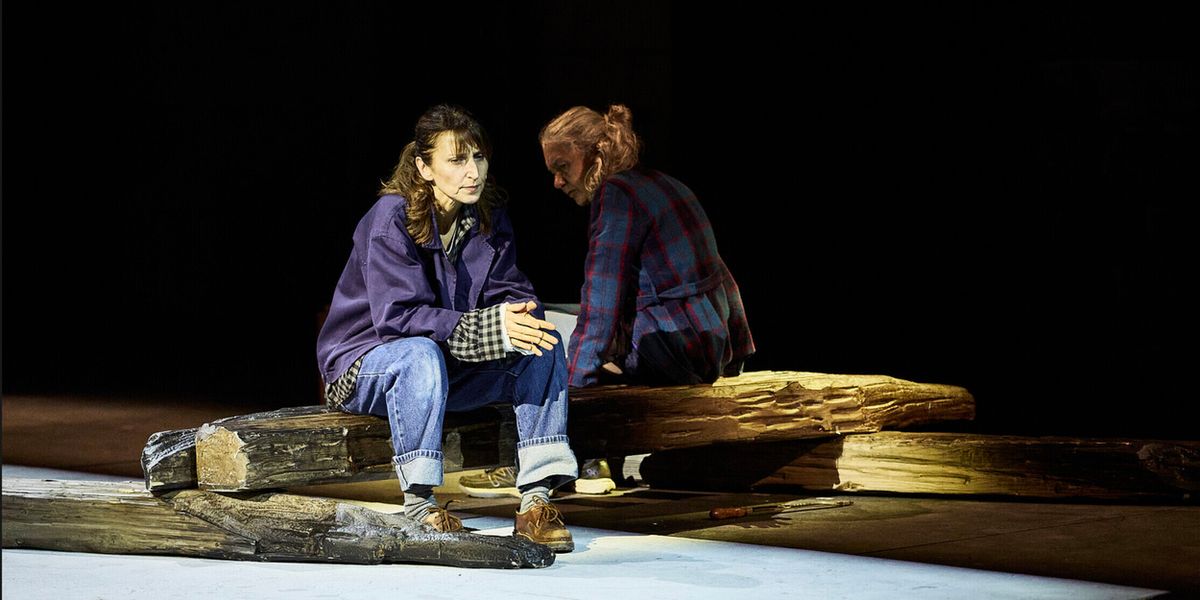
Andrea Pizzalis's striking set immediately establishes the production's atmosphere. A series of fractured wooden planks rests in a meticulous row atop a white canvas, a composition that commands attention as sculpture before it ever functions as scenery. Throughout the evening, the performers continually rearrange these planks into new sculptural configurations until, by the end, the white canvas has been cleared. Upstage, a softly illuminated birdcage sits like a shrine, quietly anchoring the audience's attention even after the bird itself recedes from the drama. Along the stage's edges sit archival boxes that eventually open to reveal documents and testimony from the Jeju Uprising, transforming the scenic installation into an archive of historical violence.
Deflorian and Monica Piseddu perform Kyungha and Inseon with remarkable restraint and emotional precision. Within minutes, they establish a relationship compelling enough to carry the evening. Questions about Inseon's condition, the fate of the parakeet, and the history shared between these two women become the emotional engine of the production. Yet with only ninety minutes to encompass Han Kang's expansive novel, the adaptation soon abandons those intimate concerns. When the electricity fails and Kyungha becomes stranded in Inseon's home during the storm, the work slips into a state of dreamlike uncertainty. The bird fades into the background as the production pivots toward Jeju 4.3 and the historical testimony hidden within the archival boxes.
As I discussed in my review of Kyung-Sung Lee's Island Story, Jeju 4.3 occupies the uneasy space between the Second World War and the Korean War, serving as both the aftermath of one conflict and the prelude to another. Here, that history is filtered through Inseon's family. The uprising has become the wound separating mother and daughter. Anna Coppola gives Inseon's mother an extraordinary stillness. Bent with age and moving deliberately along the edges of the stage, she feels less like an apparition than someone who has long since learned to coexist with grief. While Kyungha and Inseon race through memory in search of explanation, the mother quietly inhabits its consequences.
Deflorian's staging possesses a poetic assurance throughout. Giulia Pastore's lighting transforms the Cloître des Carmes into a series of haunting tableaux, making full use of one of the festival's most evocative venues. Yet the production reaches its destination too quickly. Some adaptations overstay their welcome; Che Dolore Terribile è l’Amore suffers from the opposite problem. It needed another act, or simply more room, to allow its central friendship to deepen before asking it to bear the weight of history. Within its opening minutes, the production promises an intimate drama whose emotional stakes feel irresistible. By the time the ghosts of Jeju arrive, that intimacy has largely been left behind. Given the extraordinary craftsmanship on display and the excellence of its performances, there was ample reason to believe the production could have sustained both.
Recevez l'actualité de Broadway sur WhatsApp
Recevez les dernières mises à jour, les nouvelles de dernière minute et une couverture exclusive directement dans l’application.

Sign up for all the news on the Fall season, discounts & more...
