


REVIEW: The Festival d'Avignon Presents MALDOROR By Julien Gosselin
This is the power of Gosselin’s stage: holding the audience in the novel’s narrative grip, on its own terms, with theatrical mastery.
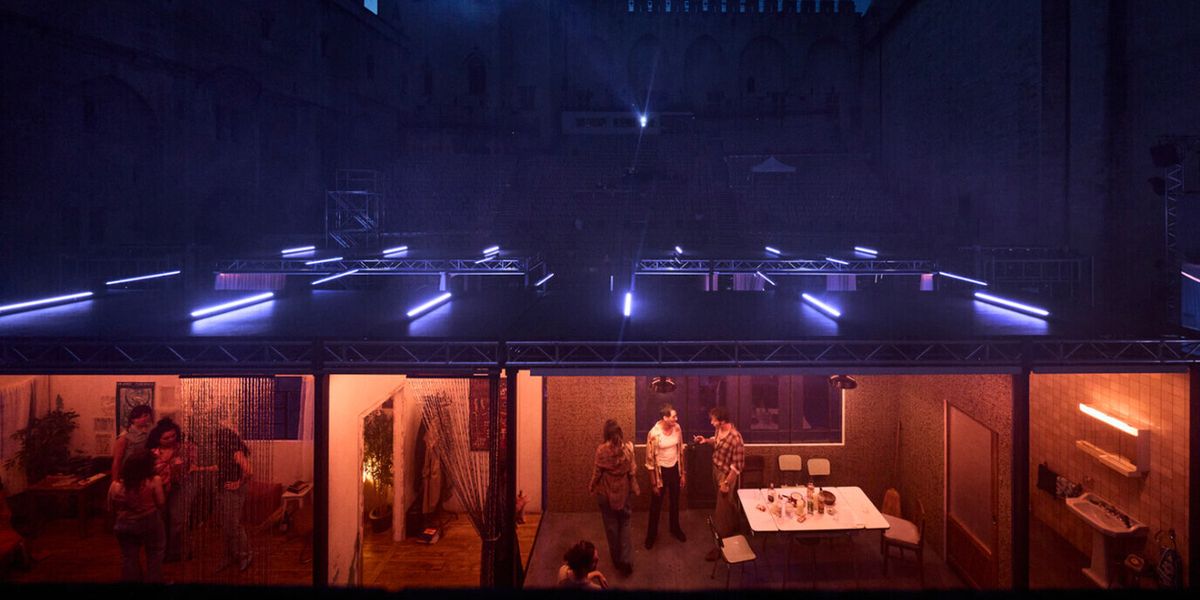
As long as there's been "the novel," theatre practitioners have used it for inspiration. Operas, melodramas, and tragedies have dramatized the novel’s psychological depth, expansive worlds, and literary rhythms for scenic experience. Given this history, for a director today to investigate the “adaptation of the novel” as a theoretical impulse might strike one as redundant. Julien Gosselin, who was recently named director of France’s Odéon, confronts theatre’s scenic relationship with the novel. His oeuvre of adaptations of Chilean author Roberto Bolaño does not just set stories in scenic space. It employs a wide variety of multimedia and literary techniques to maintain the novel’s expansiveness, literary presence, and narrative precision. His epic Maldoror, which opened the 80th edition of France’s Festival d’Avignon in La Cour d’Honneur, offered a sweeping experience, its literary intensity matched only by its performative rigor.
Performed over five hours and in three parts, Maldoror presents the experiences of those living in an artists' commune during the 1973 Chilean coup d’état. It presents the investigation of a double homicide, as an investigator attempts to locate a murderer and a body decades after the fact. It presents the tension between a political visionary’s daring extremism and reckless dispassion. It presents a meditation on the place of poetry in literary forms, revolutionary acts, and philosophies of living. It presents sex, tender and cruel; friendships, burgeoning and nostalgic; and politics, ambitious and dejected. It presents all that the novel has to offer while never abandoning the autonomous impact of dramatic mise en scène.
On stage, Gosselin's iconic large screens structure Lisetta Buccalleto’s scenography. A large projector screen hangs on the wall of the Cour d’Honneur, while four LCD screens, moving around the set, connecting and disconnecting from one another, claim scenic attention. In practice, the use of multimedia screens in contemporary theatre has crested past dramatic trend and entered into theatrical cliché. Once revivals of Lloyd Webber begin to employ a technique on Broadway, it’s safe to say that it has lost its visionary impact for Avignon. Yet to view what Gosselin does as simple concert projection misses the point. The screen images are both more cinematic and more theatrical than most treatments of multimedia theatre today. Gosselin molds the screens to create inventions that cinema itself could not replicate. They also do not aspire to Robert Lepage-like photorealistic magic. Gosselin’s images reverberate with novelistic literary emphasis, not the Disneyesque Gesamtkunstwerk.
In collaboration with videographers Jérémie Bernaert, Baudouin Rencurel, and Pierre Martin Oriol, Gosselin develops a distinct cinematic language that beautifully dwells in anonymous urban backstreets, the thrum of sweaty nightclubs, and the intense conversations of intimate salons. Nicolas Joubert’s atmospheric fluorescent lighting mixes with the glare of these screens to create melting effects between the image filmed on stage and the diegetic atmosphere of the depicted scene. With the actors projected live on stage, the experience extends to a Hollywood studio tour and a technological extension of André Antoine’s Théâtre Libre and its fourth wall. Dramatically, characters are not projected simply for us to appreciate their performative subtleties, which are exceptional, but so that they might dominate their own image. Each persona becomes its own personal Big Brother. Aiding the cinematic quality are Guillaume Bachelé and Maxence Vandevelde’s entrancing soundscapes, which quietly crescendo until the seats of the Cour d’Honneur shake.
The cast of a dozen world-class performers execute tight dialogue and monologues in English, Portuguese, German, French, and Italian. The first two parts present a cacophony of characters displaying novelistic idiosyncrasies, each performed with an exacting confidence that the unforgiving, dominating screens would expose as false if it were lacking. The third and final part concludes with Victoria Quesnel bringing the work back to the stage with a sweeping monologue about poetry, sex, and death. The entire cast—including Guillaume Bachelé, Rita Benmannana, Joseph Drouet, Denis Eyriey, Carine Goron, Jeremy Lewin, Jeanne Louis-Calixte, Cyril Metzger, Achille Reggiani, Lucile Rose, and Maxence Vandevelde—enjoys iconic moments throughout.
Of this play, there is still so much to say. I haven’t even mentioned the vignettes of a rat crime detective, the actor descending into the medieval well beneath the Cour d’Honneur, or the audience welcomed on stage for the duration of Act Two. With this much scenic invention, the text remains material. It does not become landscape but remains the specter of a novel, preserving both its story and its literary experience. The novel does not tend to shake us in the same manner as theatre. Many novels labeled "the funniest" will not elicit even a smirk from me, but even the most juvenile performance can usually earn one meaningful laugh. Novels engulf our imaginations. They can entrance us to the point that we sink through page after page, only realizing at the end of a chapter, or perhaps at the end of the book, that we have been intoxicated by the storytelling. This is the power of Gosselin’s stage: holding the audience in the novel’s narrative grip, on its own terms, with theatrical mastery that never relies on the coup de théâtre but instead enchants through a ballet of screens, text, and intimate performances.
Photo Credit: Christophe raynaud de Lage
Recevez l'actualité de Broadway sur WhatsApp
Recevez les dernières mises à jour, les nouvelles de dernière minute et une couverture exclusive directement dans l’application.

Sign up for all the news on the Fall season, discounts & more...
|
ARTICLE 353 DU CODE PÉNAL THEATRE DU PETIT SAINT-MARTIN (9/10-10/30) |
|
LE GOÛT DE LA FRAMBOISE THEATRE DES BELIERS PARISIENS (8/29-11/01) |

|
DRAG RACE FRANCE LIVE SAISON 4 - DRAG RACE FRANCE LIVE CASINO DE PARIS (9/24-10/02) |

|
CLEMENT VIKTOROVITCH ZENITH DE LILLE (2/06-2/06) |
|
|
OÙ VA LE SON QUAND IL NOUS QUITTE ? TH DU ROND POINT -SALLE JEAN TARDIEU (3/24-3/24) |
|
L''AFFAIRE BUCKINGHAM THEATRE A L'OUEST DE LYON (4/09-10/27) |
|
|
L''AGE TENDRE TH DU ROND POINT - SALLE ROLAND TOPOR (10/03-10/17) |
|
|
ROMEO & JULIETTE ZENITH D'ORLEANS (4/07-4/07) |
|
|
ROMEO & JULIETTE ZENITH NANTES METROPOLE (4/28-4/30) |
|
|
UN SOIR AVEC PIERRE ARDITI RADIANT - BELLEVUE (11/09-11/09) |
