

Review: KOWALSKI at Lookingglass Theatre Company
Fresh from off-Broadway, the production runs through October 25.
 Click for Tickets!
In one of his many essays on writing and life, famed Southern playwright Tennessee Williams once wrote that “if the writing is honest, it cannot be separated from the man who wrote it.” Whether or not one agrees with Williams, there’s no denying that this assessment certainly remains true for his own writing. Williams’s plays are all autobiographical in some form or another, a fact he publicly admitted especially when discussing The Glass Menagerie or Cat on a Hot Tin Roof. Fairly or not, then, I had this same quote in mind when seeing Kowalski, an admittedly charming new play by Gregg Ostrin that imagines the initial meeting between Tennesse Williams and Marlon Brando as Williams goes about getting A Streetcar Named Desire ready for Broadway rehearsals. And while Kowalski makes for a great showcase for two actors with charisma and wit to spare, the play struggles in search of a direction while lacking the emotional honesty and primal intensity that Williams’s name evokes for so many theatergoers. The production runs through October 25 at the company’s home in the Water Tower Water Works.
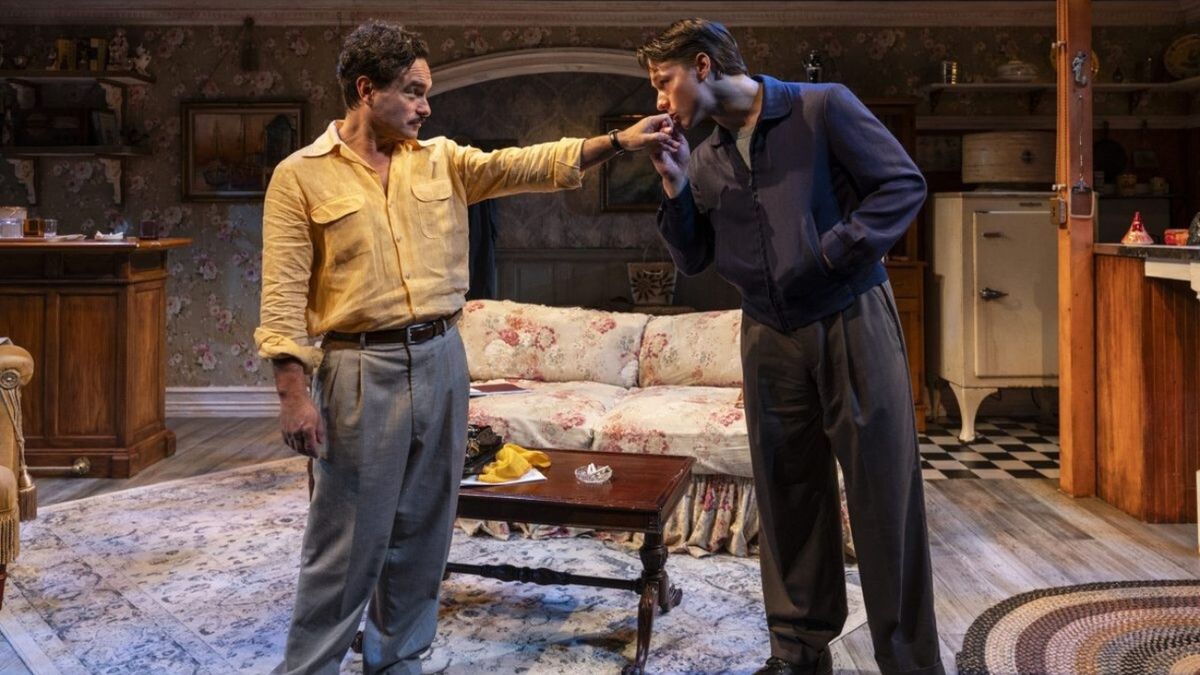
Taking place over the course of one pivotal evening at Tennessee Williams’s Provincetown bungalow, Kowalski finds Tennessee Williams (Johnny Galecki) and his frequent collaborator Margo Jones (a delightfully funny and tender Alison Cimmet) discussing his latest version of A Streetcar Named Desire, especially its potential to herald a new age in American theatre. But as the evening draws on and Margo steps out, a young Marlon Brando (Jacob Moskovitz) bursts onto Williams’s doorstep practically demanding to audition for Stanley Kowalski, the leading male role in Streetcar and the one that would ultimately launch his career into the American cultural stratosphere. Of course, Williams is reluctant; odd name aside, Brando is practically still a kid and Williams doubts that he’s capable of pulling off one of the playwright’s most controversial and complicated roles to date. What follows is a kind of psychosexual joint interview in which the two men test one another and their commitment to ushering in a new chapter in American arts.
First and foremost, a critic has to acknowledge the immense challenge that these actors are up against: bringing larger-than-life personalities to, well, life without resorting to stereotypes or caricatures. Perhaps best known for playing comic characters on The Big Bang Theory and Roseanne, Galecki instantly reminds audiences why he’s such a credit to his hometown of Chicago. With a silky Southern drawl, Galecki exudes all of Williams’s charm, good humor, and—perhaps most importantly of all—self-importance as a man at the height of his artistic powers. But Galecki also has a keen instinct for allowing shivers of doubt to run through his performance, turning what could be a strictly biographical, potentially flat interpretation of the role into a subtle exploration of how fame and success restrict an artist just as much as they free him.
But it’s Moskovitz who faces the most daunting challenge of all in bringing Marlon Brando to life. Brando, both the character and the real-life person, was confident and self-assured in his abilities as a new kind of American actor molded under the tutelage of Stella Adler and her focus on “method acting.” And yet, Moskovitz never comes across as brooding or cold as Brando so often can in his films. Part of what makes his performance so captivating is his youthful yet carefully composed confidence as well as a dry sense of sarcasm that contrasts nicely with Galecki’s pithy quips and twinkling smile.
For all their talents, though, it’s a little disappointing that the actors aren’t better served by Ostrin’s script. He has admittedly set himself a formidable task: how does one evoke the works and legacy of Tennessee Williams without inviting undue comparisons? And yet, the script invites these comparisons with increasing forcefulness as the play goes on. The best moments between Galecki and Moskovitz come when their two characters are discussing the intense emotions and brutal truth-telling that define Williams’s plays as well as a new generation of American theatrical artists, and yet this same sense of honesty and depth of emotion is missing from Kowalski. Perhaps more significantly, it isn’t entirely clear what purpose Kowalski serves as a work of theatre. If Kowalski is purely a biographical slice of life from arguably the most towering figure in American drama, it doesn’t provide any fresh or interesting revelations. If it’s meant to speak to more “universal” themes regarding art, memory, or life, these points are never made forcefully or memorably enough to register.
Kowalski makes for an entertaining, often even exciting night at the theater, thanks in large part to two leading actors unafraid to commit themselves to the honesty of performance that Williams always strived for. But viewers may walk away wishing they could see the same cast in one of Tennessee’s own plays.


Sign up for all the news on the Fall season, discounts & more...

|
Fleetwood Max Raue Center For The Arts (10/03-10/03) |

|
Love Story: A Tribute to Taylor Swift Raue Center For The Arts (11/07-11/07) |

|
Mean Girls Paramount Theatre (8/26-10/11) |

|
Million Dollar Quartet Stolp Island Theatre (10/07-1/03) |

|
Rotary Rocks The Raue: James Garner's Tribute to Johnny Cash Raue Center For The Arts (10/24-10/24) |

|
Blond Ambition: A Tribute to Madonna Raue Center For The Arts (11/07-11/07) |

|
God in a Hole Bramble Arts Loft (10/01-10/17) |
|
Memphis The Musical Studebaker Theater at the Fine Arts Building (10/24-10/25) |
|
Midday Matinee: Jo Ann Daugherty Trio & Bruce Henry present "American Songs & Stories" ECC Arts Center (5/19-5/19) |

|
Raks Inferno: Halloween Cirque Burlesque Newport Theater (10/09-10/09) |

Reader Reviews
To post a comment, you must register and login.