


Interview: Katie Bender of INSTRUCTIONS FOR A SÉANCE at Fusebox at Bass Concert Hall
The Power of Stepping into The Unknown
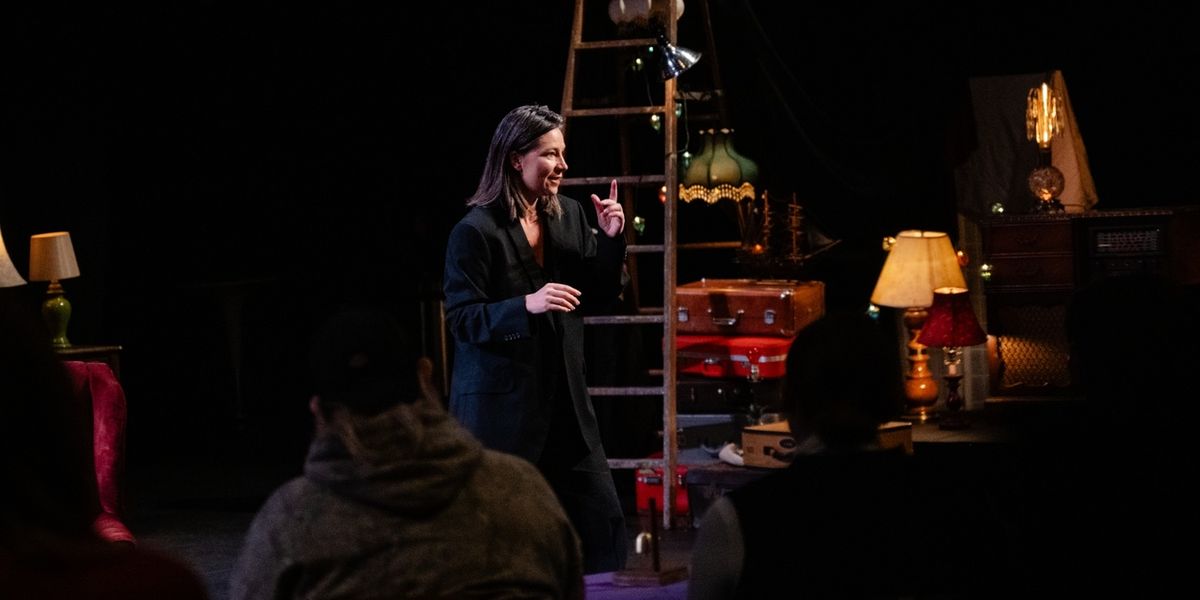
Audiences are in for a magical and provocative experience with Austin playwright and performer Katie Bender’s INSTRUCTIONS FOR A SEANCE. The show is part of Austin’s Fusebox Festival— five exhilarating days of live performance, art, film, music, dance, and theater all over the city. In the show Bender invites audiences into a space where theater, magic, and personal reckoning intersect. Centered on the legacy of Harry Houdini, her immersive séance explores the idea of escape, what it meant in Houdini’s time, what it means now, and why so many of us are still searching for it.
In this conversation with BroadwayWorld, Bender reflects on the origins of the piece, the tension between art and caretaking, and the power of stepping into the unknown.
BWW: You describe “Katie” as a struggling artist and a mother, so just how much of that is you? Where did you intentionally create distance or not?
KATIE: Yeah, yeah. It is very much me, but I would say at this point, it is sort of like an “in quotations” version of me. I went to graduate school at UT for playwriting, and Kirk Lynn introduced me to the Houdini archives at the Harry Ransom Center, and so that was my first sort of touchstone with Houdini, and I really became obsessed. And at the time, I was in graduate school, and I had a 6-year-old, and my husband was just opening a restaurant, and I was really struggling. I was in graduate school with all of these young writers who... it was nothing for them to fly down to Mexico and spend the weekend drinking beer all night. All I did was hang out with my daughter and write. I love my daughter. I'm so grateful for that time, but I also was really struggling with any time I had a success, it meant my husband had to take time to watch her, and any time he had a success, it became this terrible paradigm. I think writing about escape came out of that. Luckily, a decade later, I’m not in that same place, and also my relationship to artistic ambition has changed quite a bit, and my relationship to caretaking has changed quite a bit, but the place where the séance started was there, and that is the “Katie Bender” that I play at the top of the show.
I think something about that gauntlet of not really having enough time and not really having the artistic space that I wanted meant that I really got good at getting up at 6 and writing, which is a very hard thing to do. I sort of figured out how to fight for that space in a way that actually really serves me in general. When I started getting development opportunities, having to have the conversation with people that if I am away from my home for a month, you have to cover childcare, or you have to get a babysitter. The muscle of insisting that opportunities shape themselves to my life has actually also really served me.
BWW: It seems to be like that sort of flexing that muscle also supports those of us who are in any season.
BWW: So Houdini built his life around escape. You’ve spoken to this in your life, so what are the themes of escape that the piece might be exploring?
KATIE: Yeah, initially, when I started researching Houdini, I was really struck by the way that he used these very public escapes as a way to actually create stability for his family. He grew up in poverty, and at that time, if you could make it, you had better opportunities than if you stayed working at a shirt collar factory, which was where he was working as a kid. So he used this idea of escape to create stability for his whole family, which is pretty incredible.
For me, it’s about escaping the constrictions of motherhood in our society now, in late-stage capitalism. But I will say that over the last decade, what escape means has changed a lot, and now I ask guests early on, what is something that you wish to escape from? Everybody has a very clear sense of what they need to escape from right now, and it’s not all the same. I think, just as a culture, we are really hungry for escape in various ways, and so the séance hits differently ten years later.
BWW: What’s the correlation you see between the era in which Houdini lived and our current one?
KATIE: Houdini died in 1926, and he really came into fame in the late 1890s and early 1900s, especially in Europe. His family came to the United States—his father was a rabbi in Hungary, escaping poverty and persecution. They worked in factories, and there was vast wealth concentrated in a very small percentage of the population, alongside huge poverty, and a lot of fear-mongering around immigrants.
I think it’s really telling that Houdini would perform these feats everywhere, but he always liked to start them in big public places where anyone on the street could see them. Thousands and thousands of people would gather to see this man put himself in an impossible situation and then get out of it.
There’s a metaphor in watching someone do that. Houdini did have some tricks, some secrets to what he did, but most of it was his pure physical willpower. It was so much about physical grit—his body getting out of those chains. Of course there were some hidden keys, but mostly it was the individual’s physical grit in escaping an impossible situation.
I think people then felt the metaphor of that, and I think people now feel something very similar.
And also, with the telephone, part of the invention created this world in which it seemed totally possible—if you could speak to someone in Germany right now, then why couldn’t you speak to someone who had passed away?
There’s a kind of porousness around what was possible, and I think there are places—we don’t have much access to them here in the United States—but there are places where the invention of AI is not necessarily about taking over jobs or surveilling us, but could be about something more idealistic.
I don’t know if that’s true, but it does feel like both times are expansions of technology in a way that makes you think, what is happening, where are we going to land?
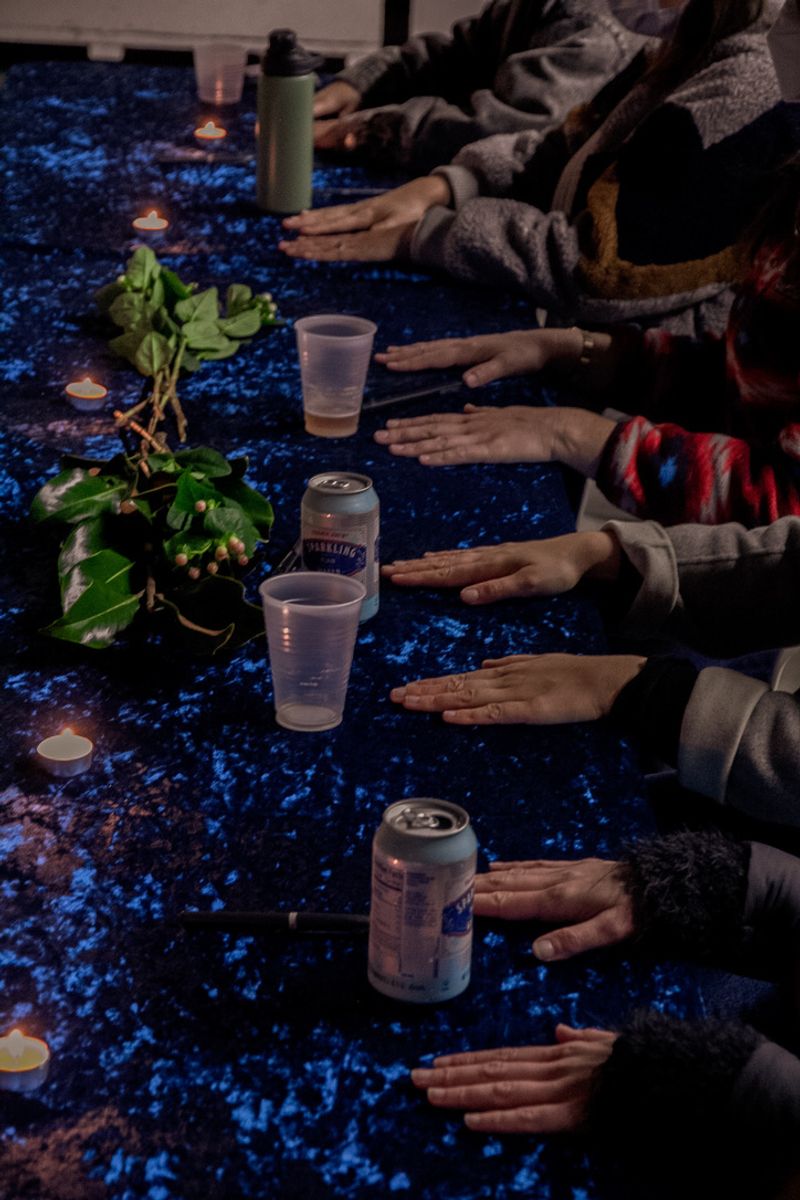
BWW: Is the séance theatrical, metaphorical, or something more?
KATIE: I think it really begins as a literal séance. I am literally doing everything I can to contact Houdini to teach me how to escape my life, and that fails, and it’s failed every time. I’ve never made contact with Houdini. Ever. But something else always happens, and then what happens becomes more metaphorical, I would say.
BWW: What if the séance worked, and what does it mean when the séance works?
KATIE: Houdini would show up to teach me how to escape my life. His first big escape that he gained notoriety for, which is called the metamorphosis—that is what I’m hoping will happen with every séance. And I will say that it does end up working, but not in the way that I think it will.
BWW: Gotcha. What would you like to leave us with?
KATIE: Well, the show is about opening people to moments of the unknown. It’s like that moment where a magician does something and you don’t understand it. For a second, your mind is open to all kinds of possibilities. Your mind is open to the possibility that it was magic, or that the box doesn’t have a lid, or that there are four balls. There’s this moment in which there’s a split in reality, where a lot of things are possible.
To me, all good magic opens us up to what is possible. What I want audiences to leave with is a reinvestment in their own lives of what is possible for them, how to create a positive escape, how to land on the other side of a positive escape. So it’s really about hoping an audience feels opened up to the possibility of something else.
I think mostly in terms of large structures—whether there is something outside of late-stage capitalism, something outside of the patriarchy, something that we could be, in small ways and large, opening up in ourselves and in our world. That’s what I hope for the guests.
BWW: Okay. Well, is there anything else you want us to know?
KATIE: That’s a good question. I guess it’s fun to know that I’ve been doing these séances—I think I’ve done four of them now at four different theaters around the country, and I’ll do it in Milwaukee in the fall.
I’ve been working with the director, Lily Wolf, as my ride-or-die collaborator on this piece for a long time. We met here in Austin—she went to UT as well. She’s now in Philly, but she comes with me to all the spaces, all the different séances that we host.
I started this here right out of graduate school at the Harry Ransom Center, and I actually grew up in Austin as well. It feels really special, a decade later, to be returning to the same campus and being close to HRC.
Eric Colleary, who is the performance curator at the Harry Ransom Center, is publishing a book about Houdini, and they’re about to do an exhibit in the fall because it’s 100 years since he died. So it feels really good to be in this time and space here in Austin.
INSTRUCTIONS FOR A SEANCE is part of Fusebox Festival returning to Austin April 15–19, 2026, offering five days of live performance, art, film, music, dance, and theater across the city. Now a biennial event, the festival activates a wide range of venues, from concert halls and galleries to parking garages and outdoor spaces, with bold contemporary work. Fusebox showcases innovative artists and unexpected experiences in a uniquely Austin setting.
INSTRUCTIONS FOR A SEANCE is running April 16-19th at the Bass Concert Hall Rehearsal Room, 2350 Robert Dedman Drive, Austin, TX, USA, Tickets to this unique experience are available here.

Sign up for all the news on the Fall season, discounts & more...

|
The Miraculous Journey of Edward Tulane Oscar G. Brockett Theatre (10/08-10/18) |

|
ALL MY SONS by Arthur Miller The Filigree Theatre @ Ground Floor Theatre (10/30-11/14) |

|
You're a Good Man, Charlie Brown BASTROP OPERA HOUSE (3/05-3/21) |

|
Erma Bombeck: At Wit's End Austin Playhouse Studio Stage (10/01-10/11) |

|
Averly Morillo McAllen Performing Arts Center (10/10-10/10) |
|
The Book of Mormon Bass Concert Hall (6/08-6/13) |

|
Foster The People Moody Amphitheater (10/16-10/16) |
|
Journeys First English Lutheran Church (10/24-10/25) |

|
Dracula: A Comedy of Terrors Austin Community College Drama Department (10/16-11/01) |

|
Every Christmas Story Ever Told (And Then Some!) Penfold Theatre Company (12/04-12/27) |
