Sondheim’s Dreams: A Sweet Mistake?
From Mrs. Lovett’s seaside retreat to the dreamworld of Follies, what happens when fantasy takes on a life of its own?
This article is presented in collaboration with The Sondheim Hub, the leading publication devoted to Stephen Sondheim’s work and legacy. Subscribe free for original essays and exclusive interviews delivered to your inbox.
Mrs. Lovett has thought of everything. The seaside cottage, the fishing boat, the friends dropping in for dinner… “By the Sea,” her daydream of married life with Sweeney Todd, shows her to be nothing if not accommodating. “Now and then you could do the guest in,” she suggests, between thoughts of kippered herring and bathing dresses.
Lovett’s description of this “cozy retreat kept all neat and tidy” captures something essential about fantasy as a mode of thinking. A daydream is a retreat: a space we can withdraw into, where desire can be indulged without friction, where the world can arrange itself to our liking.
But dreams have a habit of exceeding their instructions in the musicals of Stephen Sondheim and his collaborators. A seaside fantasy, a theatrical extravaganza, a soldier’s nightmare: each offers access to something its dreamer cannot quite manage in waking life. And that is precisely their danger.
“Dreams,” Heidi Schiller warns us in Follies, “are a sweet mistake.” She goes on: “All dreamers must awake.” Reverie, she suggests, is rarely free of consequence.
For Lovett, the reckoning is brutal. Having discovered her deception about his wife, Todd draws her into a final dance. She reaches once again for the seaside:
By the sea, Mr. Todd,
We’ll be comfy-cozy,
By the sea, Mr. Todd,
Where there’s no one nosy…
The fantasy returns at the precise moment it has become impossible. In the frenzy of her last moments, she clings once again to that same fantasy, exposed now as utter delusion. The sea runs dry. Dream-water meets hell-fire, and proves no match for it.
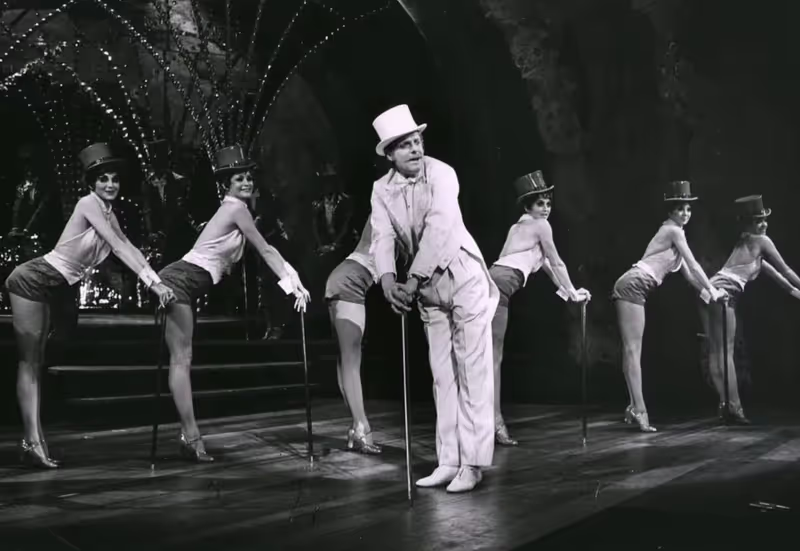
In Follies, an entire theater gives itself over to fantasy. A reunion of former showgirls and their partners in a building awaiting demolition dissolves into Loveland: a hyper-real extravaganza in which the four central characters perform their inner lives in the language of old-fashioned entertainment. The premise, that artifice can paradoxically expose truth, may be familiar. But it is fascinating to see how differently the dream-space functions for each character, and the distinct forms of psychological permission it offers.
Phyllis, in “The Story of Lucy and Jessie,” achieves a kind of detachment through linguistic sleight-of-hand. She narrates her divided self as if describing two strangers, “Lucy ‘X’” and “Jessie ‘Y.’” Each woman possesses what the other lacks:
Lucy wants to be dressy,
Jessie wants to be juicy.
Lucy wants to be Jessie,
And Jessie, Lucy
In this way, Phyllis can tell the truth about herself while keeping the pain of that truth at arm’s length. She reveals to us her fractured soul, lists each and every one of her deep-seated anxieties. She becomes her own diagnostician, safely removed from the diagnosis itself:
If Lucy and Jessie could only combine,
I could tell you someone
Who would finally feel just fine.
Buddy turns his marital misery into vaudeville in “The God-Why-Don’t-You-Love-Me Blues.” He recasts his pain, so raw in reality, as patter and punchline. But in “Losing My Mind,” Sally has no such comic protection. The torch-song pastiche gives her permission to perform what she for so long kept private — and in so doing, it exposes her. We see how completely one person occupies her thoughts: “I dim the lights / And think about you. Spend sleepless nights / To think about you.” Her years of yearning, of heartsick obsession, are distilled to their essence and made terribly, irreversibly public.
Then Ben — the very person Sally can’t stop thinking about — attempts “Live, Laugh, Love.” Immaculate in his top hat and tails, he regales us with his smooth-talking philosophy:
Success is swell and success is sweet,
But every height has a drop.
The less achievement, the less defeat.
What’s the point of shovin’
Your way to the top?
Ben here is an aging Fiyero, dancing through life advice with confidence and flair — until, suddenly, he isn’t. His performance shatters: he forgets the lyrics, loses the thread, loses himself. And this is where Loveland’s dreamscape promise breaks down. Phyllis can borrow a fiction to approach the truth; Ben can no longer make the fiction work. His failure interrupts the entertainment and exposes the brokenness beneath it. What happens, we are forced to wonder, when even a dream cannot furnish you with a self you can believe in?
Passion makes the question of who controls a dream more intimate, and more disturbing. Fosca, an isolated, chronically ill woman, tells the young soldier Giorgio why she reads: “I do not read to think,” she explains, “I read to dream… To get away from life!”
Yet her account of dreaming is far from naive. “I have no illusions,” she insists. She goes on to describe a flower with “delicious nectar at the top / And bitter poison underneath. The butterfly that stays too long and drinks too deep is doomed to die,” she says. Dreamlike pleasure may be available to us all, but our waking survival, Fosca reminds us, can depend on knowing when to stop drinking even the sweetest nectar.
Later, Giorgio dreams of Fosca dragging him into the grave with her. Her arms become “icy tentacles.” The woman who has spoken so lucidly about the dangers of dreaming now inhabits somebody else’s nightmare. It’s easy to take this as a verdict on Fosca: her love is poisonous, and Giorgio knows it before he can admit it. But the nightmare belongs to him. It gives theatrical form to his revulsion and fear, without requiring us to accept either as the final truth about her. What he experiences as a threat will become a love that transforms him.
Fosca knows what it means to dream of an escape from life. Giorgio dreams of being pulled out of the life he knows. Neither can determine what they will become to the other.
There is a useful companion to all this in a less familiar corner of Sondheim’s catalog. “Little Dream,” written for the 1996 film The Birdcage, asks: “Are you my dream / Or am I yours instead?”
The question is playful, but it catches something troubling about these imagined worlds. Lovett casts Todd as her husband without securing his agreement. She has thought of everything except the independence of the person she means to share it with. There is room in her cozy retreat for murder, marriage, and kippered herring. But it is her retreat, and hers alone.
Yet Mary Flynn, in Merrily We Roll Along, offers a distinction worth holding on to: “It’s called letting go your illusions,” she says, “And don’t confuse them with dreams.” Those words ask something harder of us than waking up, than simply snapping out of it. We each have to work out what to relinquish and what might still be worth wanting. Lovett cannot separate her longing for a shared life from the fiction that Todd is the man with whom she’ll share it. Phyllis’s Lucy and Jessie are inventions, but her wish to feel less divided is something to build upon.
If dreams are a sweet mistake, then the sweetness is at least as important as the mistake itself. We can recognize ourselves in these fantasies, sometimes with uncomfortable clarity. The difficult part is knowing what to carry forward when we, like all dreamers, must awake.
The Sondheim Hub publishes original essays exploring how Stephen Sondheim’s music and lyrics work, alongside interviews with the artists who bring his shows to life. Explore more than 300 essays, interviews, and features, including conversations with James Lapine, Len Cariou, and Jesse Tyler Ferguson. Subscribe free to receive new essays and interviews by email, or explore The Sondheim Hub.
Prefer BroadwayWorld in Google Search?
Add us as a preferred source so our stories show up more often in Top Stories and Google’s AI answers — for you.
Sign up for all the news on the Fall season, discounts & more...


.png?format=auto&width=365)