


Review: TOSCA at Wolf Trap Opera
Strong voices and stirring music unexpectedly enhanced by weather
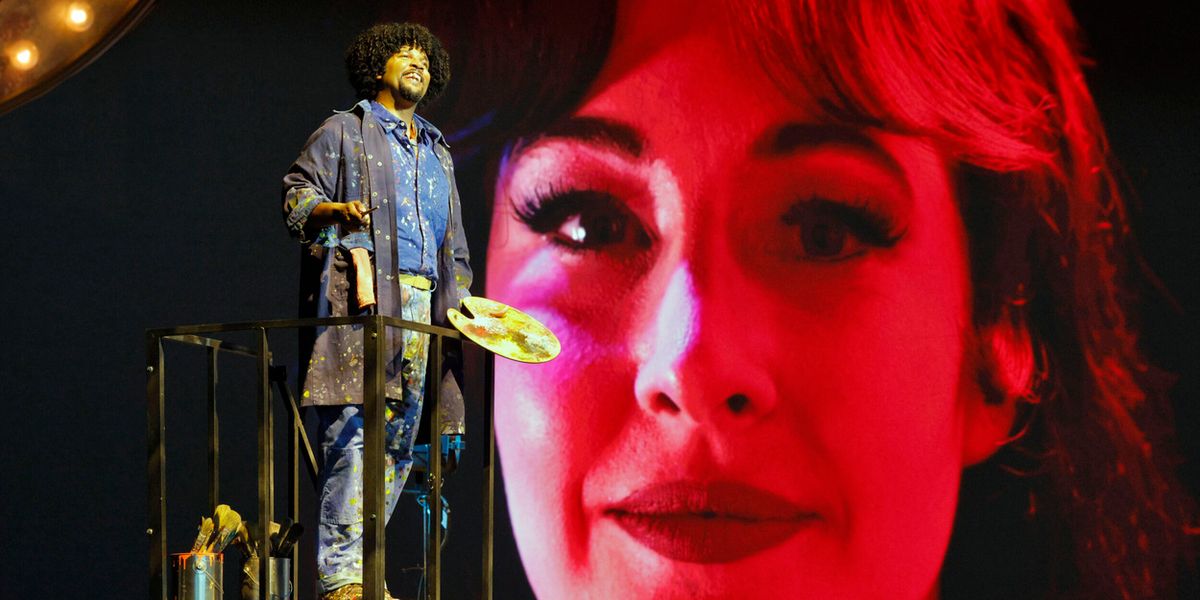
She bounds on stage in sunglasses, fur and foulard like she’s just taken a Vespa from the Trevi Fountain. The Floria Tosca in Wolf Trap Opera’s stylish new production of Puccini’s classic is fully 20th century woman — an Italian film star of 1970s Rome whose poster hangs alongside those for films by Fellini and Argento. She still sings though, and this Tosca her dulcet tones can be heard through the town before she makes her entrance in the church where her lover is painting a Madonna on the wall.
Leaning on film is fitting for the directors Tonya and Ryan McKinny, who previously created a production of “Silent Night” for Wolf Trap Opera in 2024. A huge screen not only projects the grand settings of the opera, but provides closeups of the images of longing, torture, romance and desire as the opera goes along (there’s even a “Psycho”-like shot of blood being washed down the shower drain).
As big a role as the film sometimes played, an even larger, unintentional special effect, due to a fast-moving storm front, only enhanced the performance for those dry enough to remain.
Puccini’s popular “Tosca” is well-loved for its emotional intensity as well as a kind of velocity that belies its two and a half hour running time and two intermissions. In a nutshell (pistachio, say), the artist Cavaradossi is aiding an escaped political prisoner, and the authorities come looking for him. An unscrupulous official Scarpia conjures up jealousy in Tosca in hopes of following her to their prey.
Then Scarpia himself wants to have Tosca for himself, saying he’d free the imprisoned Cavaradossi if she’d succumb to his wishes. There is more angst as she decides to save her love, and still things don’t turn out well.
All of the dark drama and sweep of music is already embedded in the much-performed work, first presented in 1900, and last staged by Wolf Trap Opera 2017. Nothing needed to change in the libretto to reflect a different era of social upheaval and political corruption — neo-fascists vs. Marxists in 1970s Italy (with brief actual footage of the conflict) as opposed to the post-French Revolution setting that inspired the original story. Such uprisings are common enough historical occurrence, of course, to bring events of the present day to mind as well, adding an immediacy to the 126-year-old work.
Wolf Trap Opera was created in 1971 as a summer residency and training program, and its returning stars, now with numerous credits, really shined, backed by the muscular yet nuanced work of the Washington National Opera Orchestra under the direction of José Luis Gómez.
Soprano Tessa McQueen in the title role, provided a kind of bold independent strength while still melting toward her beloved. Her sweeping “Vissa d’arte,” sung under a single spotlight, earned extended applause. Tenor Demetrious Sampson Jr. had his own defining moment, with the pre-execution aria “E lucevan le stele” in act three. There’s something about hearing “And the stars were shining” outdoors on a summer’s night to really enhance the experience.
Baritone Jonathan Patton didn’t get his own ovation for his Scarpia, partly because it’s tough to applaud such villainy, which came across distinctly from his stern, almost bureaucratic manner that was riveting from the stage. Baritone Sergio Martinez was a younger than usual Sciarrone, the church janitor who is skeptical of the artist, but provided good humor. Bass Cumhur Gõrgün was a convincing escapee Angeiotti, but was hardly around long enough to hear — he was on the run, after all. And it’s always a delight when the Children’s Chorus of Washington fills up the stage for crowd scenes.
Lawrence E. Moten III’s set design included not only the projections by Adam Larsen, but a Madonna painting borrowed from a Faith Ringgold self-portrait from 1965, absolutely fitting for that era.
While the weather held out for the first two acts, it got the unintended illumination of lightning in act three, its accompanying rumbling thunder underscoring the rising drama from score.
When Sampson was literally singing about seeing the heavens flash, they actually were. The final shocking flourish of the piece, accompanied by a theatrical white light, was compounded considerably and unexpectedly by the elemental flash of the surrounding storm. The accompanying downpour, of course, thinned the lawn audience considerably, even as it made for an even more memorable night for those under The Shed.
At a time when the Kennedy Center is emptied out and the Washington National Opera is suing them while moving to a smaller space, Wolf Trap Opera takes on greater cultural prominence locally. If only its grand performance waó here for more than one night.
Photo credit: Demetrious Sampson Jr. (with Tessa McQueen on screen). Photo by Cory Weaver.
Wolf Trap Opera’s “Tosca” was performed Aug. 8. More information about their season is available online.
Prefer BroadwayWorld in Google Search?
Add us as a preferred source so our stories show up more often in Top Stories and Google’s AI answers — for you.
Sign up for all the news on the Fall season, discounts & more...
|
Brian Henson's Puppet Up! Lincoln Theatre (9/30-9/30) |
|
GARBO: EL ACTOR QUE SAVÓ AL MUNDO (Garbo: The Actor Who Saved The World) GALA Hispanic Theatre (9/03-9/27) |
|
Mr. Burns: A Post-Electric Play Clarice Smith Performing Arts Center (10/09-10/18) |

|
Special Event: ARTS By George!: Jeff Goldblum and the Mildred Snitzer Orchestra Center for the Arts (10/03-10/03) |

|
The Second-Best School Shooting NextStop Theatre (9/17-10/11) |

|
Coming to America: An Immigrant Cabaret ExPats Theatre (9/30-10/18) |

|
Some Like It Hot Bernard Family Theatre, Olney Theatre Center (9/18-11/08) |
|
Stonewall's Bust The Writers Center (10/09-10/25) |
|
"Treasure Island Reimagined: Jane Hawkins and the Pirate's Gold" The Alden Theatre (10/13-10/13) |

|
Moxie Events presents "The Fleetwood Mac Experience" F. Scott Fitzgerald Theatre (10/23-10/23) |

Reader Reviews
To post a comment, you must register and login.