


Review: THE SOUND OF MUSIC Strikes A Resonant, Political Chord at Broadway San Jose
What did our critic think of THE SOUND OF MUSIC in San Jose?
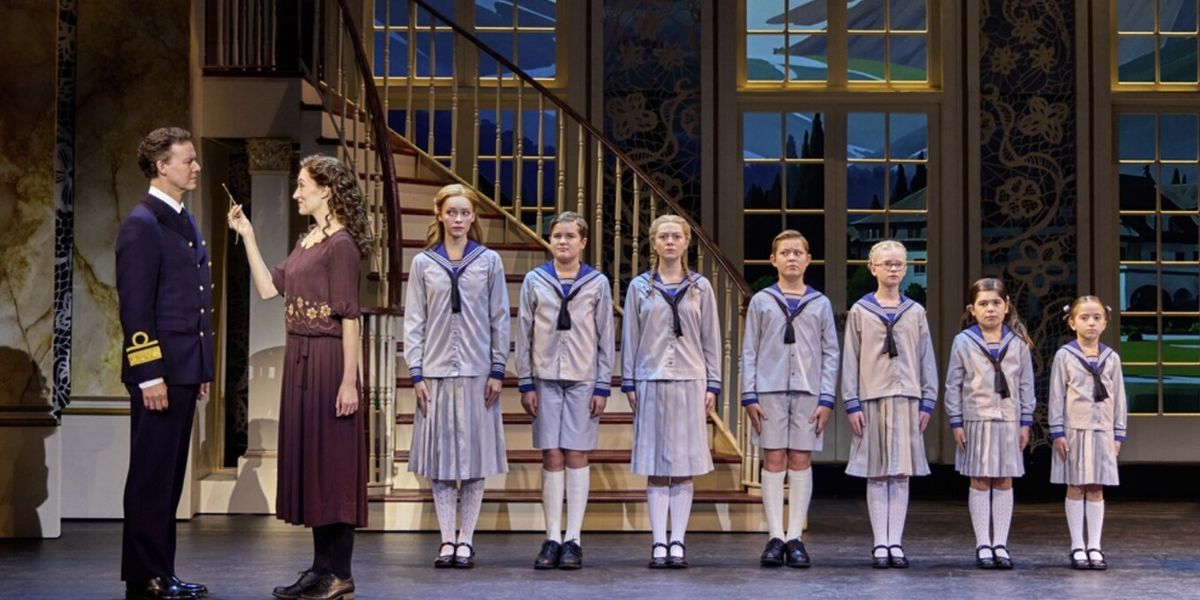
The hills are indeed alive with The Sound of Music as the national touring production played to an enthusiastic, sold-out crowd at Broadway San Jose on opening night. Boasting a stellar cast and rich production values, the show tells the real-life story of Maria (the marvelous Cayleigh Capaldi), a spirited Catholic postulant who falls in love with the widowed Captain Georg von Trapp (Kevin Earley) in the dark days before Nazi Germany's annexaction of their beloved Austria.
While its iconic Rogers and Hammerstein score will make your heart sing, it is the shadow of encoraching fascism that gives this production its pulse. As communities globally navigate modern authoritarian threats, this beautifully wrought story set on the bring of World War II could not feel more urgent.
As a kid, I remember playing my treasured record of The Sound of Music on my record player (ask your parents, kids) until I had memorized every song and sang them ad nauseum (much to the annoyance of my siblings). Back then, the Nazi storyline went completely over my eight-year-old head.
But in this revival, director Jack O'Brien intentionally strips away decades of Hollywood sentimentality to restore the original text and two songs, that focus on the raw historical stakes that each character must grapple with. Decisions must be made. Sides must be taken. By leaning into the claustrophobic threat of the Anschluss, O'Brien forces the audience to confront what it means to hold fast to personal conviction and moral courage when an entire society is capitulating. This political friction does not diminish the love story. Instead, it deepens it, making Maria and Georg's connection far sweeter and more meaningful.
Capaldi's Maria is charmingly quirky and awkward, less a rebel against convent rules and more a young woman searching for her true calling. Opposite her, a brilliant Christiane Noll as the Mother Abbess brings exquisite vocal power and grounded warmth, praying for guidance on how to direct her postulant before sending her off for a period of personal discernment.
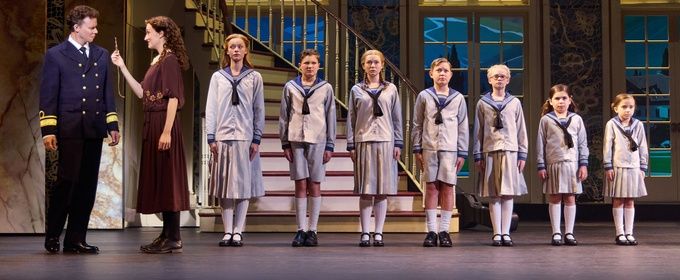
The young cast playing the von Trapp children completely steals the show. From youngest to oldest, they are: Everly Beeson (Gretl), Berkeley Waluk (Marta), Haddie Mac (Brigitta), Reece Boyle (Kurt), Skylar Matthews (Louisa), Torben Mularski (Friedrich), and Ariana Ferch as Liesl, who happens to be sixteen going on seventeen.
In 1959, Liesl's duet with seventeen-going-on-eighteen Rolf (Ian Coursey) was standard patriarchal fare. So when Rolf patronizingly croons, "You need someone older and wiser / Telling you what to do... I'll take care of you," I leaned over and whispered to my nine-year-old granddaughter, Zoey, that she never needs a boy telling her what to do! She rolled her eyes and nodded in agreement. (Big shoutout to second-wave feminists and suffs for making that moment possible!)
A special mention also goes to the non-stop brilliance of the convent ensemble (Charlotte Jenkins, Meredith Lustig, and Lisa Rosetta Strum), who provide glorious vocal grounding throughout. And just for fun take a look at the touring company's Tik Tok!
While the 1965 film adaptation streamlined the plot for broad Hollywood appeal by reducing the breakup between Georg and his wealthy fiancée Elsa Schrader (Kate Loprest is wonderful) to a simple romantic triangle, O'Brien's production restores the original stage text's crucial moral divide.
Elsa and and Max Detweiler (Nicholas Rodriguez) are pragmatists who choose to "play nice" with the regime to protect their status and comfort. Rodriguez brings welcome warmth and witty comic relief to the self-interested impresario, so in the restored Act II trio's "No Way to Stop It," he and Elsa try to convince the Captain that resistance is futile. Georg, an unjcompromising patriot whose moral code forbits capitulation, refuses.
Realizing his principles will put her at risk, Elsa calls off the engagement. She ceases to be secondary character and instead represents the tragic, quiet compromise ordinary citizens make under political pressure.
This tension culminates in the chilling Act II concert scene. As Douglas W. Schmidt's set design drops five massive Nazi banners behind the stage, a visible shudder ran through the San Jose audience.
Instead of singing "Edelweiss" as a routine folk song, Earley's Captain looks up at those imposing symbols of total occupation and pivots. His performance becomes a quiet, heartbreaking act of farewell and political defiance, a reminder that when freedom is stripped away, culture and memore becomes weapons of resistance.
The Sound of Music reminds us that darkness is resisted not just on battlefields, but in the quiet choices made in everyday life: in the songs we refuse to stop singing, the values we decide not to compromise, and the love we choose to preserve and protect.

|
The Still Point: An Immersive Experience SOMArts Cultural Center (7/16-7/25) |
|
The Tragedy of Hamlet, Prince of Denmark SPARC (7/03-7/26) |
|
Ronstadt Revolution - Featuring Natalie Amaya Woodminster Amphitheater (7/25-7/25) |

|
Macbeth Santa Cruz Shakespeare (7/12-8/30) |
|
Ah Ha! Circus Bella (6/03-7/26) |

|
Iphigenia in Splott Shotgun Players Ashby Stage (7/25-8/30) |

|
The Last Five Years by Jason Robert Brown Santa Cruz Shakespeare (9/11-10/03) |

|
Hadestown Howard Brubeck Theatre at Palomar College (8/07-8/16) |

|
Sara Felder’s Class Act The Marsh San Francisco (8/12-8/15) |

|
Beauty And The Beast Orpheum Theatre (7/24-7/24) |
Reader Reviews
To post a comment, you must register and login.