


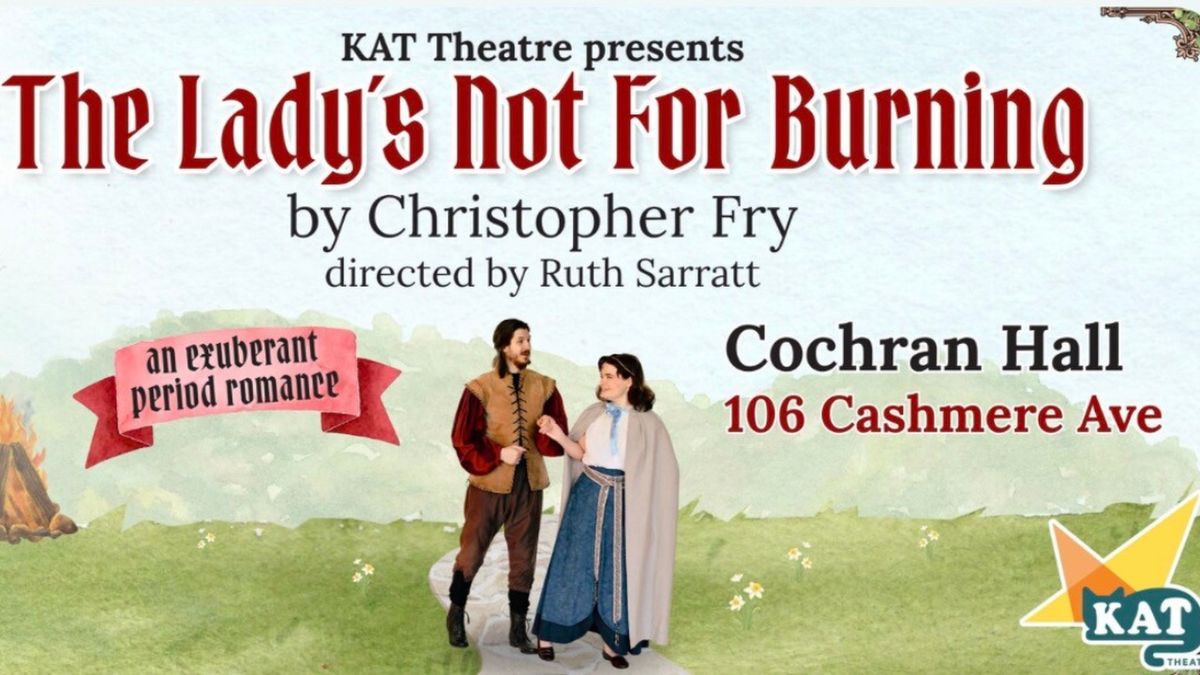
Khandallah Arts Theatre, now commonly known as KAT Theatre, was founded in 1959 with the aim of fostering the appreciation and practice of dramatic art. More than six decades later, it remains one of Wellington's longest-running community theatre companies.
Their latest production is The Lady's Not for Burning, Christopher Fry's celebrated verse play, first produced in 1948. Set in a fictional medieval English town, this romantic comedy became one of the most acclaimed British plays of the post-war era. Written entirely in poetic verse, it reflects a world emerging from the shadow of war, balancing themes of despair and hope while helping to revive interest in verse drama on the Modern Stage.
The story centres on Thomas Mendip (Sam Kesala), a disillusioned former soldier weary of life who wishes to be hanged for a crime he claims to have committed. The townspeople, however, have more pressing concerns, namely Jennet Jourdemayne (Piper Rogan), a young woman accused of witchcraft. The play's central irony is that Thomas desperately wants to die, while Jennet desperately wants to live. As the story unfolds, misunderstandings, romantic entanglements, and comic situations expose the absurdity of the town's justice system.
Upon entering the theatre, the audience is greeted by an open curtain revealing an attractive Tudor-style set, rich in detail. One delightful touch is a mouse peering from a tiny mouse hole, immediately inviting the audience into the world of Cool Clary. As the lights dim, cast members cross the stage, creating a gentle sense of a busy household going about its daily routines.
The play is filled with beautiful phrasing and poetic language, but such writing demands a particular skill in performance. Sam Kesala, Piper Rogan, and Ava Wiszniewska as Alizon Eliot handle the text with impressive fluency, delivering Fry's language naturally and confidently. They emerge as the standout performers of the evening. Some members of the cast appeared less comfortable with the demands of the verse, though this is less a reflection of their abilities than an indication of how challenging Fry's work can be to master.
Penny Maxwell's costumes were generally very good, creating an authentic period feel. The only distraction came from some of the footwear choices. Seeing Thomas in motorcycle-style boots felt slightly at odds with the otherwise carefully crafted medieval aesthetic. I also questioned the decision to give Edward Tappercoom, played by Alistair Smith, a false belly. Given Smith's naturally slender frame, the addition appeared somewhat artificial and pushed the character unnecessarily towards caricature.
The lighting design was effective in its simplicity, supporting the action without drawing attention to itself. Director Ruth Sarratt kept the staging fluid and, for the most part, naturalistic, ensuring the production maintained a steady pace despite the density of the text.
This is certainly an unusual choice of play. There is little action, and the plot itself is relatively slight, with much of the evening devoted to language and ideas rather than narrative momentum. Yet perhaps that is precisely why it was chosen. Fry's verse remains lyrical, witty, and often beautiful, and there were clearly many audience members who connected with it. Ultimately, that is what matters most.
While it may not appeal to everyone, The Lady's Not for Burning will undoubtedly reward those who have a love of language, poetry, and period drama.
Sign up for all the news on the Fall season, discounts & more...
|
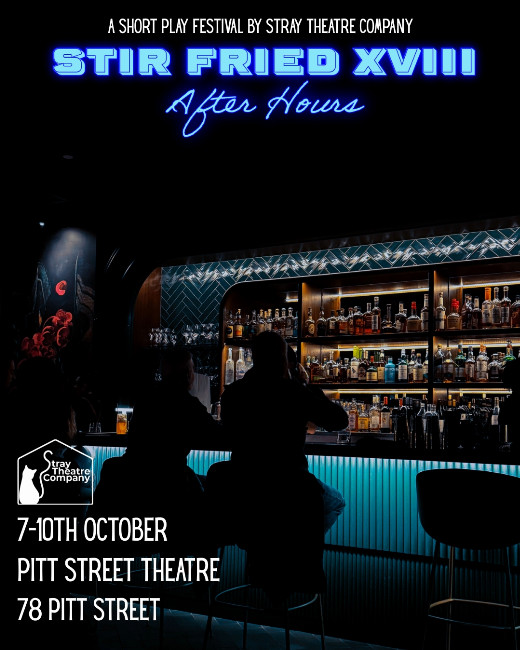
Stirfried XVIII: After Hours Stray Theatre Company (10/07-10/10) |

|
WIRED Pitt St Theatre (11/12-11/14) |

|
A Box of Memories Q Theatre (10/22-10/25) |

|
5 Seconds of Summer Spark Arena (10/24-10/24) |

|
Femmes and Thems Comedy Basement Theatre (8/27-11/19) |

|
The Lady in the Van The Rose Centre (11/14-11/28) |

|
Wicked Isaac Theatre Royal (4/16-5/01) |

Reader Reviews
To post a comment, you must register and login.