


Review: GIRL FROM THE NORTH COUNTRY at Stadttheater Fürth
Girl from the North Country – An Intense, Haunting Journey into the American Soul
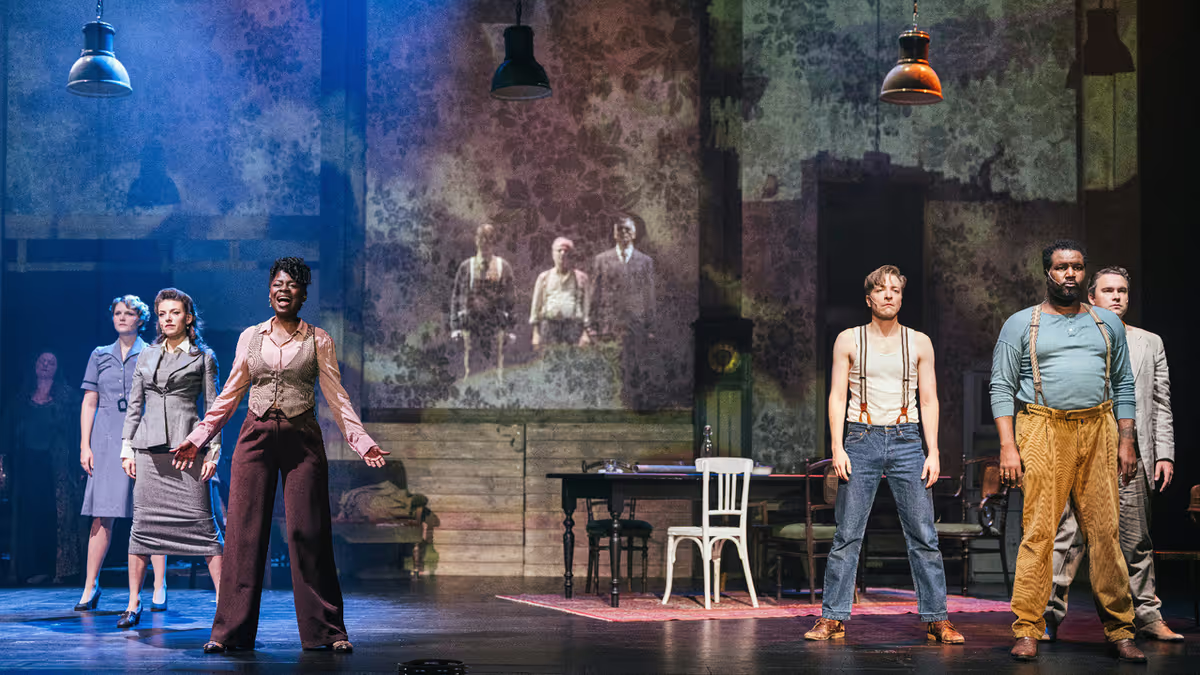
The Musical Frühling in Gmunden and its co-production partner, Stadttheater Fürth, are veritable cultural powerhouses, enriching the German-language musical scene year after year with premieres that offer a welcome antidote to a local market that often resembles a swamp of reheated, endlessly recycled fare. This year, Gmunden and Fürth present Girl from the North Country, an enormously successful and quintessentially American musical featuring songs by Nobel Prize-winning songwriter Bob Dylan, in a production that is psychologically compelling and oppressively atmospheric in its intensity.
The musical has enjoyed considerable success not only on Broadway and on numerous US tours, but also in repeated West End runs. Conor McPherson’s book proved particularly successful, and the show was among the few productions to return after the Covid-19 pandemic. Calling it a musical, however, is not entirely straightforward. It is better described as a psychological drama interspersed with songs that lift the characters’ inner lives – their struggles, hopes and traumas – out of the harsh reality of their circumstances and transform them into a lyrical, musical form of monologue, largely detached from the immediate action and situation. Bob Dylan’s poetic lyrics serve as a vehicle for conveying the characters’ emotions and forging connections with the audience. They invite us not only to appreciate his songs but also to engage with their profound, multilayered lyrics, which tell stories of their own alongside the central narrative.
Elisabeth Sikora’s German translation captures the dialogue with remarkable authenticity, intimacy and intensity, offering plenty of moments that give the audience food for thought. With most of the songs performed in German, Sikora’s exceptional skill as a translator comes to the fore. She succeeds in rendering Dylan’s Nobel Prize-winning poetry into German in a way that is genuinely moving, while retaining recognisable passages in English that continually draw us back to the distinctly American heart of the story and its music.
Both thematically and in its setting, the central narrative is deeply American. It unfolds in Duluth, Minnesota, in the winter of 1934, against the backdrop of the Great Depression. The story is narrated by the local physician, Dr Walker, who knows all the characters and provides a connecting thread throughout their intertwined lives. Nick Laine struggles to keep his dilapidated guesthouse afloat as the bank threatens to foreclose on the property, while his wife Elizabeth, who suffers from dementia, oscillates between detachment and uninhibited outbursts. Their son Gene, an aspiring writer and troubled alcoholic, is struggling to find his place in the world, while their adopted daughter Marianne, who is five months pregnant, faces an uncertain future. Nick hopes to secure her financial stability by arranging a marriage to Mr Perry, an ageing local shoemaker, despite Marianne’s reluctance. Meanwhile, Nick seeks emotional fulfilment in his relationship with Mrs Neilsen, a widowed guest awaiting her inheritance. Another family staying at the guesthouse is the Burkes: Mr Burke, a former factory owner brought low by financial ruin, his wife and their intellectually disabled son Elias. Their fragile existence is further unsettled when the self-proclaimed Reverend Marlowe, a duplicitous Bible salesman, and Joe Scott, a Black boxer whose life has been derailed by injustice, arrive seeking shelter. Gene’s former girlfriend, Kate Draper, adds another layer of heartbreak when she announces that she intends to leave him for a man with better prospects. Through these thirteen characters, the play explores poverty, loneliness and hopelessness, confronting the financial, moral, psychological and interpersonal abysses that shape their lives. The struggles of America, with all its economic and social upheaval, are woven throughout the drama.
Markus Olzinger strikes exactly the right tone with his production, translating the material into an intensely psychological theatrical experience. Heavy, leaden silences speak volumes, while emotional outbursts hit hard. Audiences more accustomed to conventional musical theatre may initially struggle with a work that is, at heart, a play rather than a musical. Yet for those willing to engage with the tangled web of human relationships at its core, what may initially seem drawn-out gradually gives way to a compelling theatrical experience, with Olzinger’s production exerting an increasingly powerful pull. Those less inclined to delve into its psychological intricacies, however, may find its deliberate pacing laborious, while those who stay with it may ultimately find themselves deeply moved.
The set, depicting the Laine family’s bleak guesthouse in a period-appropriate style, reflects the era, the social climate and the characters’ inner lives. The five-piece band is housed in the rear section of the stage. Musical director Jürgen Goriup takes his place at the piano, guiding Katarína Kožúriková, Emilia Waleska, Tomáš Cvejn and Štěpán Botoš with great sensitivity through Dylan’s score. Simon Hale’s arrangements and orchestrations transform the material from relatively lightweight country into deeply melancholic gospel melodies. Renate Harter and Nicole Zürner create a cohesive make-up design, while Julia Pschedezki’s costumes capture the spirit of the period. Amy Share-Kissiov’s choreography is understated, serving to reinforce rather than distract from the narrative, and Roland Baumann’s sound design leaves nothing to be desired. Jürgen Erbler’s video design, projected onto the guesthouse’s rising rear wall, reinforces the historical context and establishes emotional points of reference, while Ingo Kelp’s lighting design carries much of the drama through its deliberate interplay of light and shadow, mist, claustrophobia and moments of emotional intensity.
Dennis Kozeluh guides the audience through the story with poise and empathy as the family doctor, Dr Walker, who also serves as narrator. He brings out the hardships of the era without losing the warmth of a benevolent companion. Konstantin Zander convincingly captures Reverend Marlowe’s bombast and devious, thieving nature. Marcel-Philip Kraml portrays Elias, who has an intellectual disability, with such endearing warmth that his death in the second act, accompanied by the powerful number “Duquesne Whistle”, makes a particularly effective impact. As Elias’s father, Mr Burke, Axel Herrig skilfully reveals the cracks beneath his character’s self-assured façade. Another acting highlight comes from Johannes Huth as Gene Laine, who seeks solace in alcohol, caught between despair and naïve daydreams, and is ultimately left broken. Previn Moore commands the stage as Mr Perry, a man struggling to come to terms with ageing, delivering a deeply impassioned performance. His superb vocal performance in the show’s opening number, “Sign on the Window”, immediately wins the audience over. Tyrone Chambers II delivers some of the production’s vocal highlights with an outstanding gospel-soul voice that seems to know no limits. His performances of “Hurricane”, “Slow Train” and “Idiot Wind” more than compensate for acting that can occasionally feel slightly wooden. Johannes Zeiler’s Nick Laine stands at the centre of the story. His portrayal is so multifaceted – moving, repellent, sympathetic and exasperating in equal measure – and so deeply authentic that the character seems to merge with the actor. When acting no longer feels like acting, the performer has done an exceptional job.
As Kate Draper, Isabella Seliger has unfortunately little stage time, but makes the most of it vocally, notably in a deeply moving rendition of “I Want You”. Tamara Pascual brings considerable dramatic depth to Mrs Burke, combining powerful acting with a beautiful singing voice in “Is Your Love in Vain” and in the show’s most musically intense moment, “Sweetheart Like You”, which she performs with Coreena Brown. Brown, as Mrs Neilsen, has exactly the right attitude for the role, which seems tailor-made for her. Her interpretations are consistently profound, and it is clear that gospel, blues and country-folk are where her voice truly comes into its own. She pulls out all the stops in the final ensemble number, “Forever Young”, in which she takes the lead vocal. Tara Friese brings an unaffected authenticity to the role of the young Marianne, quietly drawing her into the centre of the action and into the audience’s hearts. Despite suffering from a severe cold, she delivers excellent performances of both “Tight Connection to My Heart” and “Idiot Love”, leaving a lasting impression long after the curtain falls. The same is true of Elisabeth Sikora, whose Elizabeth Laine strikes a convincing balance between madness and moments of crystal-clear lucidity. She moves seamlessly between comedy and tragedy, making her character’s detachment tangible while offering glimpses into her battered soul and the coping mechanisms that help her navigate her condition. And as if that were not enough, she also delivers outstanding vocal performances, marked by tremendous power and overwhelming emotional intensity. In her hands, “Like a Rolling Stone”, “Jokerman” and “To Ramona” become all-encompassing highlights of singing, acting and emotional expression.
Ultimately, Girl from the North Country is a demanding yet rewarding evening of theatre, carried by an exceptional cast and a production that understands the aching humanity beneath Dylan’s songs.
Erhalten Sie Broadway-News auf WhatsApp
Erhalten Sie aktuelle Nachrichten, exklusive Berichte und Theaterupdates direkt in der App.

Weekly top stories - unsubscribe anytime.

|
Der Zauberlehrling (The Sorcerer's Apprentice) theater in medias res (1/01-12/31) VIDEOS CAST |
|
Der grosse Mark Twain-Abend Die Humoristen (1/01-12/31) PHOTOS |

|
Lempicka (EEA) Staatstheater Regensburg (5/29-7/28) |

|
DER HERZOG & ICH - Das Theatermacher-Musical von Titus Hoffmann & Christoph Zirngibl Staatstheater Meiningen (12/05-6/22) |

Reader Reviews
To post a comment, you must register and login.