


REVIEW: The Festival d'Avignon Presents THÉSÉE, SA VIE NOUVELLE By Valérie Dréville and Guy Cassiers
What did our critic think of THÉSÉE, SA VIE NOUVELLE By Valérie Dréville and Guy Cassiers?
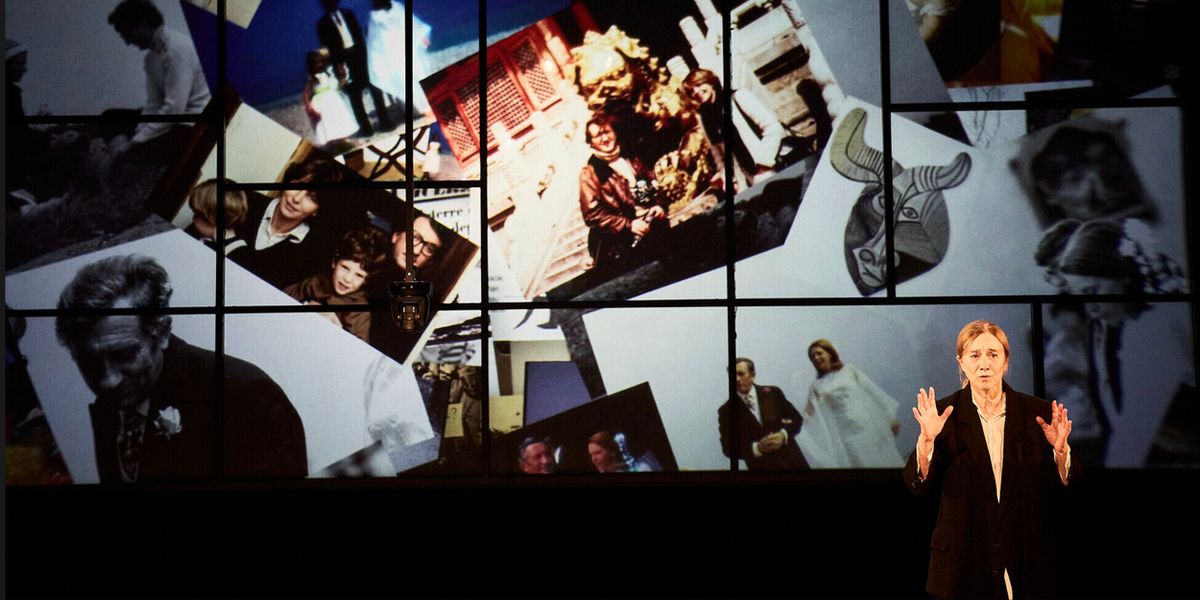
The accumulation of trauma over generations doesn’t dissipate. It settles into the bodies of its inheritors. In Camille de Toledo’s novel Thésée, Sa Vie Nouvelle, one person attempts to identify and, perhaps, emancipate themselves from the decades of accumulated terror and pain that have infiltrated the very water in their body. In a stage adaptation of the same name, now in performance at the Festival d’Avignon’s Autre Scène, Guy Cassiers translates this journey of discovery on the stage. It is an exquisitely crafted production whose immaculate surfaces occasionally blunt the unruliness of its subject. Yet Valérie Dréville’s commanding performance lends the evening a gravity that its dramaturgy alone struggles to sustain.
A woman, on stage, contends with a recent suicide in her family. This death is one of a lineage of deaths that have come from the hands of others, their own hands, and the hands of illness, that have marked her family tree. She stands over a platform of family archives, largely images, as she attempts to collect a sense of what she’s inherited. She makes points of discovery, registering the sadness that has transformed these quotidian or nostalgic items into relics. At the play’s conclusion, a camera, which has projected these images, pulls back to reveal that the accumulation is also her portrait. Bram Delafonteyne’s videography provides one portion of the scenographic polish that will elevate this evening.
The evening's greatest strength is Valérie Dréville. Some monologues make you forget that they’re monologues. You leave wondering, “How did one actor create such a multivalent experience?” Thésée, Sa Vie Nouvelle, however, places us in an unrelenting introspection. Many of her discoveries are well-worn: the body keeps the score, you can’t outrun history, your ancestors can haunt you with their trauma. Though Valérie Dréville’s performance turns what could have been a piteous drone into a Racinian soliloquy. She shapes Toledo's winding prose with the assurance of someone speaking thoughts rather than reciting literature, allowing each syntactic turn to register as an emotional shift. She speaks with the confidence of a poet reciting their own work, rather than an actor constructing an adaptation of a novel on the stage.
Dramatic polish elevates and perhaps hinders Thésée. There is an immaculate quality to every aspect of the piece. Zélie Champeau’s subtle lighting gives us the elegant, dramatic mind-palace that Dréville explores. Jeroen Kenens’s sound design makes a melancholic haze for her to meditate within. Yet this very precision works against the play's investigation of inherited memory. Trauma rarely presents itself as coherent. Family history is reconstructed through contradiction, accident, and incomplete evidence. With so much scenic confidence and precision, the work’s final moment of cohesion with the reveal of the portrait is presumed rather than discovered. The pieces have already fallen together.
Photo Credit: Christophe Raynaud de Lage
.
Recevez l'actualité de Broadway sur WhatsApp
Recevez les dernières mises à jour, les nouvelles de dernière minute et une couverture exclusive directement dans l’application.

|
FLASHDANCE - THE MUSICAL - FLASHDANCE Le Grand Rex (4/11-4/11) |
|
|
LA JALOUSIE RADIANT - BELLEVUE (3/06-3/06) |
|
|
SPIN OFF IMPRO CLUB AVIGNON (7/16-7/25) |
|
|
LES PETITES FILLES MODERNES TH DU ROND POINT-SALLE RENAUD BARRAULT (2/25-3/14) |
|
THE RISE LDLC ARENA (11/16-11/16) |
|
ORLANDO TH DU ROND POINT -SALLE JEAN TARDIEU (1/27-1/30) |
|
|
VELVET TH DU ROND POINT-SALLE RENAUD BARRAULT (1/07-1/10) |
|
Sofiane Pamart – Stade de France Stade de France (4/17-4/17) |
|
|
LA FOLLE JOURNEE OU LE MARIAGE DE FIGARO - LA FOLLE JOURNEE OU LE MARIAGE RADIANT - BELLEVUE (2/04-2/05) |
|
|
POTICHE RADIANT - BELLEVUE (1/14-1/14) |