


REVIEW: The Festival d'Avignon Presents 1,2,3 POQUELIN By tg STAN
Performing five such adaptations in 1,2,3 Poquelin at the Festival d’Avignon’s Carrière de Boulbon, they create a fantasia around France’s national playwright.
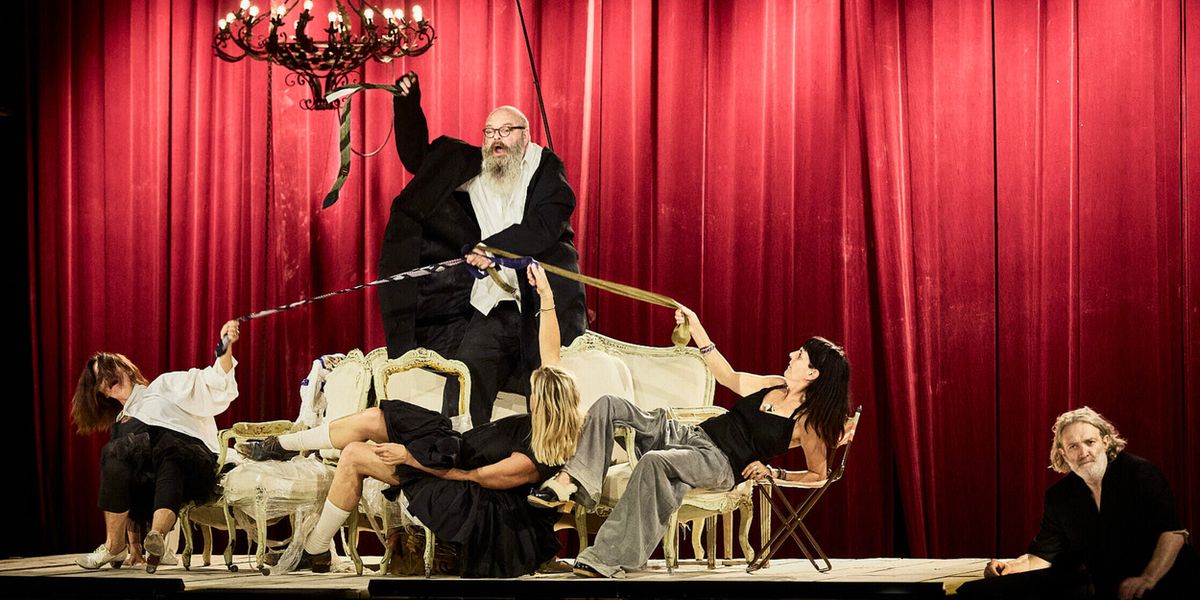
Molière is a surprising figure to hold such a central position in French culture. The image of France as sophisticated, understated, and elite extends only partially to his oeuvre. In practice, Molière’s theatre appropriated and elevated the popular Italian tradition of commedia dell’arte. The Belgian company tg STAN unleashes this popular energy in its performances. Cutting entire Molière plays into rapid-fire one acts, the company strips his plots down to their essentials. In this reduction, they reveal the fundamental theatricality of the playwright’s work. Performing five such adaptations in 1,2,3 Poquelin at the Festival d’Avignon’s Carrière de Boulbon, they create a fantasia around France’s national playwright.
The five pieces presented by the Belgian ensemble included The Forced Marriage, The Miser, The Learned Women, The Doctor in Spite of Himself, and The Hypochondriac. The energetic seven-person company (Robby Cleiren, Jolente De Keersmaeker, Damiaan De Schrijver, Els Dottermans, Tine Embrechts, Bert Haelvoet, Willy Thomas, and Stijn Van Opstal) performs approximately forty roles over the course of the evening. The company distributes the material democratically, ensuring that each performer has moments that capture the audience’s attention. I was particularly delighted by their treatment of The Learned Women, a work I admit I had not encountered before this production. The performers approached Molière’s comedy through the lens of contemporary drag and even recalled the absurdity of the English television series Absolutely Fabulous. The result modernized the play while remaining attentive to its original comic impulses.
A company of this caliber could easily present a performance without visible imperfections, or, as is more common in live theatre, with a level of professionalism that conceals the cracks. This is not tg STAN’s objective. Forgotten lines produce calls to the prompter offstage. Unexpected discoveries send actors into laughter. Improvisation, both planned and spontaneous, interrupts the action, while blocking remains fluid and unpredictable. This looseness created a circus-like atmosphere within the quarry, with audience members drinking beer and eating popcorn from their seats. Rather than presenting a vision of Versailles, the production returns Molière to his popular theatrical origins. Breathless monologues and rapid exchanges highlight the playwright’s extraordinary command of language; many of the evening’s greatest laughs belong entirely to Molière. Yet the texts are never treated as sacred objects. Within tg STAN’s collective spirit, the plays become playgrounds.
Alongside moments of genuine theatrical panache, the intentionality of the design elements elevates the production beyond self-indulgent buffoonery. The set, two chandeliers suspended from scaffolding behind the elevated stage, evokes the dual inheritance of Molière’s theatre: both aristocratic spectacle and popular entertainment. One chandelier hangs above the action at the top of the quarry, glowing like a lighthouse. Luc Schaltin’s lighting design guides the evening between moments of collective celebration and concentrated theatrical atmosphere. Inge Büscher and And’Huys’s utilitarian yet vibrant costumes similarly establish distinctions between the performers and the many characters they inhabit throughout the evening.
After four and a half hours spanning five plays the production begins to loosen. More calls go out to the prompter and more props are misplaced, including the clever foam pool noodles used to stage the numerous beatings that recur throughout Molière’s comedies. Although the company maintains a remarkable level of quality throughout the performance, the extended duration inevitably produces fatigue and diminishing returns. Perhaps a company so connected to street theatre traditions might find an even more fitting home within the city itself. I hope tg STAN returns to the Festival d’Avignon, where the festival’s heart might become part of their theatrical vocabulary. While their evening-length fantasia occasionally grows weary, greater itinerancy through the city or a more varied spatial arrangement could offer new possibilities for exploring the dramatic vitality at the heart of Molière’s work.
Nevertheless, after spending an evening in the Carrière de Boulbon, I found myself newly intrigued by the theatrical foundations of la langue de Molière, not as a monument of French cultural prestige, but as a living, unruly, and profoundly popular force.
Photo Credit: Christophe Raynaud de Lage
Prefer BroadwayWorld in Google Search?
Add us as a preferred source so our stories show up more often in Top Stories and Google’s AI answers — for you.
Recevez l'actualité de Broadway sur WhatsApp
Recevez les dernières mises à jour, les nouvelles de dernière minute et une couverture exclusive directement dans l’application.

Sign up for all the news on the Fall season, discounts & more...
|
RADIO LIVE : VIVANTES TH DU ROND POINT-SALLE RENAUD BARRAULT (5/28-5/30) |
|
SO CULTE ! - SO CULTE ! NOS ANNEES 90 BOBINO (2/26-4/25) |
|
|
RADIO LIVE : NOS VIES A VENIR TH DU ROND POINT-SALLE RENAUD BARRAULT (5/29-5/30) |
|
|
BERNARD WERBER CASINO PARTOUCHE DE HYERES LES PALMIERS (10/16-10/16) |
|
|
UNE HISTOIRE DE FRANCE RADIANT - BELLEVUE (11/27-11/27) |
|
|
LE TEMPS DE VIVRE TH DU ROND POINT - SALLE ROLAND TOPOR (6/09-6/13) |
|
|
DIRTY DANCING - LE TRIBUTE - DIRTY DANCING THEATRE SEBASTOPOL (4/18-4/18) |
|
|
SIMON NOENS - SIMON NOENS DERNIERES DATES AVANT L OLYMPIA THEATRE DAUDET (5/21-5/21) |
|
|
AILLEURS STUDIO DES CHAMPS-ELYSEES (9/30-12/30) |
|
|
COEUR DE BRETAGNE LE LAPS - PARC DES EXPOSITIONS (11/21-11/21) |
