Lena Hall on Grief, Loss & Your Friends & Neighbors
Hall plays the character of Ali Cooper in the Apple series.
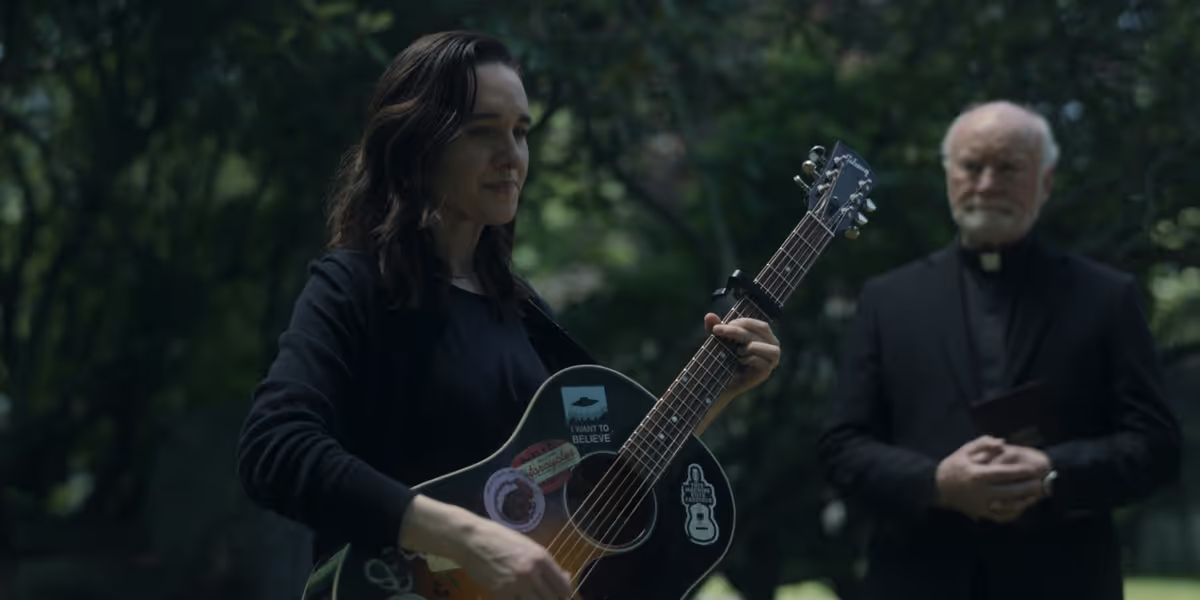
For creatives, art can often make a habit of imitating life. Feelings or opinions drawn from one’s own experiences can consciously or unconsciously end up in the work; that is part of the job. But rarely does it occur as explicitly and profoundly as it did for Lena Hall while filming the second season of Your Friends & Neighbors.
“I didn't really know where we were going with the new season until maybe a week before we started filming,” says the Tony-winner during an interview with BroadwayWorld. “I heard a little bit here and there about my character getting a job and becoming more independent. But as far as everything that happens, I was not as privy to that until a little later. And it's interesting; a lot of it was really, really fun to read. And then some of it, of course, was much, much more difficult.”
In the Apple series, Hall plays Ali Cooper, the sister of Jon Hamm's central character, known to most as "Coop." While he is off stealing from his neighbors (as he is wont to do), Ali faces her own challenges as a woman living with mental health struggles, as depicted in season one.
As Hall points out, Ali is gaining some independence this time around. In season two, she has found a new job as a music teacher, and, overall, things seem to be looking up for the character. But everything comes to a halt at the end of last week’s episode when Coop and Ali’s father, Ron, unexpectedly passes away. The real-world links of this story arc are astonishing. While “acting” the role of a grieving daughter onscreen, Hall’s real-life father lay dying at the same time.
“At any moment, I was waiting for a phone call to tell me that he had passed,” recalls Hall. “It felt like I was in The Truman Show or something… like the universe had planned this thing for me to go through before I actually had to go through it myself.”
Indeed, the latest episode dedicates its runtime to a poignant and honest exploration of grief and the complicated feelings and behaviors that arise following the death of a loved one. Much of the action unfolds at Ron’s celebration of life, held at the Cooper family home. Director Stephanie Laing’s camera oscillates between various perspectives and points of view, from Coop to Ali to the assorted mourners. The camera weaves throughout the house, inviting us inside a celebration full of bewildered, grieving people. This has a slightly surreal effect, even otherworldly. That is, of course, exactly the point.
“I believe that was meant to feel almost like the father was there, walking and watching everything happen,” Hall shares. “When you're dealing with the death of a family member, it is very out of body. It does not feel like it happened.”
As the episode plays out, we watch as the family members—Coop, Ali, and their mother, Marley—process their grief in wildly disparate and isolated ways. Hall witnessed this herself in her own family when her father did indeed pass away shortly after filming wrapped.
“[My mom’s] response to her grief of losing her Best Friend of 51 years was not what I expected. And it was very different from what I was experiencing and very different from what my sister was experiencing,” she notes.
“Grief has so many different sides to it. It's so very complex. There's anger in grief, there's comedy in grief…. What's so great about that episode, in particular, is that it takes that numbness of grief, and it also colors it with all of the other things that happen when you do lose a parent.”
One of those “other things” is sorting through a parent’s personal items and deciding what to do with the tangibles that are inevitably linked to the person. Hall admits that she doesn’t generally attach much sentimental value to objects, “but looking at my father's room and all the things in that house is a totally different game because that person no longer is there.”
In the show, this is represented by Ron Cooper’s belt and television set, the fates of which become a subject of disagreement among family members. For Hall, it was a mermaid sculpture loved by her dad, hated by her mom. And then there was the case of the waterbed.
“My father had this waterbed in his room for like 60 years. [It] is where my sister and I were conceived. So much happened on that waterbed,” Hall explains. “Literally, the morning after the memorial, the waterbed burst. It was like my dad saying, ‘All right, move on. It's time.’ And I had to clean up the waterbed and siphon all the water out and say goodbye to the waterbed right after the memorial.”
Looking back at her own childhood, Hall remembers being taught about the importance of failure in her creative pursuits. This attitude of openness continues to fuel her as an artist whose work spans the mediums of stage, music, and the screen.
“A lot of people stop themselves because they're afraid of failure… But what's really interesting is that failure is the only way that you can create anything new. Failure is what teaches you what works and what doesn't.”
Her creative ambitions have led her to Tony-winning roles in Broadway shows like Hedwig and the Angry Inch and television projects like Snowpiercer. It was that series that allowed her to become more comfortable in front of the camera, a required quality for her eventual turn as Ali.
“There's this thing in your face that is not human. It's a camera… And so to open up in a way that is telling of your vulnerability and let the emotion show is a skill that was very difficult for me to click into until later.”
This season, Hall continues to showcase her musical talents as the character. Often accompanied by a guitar, she performs renditions of songs like Warren Zevon’s Keep Me In Your Heart and Neil Young’s Come a Time, the latter of which she sings for Ron earlier in the season.
After the celebration of life, the latest episode culminates with Coop taking a trip to a bowling alley that he used to frequent with his dad as a kid. In a poignant moment, he looks on and sees a vision of his father as he used to look.
Having now been through this experience with her own dad, Hall appreciates how the show depicts the complex, often surreal feelings that remain after such a death. “When Coop opens his eyes and sees his father or feels his father, that is so relatable because there are times where I feel my dad right there with me… It's beautifully done.”
The latest episode of Your Friends & Neighbors is now streaming on Apple TV. A new EP of songs from the series, performed by Hall, is now available and can be streamed below.
Photo Credit: Apple
Sign up for all the news on the Fall season, discounts & more...
.jpg?format=auto&width=300)