


Art as Activism: Dr. Nicole Johnson Is Lighting Pathways to Liberation
Johnson is an artist, researcher, strategist and founder of the Harriet Tubman Effect.
Art as Activism on Broadway is a recurring series exploring how theater can move beyond entertainment to serve as a catalyst for social change, advocacy, and cultural dialogue. Through the Harriet Tubman Effect, Dr. Nicole Johnson is using storytelling, imagination and intentional action to transform who gets to create, lead and experience theater.
Dr. Nicole Johnson believes imagination is as necessary to liberation as water is to the body.
Not an added luxury. Not something we reach for only after the real work is finished. Water. The very source that keeps us alive.
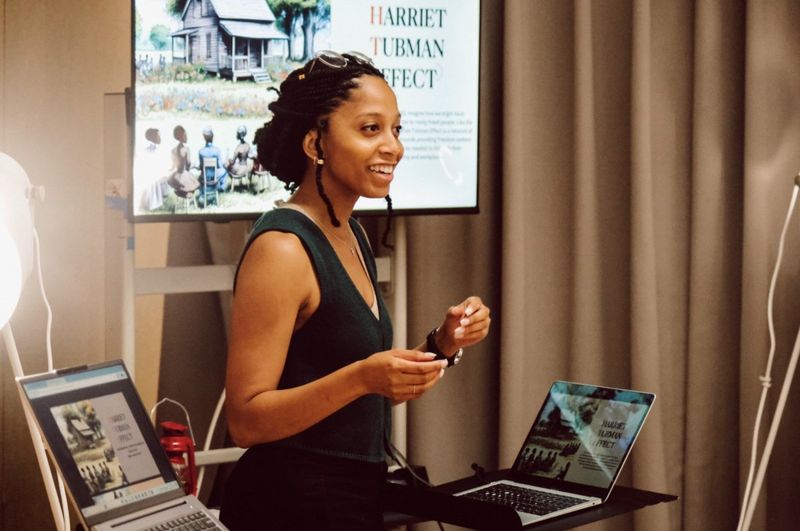
Photo Credit: Eva Woolridge
“If liberation is survival and liberation is life, I think imagination is water,” Johnson told me. “It’s so necessary. I was just thinking about this this morning, that I’m craving a bit more inspiration and imagination. It’s because I haven’t shifted my environment. It’s kind of like drinking the same water. Sometimes the water is a bit dry. There is literally not enough where I’m at, and so I have to go seek that out to quench my thirst, but also to reactivate my organs, coat my throat and activate my mind.”
When I first met Nicole about three years ago, I felt like I was out on a no man’s island, drowning in the disappointment of what I imagined this industry would be for me.
I was still trying to find my footing and questioning whether there was space for the kind of artist and human being I wanted to be. Then I listened to Nicole speak in a meeting about the responsibility we have to be intentional about artist care. She spoke about centering humanity in artistry instead of treating artists like parts in some transactional machine.
At a time when I was struggling to keep my head above water, her words gave language to something I had been feeling but could not yet name. I became intentional about following her work because care can be felt, even from a distance.
Three years later, it was an honor to sit down with her and learn more about the human being behind that care.
Johnson is an artist, researcher, strategist and founder of the Harriet Tubman Effect, a collective of leaders working to dismantle systemic oppression through storytelling. But long before she began transforming systems, she was a young musical theater performer using art to advocate for someone she loved.
Her younger brother is autistic. While Johnson was living, studying and performing in New York, her family remained in Florida. The distance made her question whether she was fulfilling her responsibility to him as his older sister. Instead of sitting with that feeling, she created something.
“My first production that launched my nonprofit company was a dance showcase called Move for Autism,” she explained. “From that point on, it was clear that I was going to be producing socially conscious work, and it was also clear that the activism, as I defined it, was very familial. It was trying to advocate on behalf of my brother. And then I was hoping that I could help other people advocate for things that they were passionate about or for causes that were close to them.
The nonprofit was called MOVE, which stood for Motivation, Opportunity, Vision and Entertainment. Johnson started it while she was still in high school. Even then, she was thinking about how community dialogue, performance and language could help people name what they were experiencing.
“I’ve always been someone who’s leading people, dating back to early student council days in middle school and elementary,” Johnson said. “I feel like the concept of being a founder, which today I really define more as someone who has the quality of life of other people underneath their decision-making, I’ve always kind of been that type of person.”
That definition of a founder says a great deal about Johnson. Leadership, in her understanding, is not rooted in ownership or authority. It means accepting that your decisions can help shape another person’s life.
Over the years, Johnson carried her creativity into government, education, technology and theater. She worked as a creative within the Department of Education, New York City government and startup culture. She never saw her artistry as something she had to leave behind when entering a different field. Instead, she brought the artist with her.
“At my heart, I was a musical theater, dance ensemble performer,” she said. “I was very multi-hyphenate even before I stepped into my founding role at Harriet Tubman Effect.”
That artistic foundation is essential to understanding the Harriet Tubman Effect. While it is often described as a research institute, human resource community or collective, Johnson sees it as something larger and more alive.
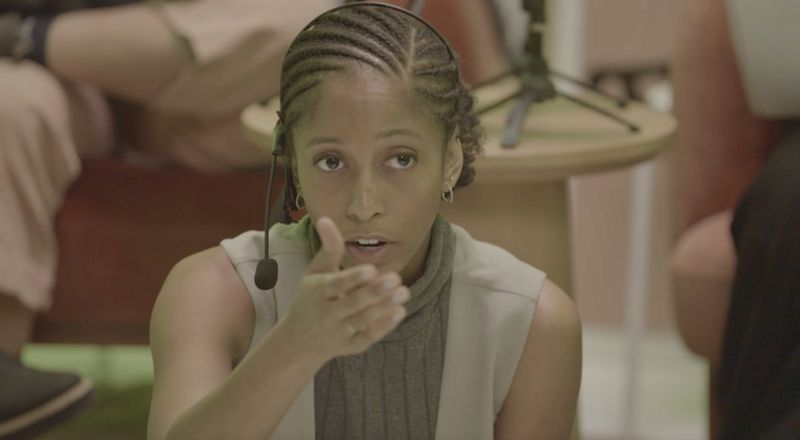
“For me, Harriet Tubman Effect is a culture,” she said. “It’s a culture that is really anchored in values.”
Those values include research as learning, reallocating wealth, creating relevant work, activating a culture of empathy and resisting white supremacy culture.
“We take the research from the field to better understand what it means to know that our institutions and our communities were built on enslaved labor and that many of the characteristics of our workplaces are still rooted in very old, traditional modes of commerce,” Johnson explained.
The goal is not simply to establish another organization that people visit when their institutions are in crisis. Johnson wants the values, practices and resources of the Harriet Tubman Effect to permeate how people work, communicate and care for one another.
“That was always my goal for Harriet Tubman Effect, that it wasn’t this one organization in a building that people come to, but it’s something that permeates our behaviors, our societies, the way that we communicate with one another,” she said. “I think we’re growing and becoming that much more effective by being able to be more like a culture than an organization.”
It is a vision rooted in the legacy of Harriet Tubman, not simply as a symbol of courage but as a strategist, organizer and architect of pathways to freedom.
Johnson and the Harriet Tubman Effect often draw upon Tubman’s leadership during the Combahee River Raid. Tubman helped orchestrate an operation that liberated more than 700 enslaved people in South Carolina. Johnson places the size and complexity of that effort in language theatermakers can immediately understand.
“We talk about how 700 people is like seven Off-Broadway theaters literally trying to activate and move people,” she said. “You think about moving people down the streets of New York, and it would be crazy. But Harriet’s doing this with a language barrier, with so many other obstacles, with gunfire, with violence.”
Johnson is interested in the details of Tubman’s work. The planning. The communication. The movement of people and resources. The understanding that liberation requires more than hope. It requires structure.
That same clarity shapes Johnson’s understanding of activism.
“I think activism needs clarity and structure and strategy and scaffolding,” she said. “Our systems are very complex, the ones that exist and that have been oppressive. So then why not create very intentional, detailed, complex systems that do something different?”
For Johnson, intention is not the enemy of artistic freedom. It is part of the art of creation.
“I want you to know why I created this,” she said. “I want you to know what my goals are. And I want it to hit the audience in a way that I can design.”
Johnson does not believe storytelling becomes irrelevant when it is time to do the harder work of changing institutions. For her, storytelling is the work.
“We really believe that storytelling has the power to do all of the things,” she said. “When is it not enough? When do we need to do more? We actually think storytelling can do it all.”
She describes storytelling as operating across four interconnected levels.
“So we think that on the intrapersonal level, the stories you’re telling yourself change your behavior,” Johnson explained. “On the interpersonal level, the stories that you’re telling others about the potential for something new, for a new system, for a new onboarding practice, for a new way of orchestrating in the theater, we think those stories can change the way that we expect things from one another.”
The stories institutions tell reveal what they value and whether their policies hold them accountable to those values. On a societal level, new stories can shift the culture itself.
“If we’re telling new stories with new characters, new behaviors, new expectations of human existence, we’re essentially changing the culture on a societal level,” she said. “Because really, it is all about what we believe.”
But it is not only about the story. It is also about who has the opportunity and authority to tell it.
“Who are they choosing to tell the actual story?” Johnson asked. “Is it a Black woman, a Black cis hetero woman? Is it a trans Latina person who’s telling the story? Perhaps it changes our ability to change the systems. There’s so much in storytelling that I’m really excited about, and I feel like it is actually our main tool. We just haven’t tapped it enough, and there’s not enough of us telling different stories.”
Johnson believes art is inherently political because it is created, shared and interpreted by people whose perspectives have been shaped by the world around them.
“Because it’s from people and viewed by people and received by people, I do think it’s inherently political,” she said.
Yet art becoming activism requires another layer. It requires intention.
“I think intention is a lost art in many of our communities,” Johnson said. “The idea that says, ‘I have a goal. I have learning goals for what I want to share. I have goals beyond my own personal expression.’”
That intention is visible in Lantern Tix, an accessible ticketing initiative developed through the Harriet Tubman Effect community. The work grew out of Johnson’s experience with the Broadway revival of Into the Woods, where she collaborated with Gavin Creel, Sara Bareilles and others to reconsider who was invited into the opening-night experience.
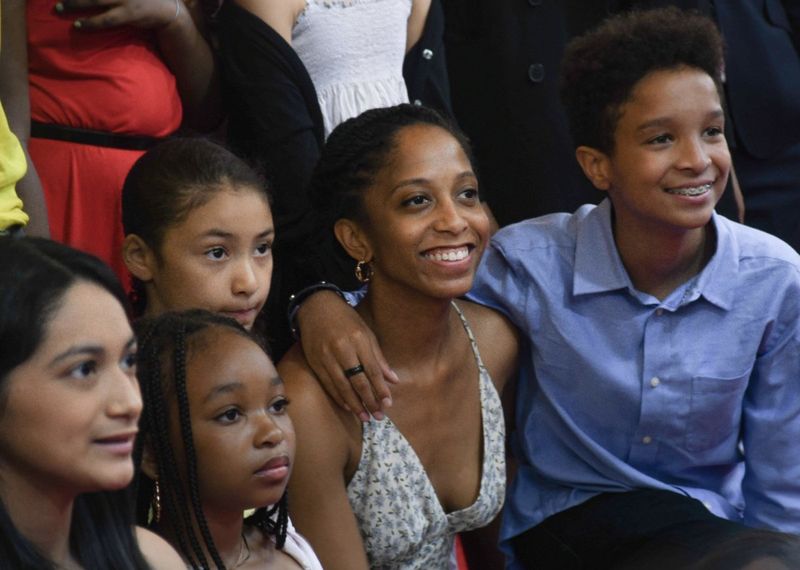
“We would have 50 people of different class and race backgrounds in the front rows and walking the carpet,” she recalled. “It started off with this really cool opening of the gates, breaking down the barriers to let different people experience this.”
Members of the cast and crew dedicated some of their opening-night tickets to the effort. Johnson describes the choice as a reallocation of wealth and value.
But access could not begin and end with placing someone in a seat. Johnson and Harriet Tubman Effect researcher, Joe Hetterly, wanted audience members to receive the full theatergoing experience, including the communication, information and sense of belonging that often accompany a traditionally purchased ticket.
“We began to think, what is it like to make sure that there is integrity in the process of making sure people can afford a ticket, but they’re still experiencing everything?” she said. “You get the whole experience of being a part of the community instead of just a basic comp, but it’s still an affordable ticket.”
That required designing a new pathway, one that respected the value of the art while acknowledging that traditional Broadway prices place theater beyond the reach of many families.
“If you want to bring your whole family of six, you can’t buy six $99 tickets,” Johnson said. “You need a different price point.”
The initiative has since inspired accessible ticketing efforts across numerous productions. More important than the number of tickets distributed is what can happen after someone enters the theater.
“It’s a ticket that we negotiated how to create a pathway for, and it ends up taking a young person all the way through perhaps their high school experience into where they go to college,” Johnson said. “You just never know what kind of pathway you’re creating and what the impact is going to be.”
Johnson connects that pathway directly to Tubman’s legacy.
“We wanted to create pathways to cultural access, and we were going to design the pathways and introduce them to theater owners, producers and the public,” she said. “Our effort in reallocating our time to figuring out what those pathways are and pushing down the barriers is an example of what Harriet did in creating pathways to freedom for so many other people. We think of it as lighting lanterns to get to a seat.”
It would be easy to discuss Johnson only through the people, organizations and systems she helps transform. But she is also reclaiming art as a place for her own voice.
“I’m an animator, and I’ve really begun to realize that I can experience art in lots of different ways,” she said. “It’s very important for me, as a Black woman who has not really used art as personal expression as much, to start doing that.”
For Johnson, making space for her own artistic expression is also a form of activism.
“It’s activism within my own sphere,” she explained. “Advocating for myself, advocating for my voice, saying that it’s worthy of space. That’s representation work.”
That act of self-advocacy has required Johnson to unlearn the belief that her value is determined by how much she gives to everyone else.
“My effort does not determine my worth,” she said. “My effort to help other people doesn’t say that I am valuable if I help them enough or if they are successful. I have a different life than them, and I should separate it. I can offer what I can offer, but my offering cannot be the thing that makes them grow. That can’t be the equation.”
When Johnson needs to be transformed herself, she returns to water. She lives in Florida so she can be closer to nature. She practices Tai Chi and Gong fu cha tea. She travels and immerses herself in other languages, cuisines and cultures. She intentionally creates experiences in which her body can be cared for.
“My body needs to be cared for,” she said. “Particularly my body as Nicole, who gives so much to so many other people. I have to care for myself even more because I’m out here creating large systems and doing direct giving work. I’m doing a lot of service.”
It is another kind of pathway. A route back to herself.
As Nicole sat outside in nature answering my questions, I could hear the same care that first drew me to her work three years ago. This time, I was not listening from the other side of a group call. We were in conversation about artistry, liberation and what it means to create systems that allow people to remain fully human.
At the end of our interview, she said, “I’m proud of you, friend.”
That feeling flows right back to her.
I am proud of Nicole, and I am grateful for her unwavering commitment to creating pathways of care, access and liberation for anyone who needs them. We all need them.
Johnson is not only asking us to imagine freedom. She is asking who has access to imagination, who has the time and safety to cultivate it and what systems must be transformed so more people can participate.
“We’re responsible for our imagination, for cultivating it,” she said. “We have to find ways to make sure that we value imagination. And then, how can we make imagination more accessible for other people? How can we all be sitting around engaging with the key to our liberation?”
Then she asks the questions that sit at the heart of her work.
“Who has access to water? Who has access to imagination? Who has the time for it? Who’s bogged down and navigating trauma so they can’t even access their imagination? That’s the work that I’m really excited that I get to do.”
For Nicole Johnson, imagination may be the water, but the work is making sure everyone can drink.
And perhaps that is what art as activism looks like in practice. It does not only tell us freedom is possible. It lights the lanterns, clears the barriers and creates a pathway for all of us to reach it.
Prefer BroadwayWorld in Google Search?
Add us as a preferred source so our stories show up more often in Top Stories and Google’s AI answers — for you.
Sign up for all the news on the Fall season, discounts & more...
.jpg?format=auto&width=300)
.png?format=auto&width=365)




