

Review: DEATH OF A SALESMAN at Adelaide Festival Theatre, Adelaide Festival Centre
Miller's classic play get a new lease of life.
Reviewed by Barry Lenny, Sunday 27th September 2026.
Arthur Miller’s Pulitzer Prize-winning two-act tragedy, Death of a Salesman, subtitled Certain Private Conversations in Two Acts and a Requiem, premiered on 10th February 1949. It’s age hits home personally. I was born one week later. This production, directed by Neil Armfield, opened in Melbourne in 2023, in Sydney in 2024, and has finally come to Adelaide. Armfield has assembled a sensational cast and created an powerful and relevant interpretation of Miller’s play.
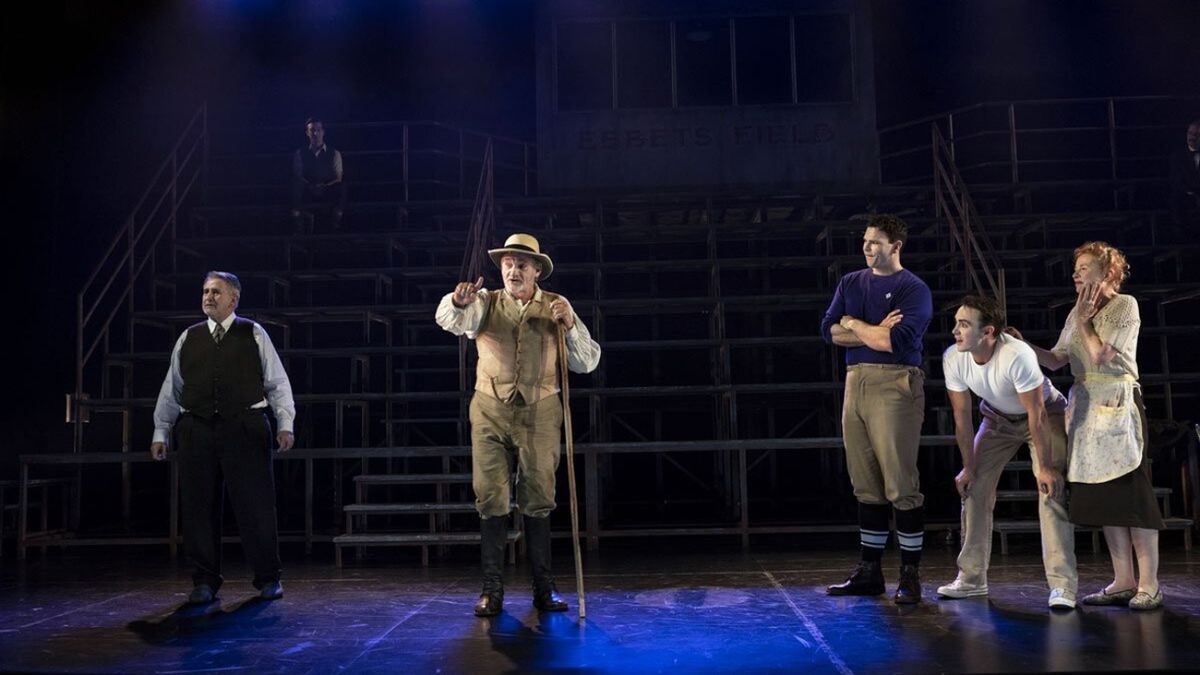
The set design, by Dale Ferguson, who was also responsible for the costume design in association with Sophie Woodward, is the bleachers at Brooklyn’s Ebbets Field baseball and gridiron stadium, where a young Biff Loman was once expected to have begun to build a career in football. Costume changes help to delineate between past and present. The members of the cast sit, spaced around the bleachers, those who are not currently involved in the action at the front of the stage watching and reacting to all that is happening.
The American classic opens in the Brooklyn apartment of 63-year-old Willy Loman, a travelling salesman with the Wagner Company. Anthony LaPaglia plays the central role, Willy Loman, a man at the end of his tether. He is failing in his work but suffers from the delusion that he is still successful, and important to the company. He no longer has a base salary, though, his income having been reduced to commission only, his poor sales meaning a minimal income and struggling to make ends meet. His travelling is proving physically hard on him. Begging for a transfer to a position at the home office results in his dismissal by Howard Wagner, the son of the man who had originally hired him. His delusion extends to his two sons, Biff and Happy, whose successes and glowing futures are all in his own mind. He refuses to accept the truth of their failures and inadequacies.
LaPaglia enters struggling under the weight of two large suitcases, and the weight of failure. He speaks to his wife, Linda, of his mind wandering while driving, losing a degree of control of his car, and confusing it with a car he had driven long ago. His sales had been poor, his commission nowhere near enough to pay outstanding bills. LaPaglia takes only moments to create a clear picture of Willy Loman, and he maintains that complex character coherently through all of Willy’s highs and lows, the positive moments, the gentleness with Linda, and the blazing rows with Biff. He gives a remarkable performance, nuanced and deeply moving, presenting the many facets of Willy through his actions, and his interactions with others.
Willy is a small man who only sees the small picture. Times and circumstances change, but Willy did not. He still believes that his ‘hail fellow, well met, attitude to his buyers works as it once did, but the new, younger buyers no longer treat him like a friend. Pats on the shoulder no longer relate directly to sales figures. It has all become strictly business post-war.
Alison Whyte is truly wonderful as his loving and supportive wife, Linda, the rock on whom the family is built. Whyte clearly displays Linda’s devotion to Willy, defending him against her sons, when necessary, worrying about his state of mind, and erupting in fury at them when the boys’ disrespect goes too far. It is a superb performance, Whyte beautifully displaying Linda’s anguish as her control of the dysfunctional family collapses.
Josh Helman plays the older son, Biff, the ‘golden boy’, once expected to become a college football player, but failing to pass maths to gain college entry, after refusing to accept tutoring help from Bernard, the neighbour’s nerdy son. He left home and roamed from state to state, rural job to job, and has come home to visit after many years away. Helman shows Biff’s inner conflict, knowing that he is not, and never will be what his father expects, and trying hard to make his father see his truth. Helman’s fine performance brings out Biff’s frustration at being unable to get through to Willy, coupled with the anger and disappointment of the long-held secret that they carry.
Ben O'Toole appears as the indolent younger son, Harold, known as Happy, stuck in a low-level job in which his efforts are minimal, while allowing Willy to believe that he is following in his footsteps as a salesman. He and Biff were sports ‘jocks’, well built and good looking, relying on those temporary attributes for their future success, and later realising that it was not enough. He stayed home, comfortable, achieving nothing of note. Like Biff, he is a womaniser and braggart, perhaps worse than Biff, considering it a real success if he seduces a woman who is already in a relationship. O'Toole does a great job as the arrogant, lying younger brother, feeding on his father’s gullibility.
Marco Chiappi is the Loman’s neighbour, Charley, who plays cards with Willy and now offers the now unemployed man a job, which he rejects due to misplaced pride. Charley goes on to give Willy money whenever he asks, each time the bills arrive. Willy swears that he will pay him back, but Charley knows that will never happen. Chiappi presents Charley as a kind, generous man in a warm characterization.
James Smith is Charley’s studious son, Bernard, mocked in his youth by Biff, Happy, and Willy, and now a lawyer about to address a case in the Supreme Court. As the youth, Smith is suitably gangly and overenthusiastic and then, as the older man, every bit the highly successful lawyer.
Luca Sardelis plays Jenny, Charley’s secretary whose voice is heard in announcements, and as Letta who, along with Elizabeth Blackmore as Miss Forsythe, are approached by Happy at Frank’s Chop House, and leave with him, Biff reluctantly following them, leaving Willy alone, a broken man. They are both vivacious as the good-time girls.
Willy’s deceased, wealthy brother, Ben, from whom he had been estranged for many years, is played by Anthony Phelan. He claims to have walked into the jungle at 17 and walked out again at 21, a rich man. Willy talks to Ben in an hallucination, believing that his late brother has endorsed his plans. Phelan is an imposing presence as Willy’s older brother.
Paula Arundell plays The Woman, whom a young Biff catches in flagrante delicto with his father in a Boston hotel room, a receptionist who is paid for her sexual services and the promise of easy access to her company’s buyer, with pairs of stockings, an event that affects Biff’s future choices. She brings a joyful playfulness to the role.
Mark Saturno plays the distracted Howard Wagner, who is absorbed in his new wire recorder (a precursor to the tape recorder) and who fires Willy with no qualms, and also plays Stanley, a busy waiter at Frank’s Chop House where Happy is waiting to celebrate with Biff and Willy, and meets Miss Forsythe, who leaves to bring her friend Letta to make up a foursome with Biff. Saturno builds two very different characters, especially endearing as Stanley, who treats the abandoned Willy with kindness.
Niklas Pajanti has created a subtly changing lighting design and the music from composer Alan John, coupled with the sound design by David Greasley and David Tonion equally subtly underscore the action.
The standing ovation and thunderous applause at the bows was entirely expected, and thoroughly deserved by every member of the cast. Do whatever you can to get tickets. The production only runs until Sunday 4th October, so don’t delay.
Sign up for all the news on the Fall season, discounts & more...

|
Vanya and Sonia and Masha and Spike Little Theatre (10/09-10/18) |

|
The Heartbreak Choir State Theatre Company South Australia (11/20-12/05) |
|
The Shawshank Redemption Her Majesty's Theatre (4/01-4/11) VIDEOS |

|
Log Boy State Theatre Company South Australia (10/01-10/10) |

Reader Reviews
To post a comment, you must register and login.