


Review: RUTH, Wilton's Music Hall
This musical based on the life of the last woman to be hanged in the UK makes its world premiere

 In a staging device that feels made for the cavernous Wilton’s Music Hall, Bibi Simpson as convicted murderer Ruth Ellis addresses the audience with aristocratic authority, a tiny figure within an isolated prison cell. We are instantly drawn into her world, witnesses and voyeurs to her version of events, and active participants in the birth of her notoriety.
Framing this tale of the last woman to be hanged in Britain, by debut musical theatre writer Caroline Slocock, is a deathbed conversation between Ruth and her soon-to-be executioner Albert Pierrepoint (Ian Puleston-Davies), who takes on an avuncular aspect in this adaptation, gently coaxing Ruth to a greater degree of sympathy for her past self. In classic biopic fashion, this is interspersed with episodes that have led Ruth to this point, for which she proves to be an intriguingly unreliable narrator.
Me-Li Yap is Ruth as a teenager being abused by her father, which feels tacked on rather than properly explored; Yap being double-cast as one of Ruth’s fellow nightclub hostesses later on is confusing rather than elegant. Far more convincing are the events leading up to Ruth’s 1955 murder of the racecar driver David Blakely, acted out with a level of artifice that never lets us forget that this is a story elevated to legend by the tabloid press. “Going through the motions, like an actress in a play,” as Ruth sings at one point.
In this part of the timeline Ruth is played by Hannah Traylen who, along with Connor Payne as Blakely, is compelling in her portrait of a woman trapped in a cycle of domestic violence both by circumstances and by genuine love for her partner despite constant mistreatment. At the same time, she’s considering marriage to awkward accountant and prototypical ‘nice guy’ Desmond (John Faal), who the narrative is careful to remind us in fact shared some guilt for Blakely’s murder.
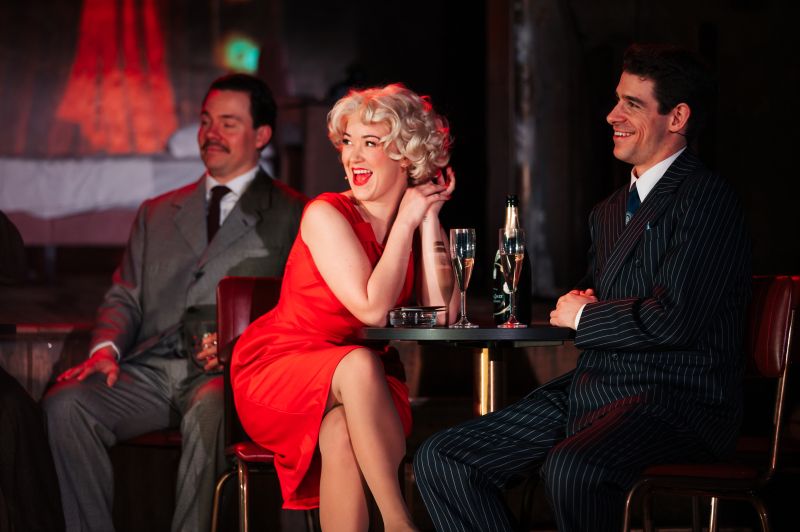
Photo Credit: Charlie Flint Photography
This all just about straddles the line between sordid and unflinchingly honest about the lives of sex workers in 1950s London. While there are some elaborate swing dance numbers and smoky cabaret numbers, there is also raw acknowledgement of the types of sexual violence faced by Ruth and her friends, and of the societal dominance of the privileged male perpetrators (as immortalised in a memorable comic song called ‘Hypocrites’). When the action shifts in Act Two to an overlong courtroom dramatisation, one guiltily misses the tawdry honesty of the nightclub scenes.
Accompanying Slocock when it comes to the show’s music are three other lyricists and composers, and sometimes the effect is of too many cooks. The musical style here is an eclectic mishmash of belty ‘I Want’ songs, quirky 60s girl group-inspired ditties and crooned ballads. Facile lyrics (“look, in my hand, a gun”), meanwhile, serve to disrupt rather than enhance some otherwise well-written dialogue.
Mostly, though, this feels like Chicago with slightly more narrative sophistication. The interest in Ruth is not in her crime itself, but in the enduring fascination and compassion for Ruth it has inspired, which we see develop in real time in the figure of Pierrepoint. The figure of Ruth in her prison cell is a figure of defiance, a kind of Greek chorus warning us against either overromanticising or dismissing the motives for her crime as depicted on stage.
Read our guest blog from Ruth's writer Caroline Slocock here.
Ruth plays at Wilton's Music Hall until 28 March
Photo Credits: Charlie Flint Photography
Sign up for all the news on the Fall season, discounts & more...
.jpg?format=auto&width=300)





Reader Reviews
To post a comment, you must register and login.