


Review: TRAVIATA May Not Be in Opera’s ABCs But Jaho Gives Lesson in Making It Her Own
AIDA, BOHEME, CARMEN Are Supposedly the Ones to Beat—But the Met Audience Fell for Verdi’s Fallen Woman
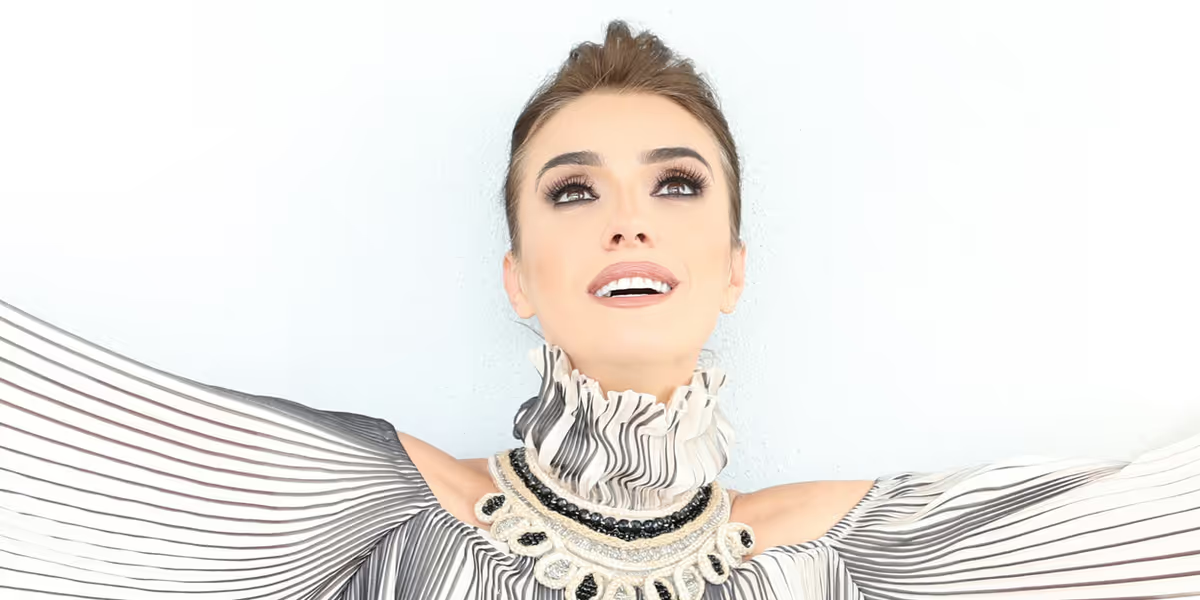
Albanian soprano Ermonela Jaho wasn’t the first Violetta of this season’s LA TRAVIATA by Verdi at the Met. That means less rehearsal time and preparation in general—but you could have fooled me and the rest of the audience at Wednesday’s performance. She was in tiptop shape, after a bit of warming up, as if she’d been working in this production every day of her life. She doesn’t make her way to New York very often, but it’s certainly a welcome visit.
Violetta (the Parisian courtesan in failing health) is one of Jaho’s calling cards and she certainly brings her own touches to it. With carefully shaded line readings and nuanced singing, she makes it sound like she’s spent lots of time with the score so she could emulate the emotions of the heroine, both shown and implied. I’d heard about her intense interpretation but descriptions don’t do it justice. Whether singing about her love of freedom in “Sempre libera” or in her death scene, “Addio, del passato,” she was riveting.
She had an interesting pairing with tenor Kang Wang, his first major role at the Met, though he’s had a decade of smaller parts (ROSENKAVALIER’s Italian Singer and SALOME’s Narraboth have been the largest).
He was an unusually callow Alfredo: While he was certainly capable of bedding Violetta, you could also imagine him as a gamer, with a short fuse but plenty of charm when called for (notably in his duet with Violetta, “Libiamo” and his aria “Dei miei bollenti spiriti”). With an appealing voice and stage presence (not to mention steady high notes), he’s the kind of performer always welcome at the Met.
As Alfredo’s father Giorgio, baritone Lucas Meacham has the opera’s most problematic role: You have to find him a loving father trying to protect the reputation of his daughter, while he puffs out his chest as a know-it-all who bullies his son and basically banishes Violetta. He does well with his two distinctive arias (“Pura siccome un angelo” and “Di Provenza”) but there’s little to grasp onto with a “heavy” whose actions are hard to forget.
The Met orchestra had a good evening under the steady baton of Marco Armiliato with the house’s chorus in fine form under Tilman Michael. The choreography from Lorin Latarro was a bit over-the-top but fun if you bought into it. (The audience did.) The solo dancers, James Whiteside and Cara Seymour, added sex and verve to the performance.
The handful of smaller roles were handled well. Mezzo Edyta Kulczak was a more-than-usually lively Flora, always ready for one of her own parties. Met veteran baritone Dwayne Croft handled the loathsome Baron Duphol well, with mezzo Hannah Jones as Violetta’s trusty servant Annina and bass-baritone Jeongcheol Cha as Marquis d’Obigny.
I’ve done lots of moaning and groaning about some aspects of the production—especially the appearance of the sister of Alfredo (Violetta’s tenor love), who Verdi and his librettist Francesco Maria Piave never thought necessary to bring on stage, only to mention in passing.
But that didn’t stop director Michael Mayer from having her spectre traipse about, particularly silly in Violetta’s deathbed scene, where she walks around like the ghost of Christmas past. And, aren’t we a little past the time for Violetta’s deathbed to be front and center for the entire opera? We get it already: her impending death hangs over the action from the start! The director for the revival, Jonathan Loy, was along for the ride: You can’t fight success, which it certainly had with the audience--only make sure it doesn’t get in its own way.
Christine Jones’s unit stage design (with Kevin Adams’s lighting) is colorful and appealing, the kind of set that gets the audience applauding from the moment it is introduced, but doesn’t really work for the more intimate country house scene. The costumes from Susan Hilferty make life among the “have-plentys” look as glamourous as it should.
Performances of LA TRAVIATA will continue through June 6, with the cast reviewed on until May 16. For more information and tickets, please see the Met’s website.
Caption: Soprano Ermonela Jaho
Photo credit: Fadil Berisha
Prefer BroadwayWorld in Google Search?
Add us as a preferred source so our stories show up more often in Top Stories and Google’s AI answers — for you.
Sign up for all the news on the Fall season, discounts & more...

Reader Reviews
To post a comment, you must register and login.