


Review: BBC PROMS: STRAUSS’S ‘FOUR LAST SONGS’, Royal Albert Hall
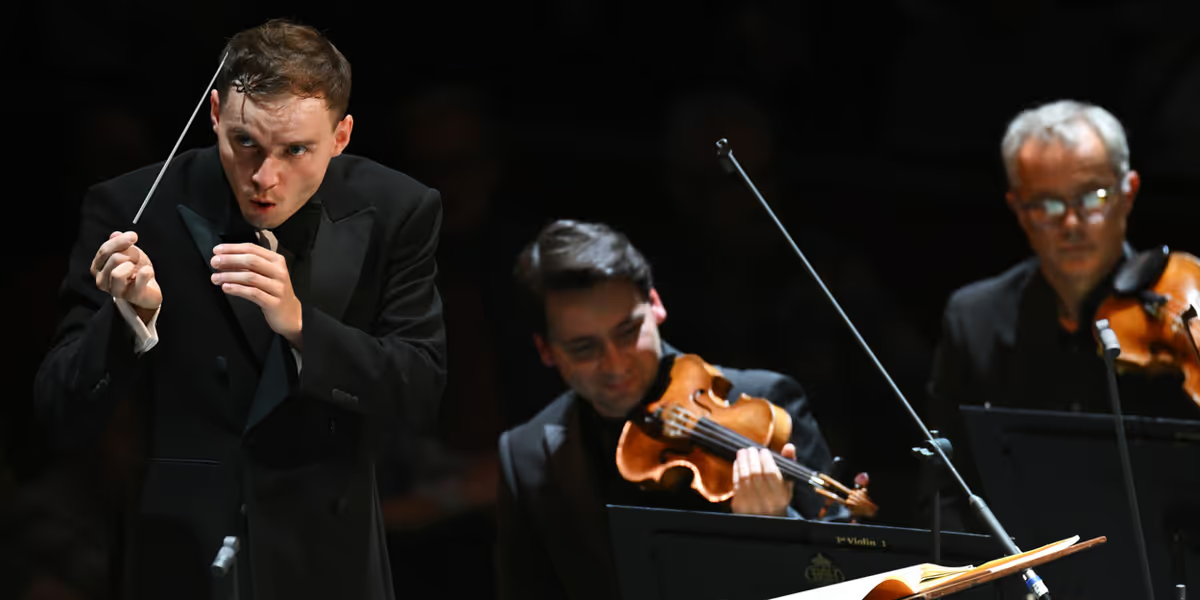
This served as conductor Paweł Kapuła’s debut at the Proms
“It is difficult composing endings. Beethoven and Wagner could do it. Only great composers can do it. I can do it too.” It wasn’t just Richard Strauss’s death-embracing “Four Last Songs” which fit this theme in the BBC Scottish Symphony Orchestra’s final Prom of the season, as Franz Schubert’s 8th symphony remained unfinished at his death - and Schubert’s setting of a morbid Goethe poem inspired Hans Werner Henze’s “Erlkönig”. The Benjamin Britten arrangement of the third movement of Gustav Mahler’s 3rd symphony (What the Wild Flowers Tell Me) does not immediately strike you as being consumed with mortality, but if you listen carefully you might find themes which go beyond the superficially pastoral. Quite a programme for this orchestra to go out on.
“Erlkönig” (meaning ‘Elf King’) follows a man desperately carrying his ill child through the night, before the child’s death is inflicted by the Elf King. Henze’s orchestral fantasy from 1996 captures the urgency in the father’s flight; the cinematic nature of this ten-minute piece surely served as an inspiration for Howard Shore when he came to compose the score for Peter Jackson’s Lord of the Rings film series, as well as many other fantastical soundtracks in the thirty years since it was written.
The orchestra’s performance of this piece was vibrant and full of dynamism, delicate strokes from conductor Paweł Kapuła’s baton guiding them effortlessly through the father’s journey and the son’s dying visions.
.JPG?format=auto&width=800)
Dying at the age of 31 - officially from typhoid fever, but possibly from syphilis - Schubert left many unfinished pieces dating from across his career, the implication being that he would start something and then set it aside, but then never get round to completing it. The two movements were composed while Schubert was in his mid-twenties, but displayed incredibly maturity in their melodies and style; Mozart may be the go-to precocious (and prolific) talent, but Schubert should also be remembered in this bracket.
The orchestra, thinned out slightly from the first piece of the night, gave a compelling performance of this rather extraordinary composition. From the syncopated sections to the pizzicato strings, they demonstrated the split personality of the symphony with terrific displays of musicianship - it was hard to know which section to watch at times.
Returning from the interval with Britten’s arrangement of Mahler’s What the Wild Flowers Tell Me was something of a masterstroke. Although there are hints at a darkness beneath the surface, there is a lot more levity here than one might expect from Mahler - a composer with whose pieces I tend to associate existential dread. The orchestra was full of brightness in their performance, Kapuła making excellent use of his musicians.
.JPG?format=auto&width=800)
Richard Strauss didn’t come out of the Second World War well, as his assets were frozen in the wake of accusations of self-serving behaviour and the uncovering of Nazi affiliations. Despite this, and nearing the end of his life, his creative juices were still flowing and between 1947 and 1948 he composed Frühling, September, Beim Schlafengehen, and Im Abendrot; the latter will be familiar to fans of the Steve Coogan and Rob Brydon series The Trip to Italy.
For this final part of the programme, the BBC Scottish Symphony Orchestra were joined by Welsh-Ukrainian soprano Natalya Romaniw. It’s another instance where I think some surtitles or captions might be a nice bonus, as the words are poetry - however, listening to how the German text gels with the melodies is just as good an experience.
A fitting way for this particular ensemble’s Proms season to come to an end; a programme laced with goodbyes, but never too doleful.
The BBC Proms run at the Royal Albert Hall until 12 September
Photo credits: Chris Christodoulou
Sign up for all the news on the Fall season, discounts & more...
.jpg?format=auto&width=300)





Reader Reviews
To post a comment, you must register and login.