


Review: THE MARRIAGE OF FIGARO, Glyndebourne
The iconic opera venue opens its Autumn Season
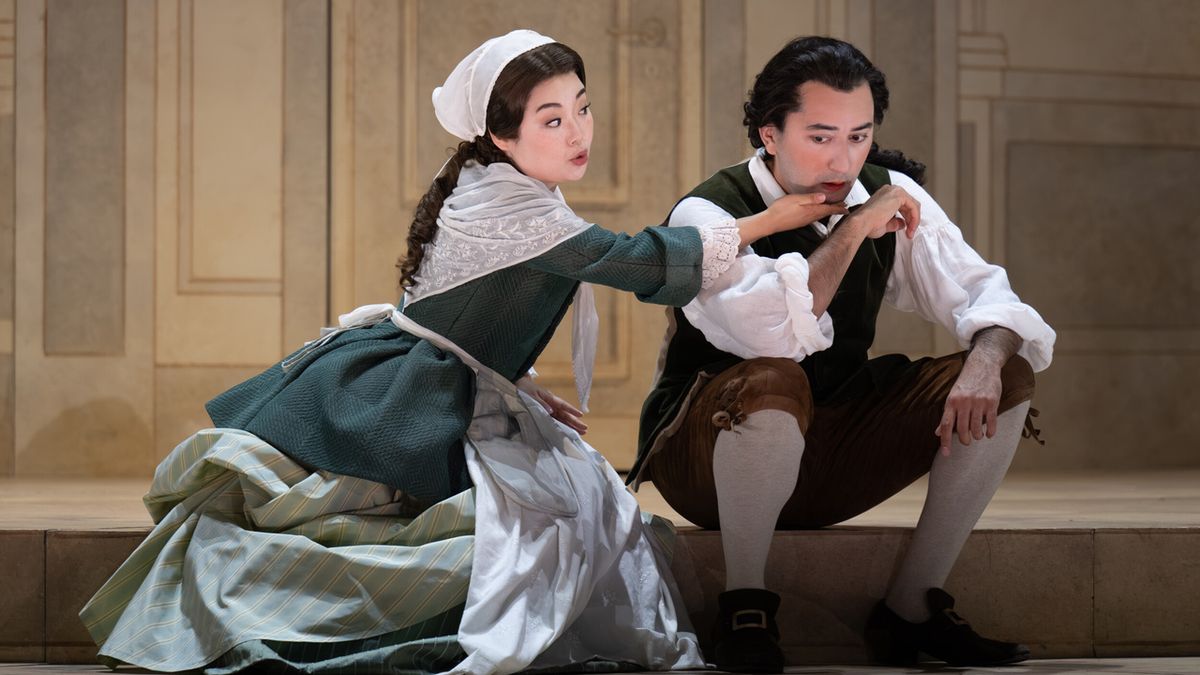

Glyndebourne first opened its manicured doors with a production of Mozart's The Marriage of Figaro, and ninety two years later, the opera begins its fourth Autumn Season. A revival of last summer's breezy production, originally directed by Mariame Clément, it leans into the deceptively simple comedy of the piece, embracing its much sharper edges with aplomb.
Servants Susanna and Figaro are getting married, but their womanising master the Count wants to take Susanna to bed before the marriage. Recognising her husband's plans, the Countess teams up with the pair to outwit and shame him. What follows is a chaotic mix of disguises, mistaken identities and betrayals.
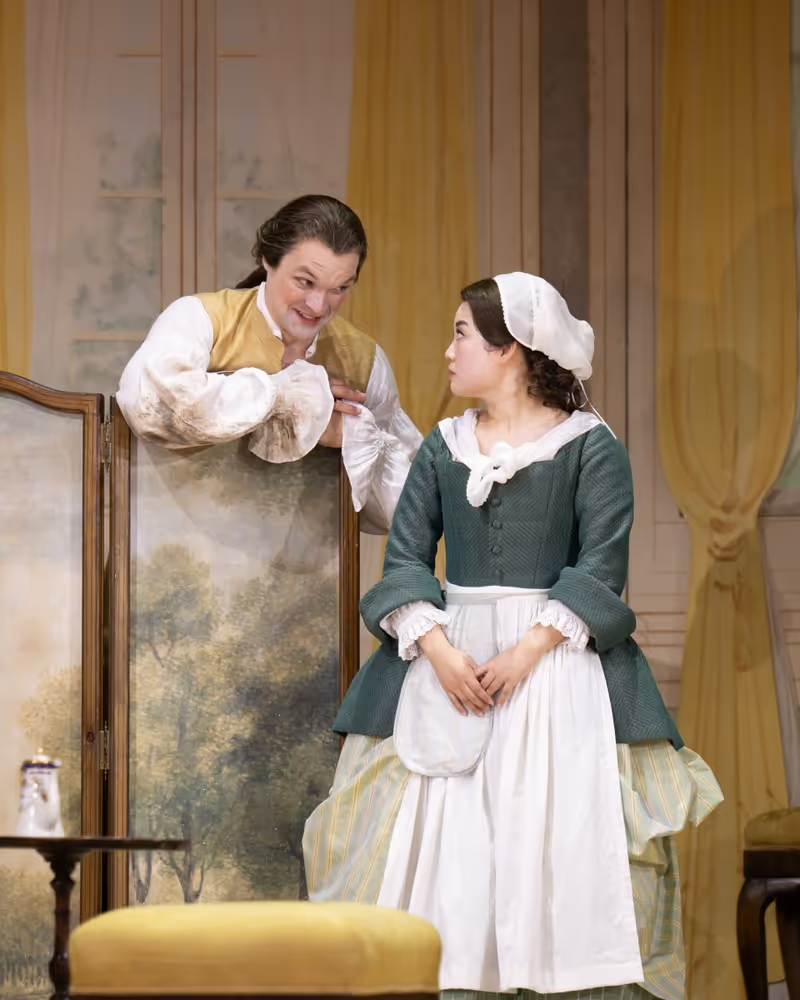
Photo Credit: © Glyndebourne Productions Ltd. Photos: ASH
Uzbekistani bass Jasurbek Khaydarov makes his UK opera and Glyndebourne debut in the title role. His "Non più andrai" is colourful, but projection is an issue in much of the first half, improving in the second. It's a fact that it is the women who dominate this opera and Khaydarov struggles a little to make an impression amid the array of strong characters on stage.
Henna Mun, who was sweetly childlike as Phyllis in last Autumn’s The Railway Children, returns to Glyndebourne as Susanna. This role is a big step up for her and she embraces the cheekiness and resourcefulness of the character incredibly well. Her voice has great clarity and charm; particularly in the hugely romantic "Deh, vieni, non tardar" – she surely has a very promising future.
Madeline Boreham makes a wonderful Glyndebourne debut singing the Countess; her "Porgi, amor" is heartbreaking in expressing her pain at her husband's behaviour, with some crystal-like top notes and incredible breath control. “Dove sono” is utterly heartfelt, yet brimming with poise and calm dignity. The relationship between the Countess and Susanna is pivotal to the production and Mun and Boreham have a touching connection. They display palpable mutual respect and a real sense of sisterhood, as well as vocal synergy.
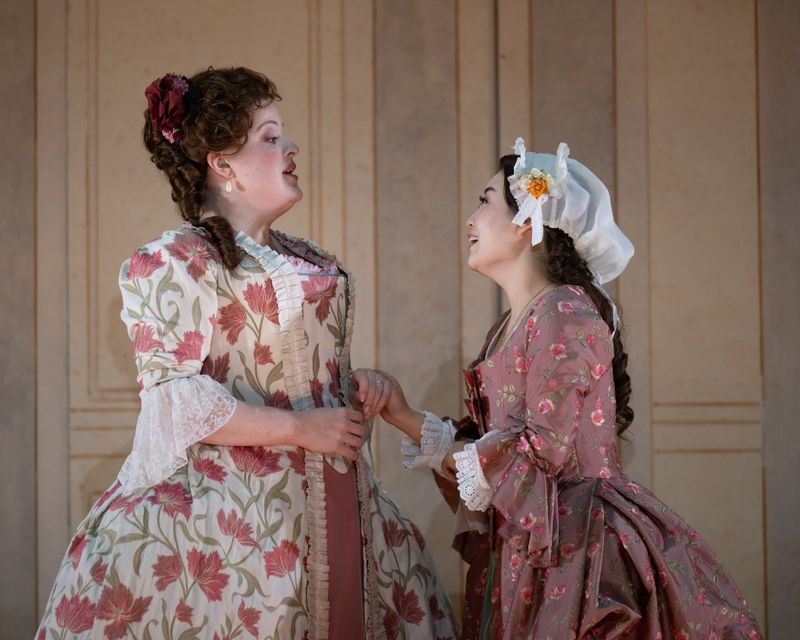
Photo Credit: © Glyndebourne Productions Ltd. Photos: ASH
Russian baritone Anton Beliaev is charming, then sneeringly cruel as the priapic Count. He definitely leans into almost playing the cartoon baddie here, increasingly looking like he is chewing on a wasp and raising one eyebrow in amazement that he might be challenged. His "Vedrò, mentr'io sospiro" is sung almost spitting with outrage that his servants and wife are trying to foil his plans. Beliaev conveys much through his body language, using his tall stature to become even more imposing. This is particularly stark against the diminutive Mun.
Rachel Roper shows excellent comic timing as Cherubino, delivering a sparkling "Non so più cosa son", Biqing Zhang makes and engaging Barberina and Madeleine Shaw brings huge comedic value to Marcellina.
The decision to include a silent daughter for the Count and Countess works well – both as a symbol of the Countess's sadness, but also as a snapshot of the Count's personality. He portrays the doting father figure, then casts lascivious looks towards the nanny while he strides past his wife without glancing in her direction. These 30 seconds deftly encapsulate his whole character.
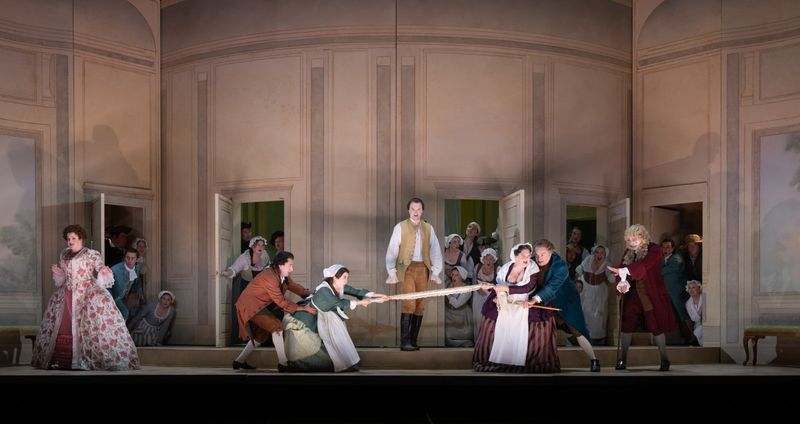
Photo Credit: © Glyndebourne Productions Ltd. Photos: ASH
There's a lot of physical comedy, with nice touches such as when Susanna and the Countess are gesturing to Figaro behind the Count's back, then he turns to them and they quickly engage in a game of Rock, Paper, Scissors. Servants overtly eavesdrop behind doors, there's a tug-of-war and Don Curzio sneezes with such violence that he loses his wig.
Revival Director James Hurley continues Clément's vision that finds the hidden, darker depths underneath the comedy. The basis of the story hinges on droit de seigneur, a medieval custom whereby a feudal lord was entitled to have sex with a female servant on her wedding night; which the Count appears to reject and then embraces. This is unsettling in itself, but as the story progresses, it is clear that domestic violence is also at play: the Count pins the Countess by her throat on a number of occasions, snarling and dangerous. It makes the final scene where the Count is left alone with barely a backward glance from his wife more poignant and credible. She knows he will never change.
There is faith in the quality of Da Ponte’s libretto and Bertie Baigent conducts The Glyndebourne Sinfonia with fluidity and vigour. There is clearly deep knowledge and understanding of Mozart's amazing and intricate score and the whole orchestra sounds like it is throughly enjoying itself; the overture is a particular highlight, played with huge vitality.
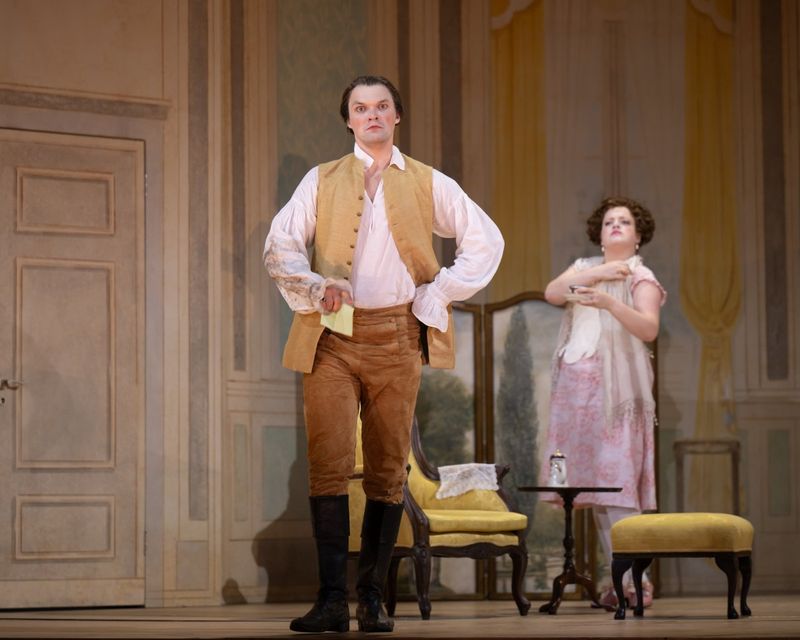
Photo Credit: © Glyndebourne Productions Ltd. Photos: ASH
It's wonderful to see the return of Julia Hansen's handsome set, which cleverly rotates to reveal a labyrinth of rooms. With gorgeous Rococo details and pastel hues inspired by Louis Carrogis Carmontelle’s painting of Mozart as a boy, the scene changes are endless, with a particularly beautiful reveal of the garden scene.
The Glyndebourne Autumn Season takes a more relaxed approach, with much lower prices, no black tie or long intervals which aims to attract a new audience to the venue. This even extends to the titling of the operas, with production names being in English, rather than the original Italian. It is also an opportunity to hear new and exciting talent, which this production more than provides. In a canny piece of programming, you can also see Rossini's prequel The Barber of Seville (written 30 years later) during the season.
The Marriage of Figaro may be Glyndebourne's most played opera, but this revival proves that it still has so much to say, not to mention containing one of the most sublime scores ever written. Whether you are new to opera or a seasoned lover, this production is a joy.
The Marriage of Figaro runs until 8 November, as part of Glyndebourne's Autumn Season
Photo Credits: © Glyndebourne Productions Ltd. Photos: ASH
Sign up for all the news on the Fall season, discounts & more...






Reader Reviews
To post a comment, you must register and login.