


Previews: A STREETCAR NAMED DESIRE at The Studio@620
On stage now through April 26
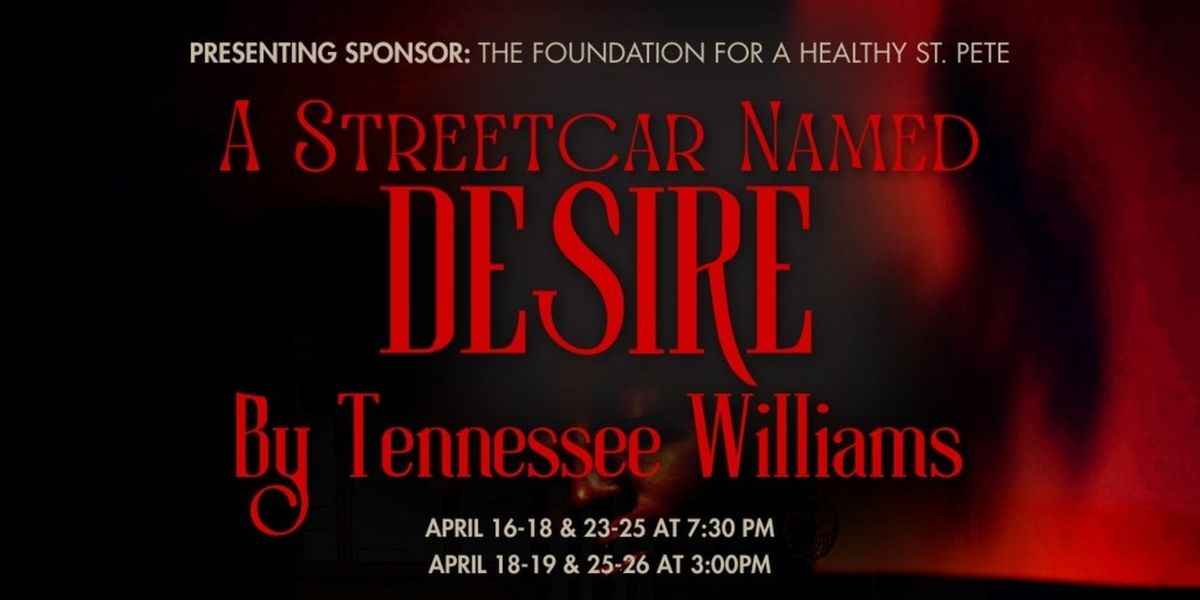
On stage at The Studio@620 through April 26 is a newly illuminated staging of A Streetcar Named Desire, directed by Erica Sutherlin as part of the Sankofa Series.
Running in 1965 rather than the 1940s, this reimagining places Tennessee Williams’ classic inside the rise of second wave feminism, a shift that reshapes the play’s emotional and political terrain.
Sutherlin explains that the new setting unlocks a different perspective on the women at the center of the story. She says, “I really wanted to explore this production through the lens of women in this play. Who are they? Why are they? What is their strength? How do they show it? How do they participate? How do they reject it? Can these questions be explored through this play?”

The production also reframes the Kowalski home as a biracial marriage, a choice that deepens the story’s examination of identity, power, and community. Sutherlin notes that both Stella and Stanley, as well as Eunice and Steve, are biracial couples in this world. “Of course, we can have conversation about the racial tension within the narrative, but we also get to explore relationship tensions, the cultural dynamics that seep into the room because of who they are in 1965. Or how they have chosen to love. Who are these people existing in this landscape? How do they define community because there is a community in the world of this play. Honestly, no one escapes culpability in this play. No one is completely good or bad or completely strong or weak. People are shades, gradients of the whole.”
As part of the Sankofa Series, the production looks back at the American theatrical canon not to reclaim it, but to reexamine it.
Sutherlin says, “You know, it's not reclaiming anything. Nothing was lost. We are going back and taking a look at another aspect or dynamic of America by using the classic or traditional American theatrical canon as the vehicle. So, we are reflecting America back to America.”
Blanche’s unraveling, often tied to class, gender, and trauma, takes on new dimensions in this staging. Sutherlin emphasizes that Blanche’s collapse is not rooted in fragility. “All of the layers of survival as a woman. Yes, facing aging beauty because society dictates beauty norms but exploring what do those norms force women into doing, being, you know? How do women manage all of the things, the weight placed upon us at any given moment and what happens when it all becomes too much, weighed without escape?”
The Foundation for a Healthy St. Petersburg partners with the production to highlight mental health, domestic stability, and systemic identity. For Sutherlin, directing with community in mind is always the starting point. “That doesn't mean that the work will not bring discomfort. There are moments in the world when we need to be reminded of women and their journeys holistically, the flow and the disruptions. I'm not afraid to talk about that.”
Actor Max Carley, who plays Stanley, describes how the 1965 setting and the biracial marriage reframed his understanding of the character. “It just shows how bold their relationship is, we all know how passionate they are, but here they are also defiant. In 1965, in the South, that choice has real consequences.” He adds that Stanley aligns himself with people who understand his world rather than those who simply look like him. “He’s direct, he’s unapologetic, and he says exactly what he thinks even when it’s uncomfortable or ugly. Which is where it gets dangerous.”
Carley found himself surprised by the internal pressures shaping Stanley’s behavior. “There is a massive amount of pressure influencing Stanley’s behavior. The pressure to provide and hold his household together as his family grows and their apartment feels smaller with each passing day. There’s a huge weight on him to be a man who can support and protect them.” With the feminist movement rising and Blanche re entering Stella’s life, Stanley begins to feel his grip on his home slipping.
One of the most iconic moments in the play, Stanley’s cry of “Stellaaaaah,” takes on new meaning in this production. Carley says it feels rooted in fear rather than bravado. “He’s not just afraid of losing her because of what he’s done, he’s afraid of losing her to everything outside their world. The pressures from society, from her past, from the idea that she could outgrow him or move beyond the life they’ve built together. So it feels less like a performance of masculinity and more like a desperate attempt to hold onto the one thing that defines him.”
Carley hopes audiences leave with questions rather than conclusions. “We’re living in a really charged and divisive moment, especially when it comes to how we talk about masculinity. What I think this production does so well is that it doesn’t give easy answers. It puts someone like Stanley in front of you and asks: how do we respond to this kind of man? Why can that energy still be attractive? Why does Stella make the choice she makes? I hope audiences leave talking about the contradictions present in power, desire, responsibility, and question where the line is between strength and harm.”
A Streetcar Named Desire runs through April 26 at The Studio@620. Learn more and buy tickets at https://thestudioat620.org/events/a-streetcar-named-desire/

Weekly top stories - unsubscribe anytime.

|
Bat Boy: The Musical Carrollwood Cultural Center (10/16-10/25) |

|
Women of Resistance Sarasota Opera House (12/17-12/17) |

|
Little Shop of Horrors Carrollwood Cultural Center (7/23-8/01) |

|
The Mel Brooks Musical: Young Frankenstein Carrollwood Cultural Center (3/12-3/21) |

|
Hans Zimmer Benchmark International Arena (3/14-3/14) |

|
The Sunkicks: Home for the Holidays Central Park Performing Arts Center (11/27-11/29) |

|
Who Goes There? (the Thing's the play) Carrollwood Cultural Center (4/24-4/25) |

|
The Hobbit Jobsite Theater (7/14-8/08) |

|
Raising Twelve on a Nickel and a Prayer Hillsborough College Theatre (12/16-12/20) |

|
Meteor Shower American Stage Theatre Company (11/04-11/22) |
