

Two Queens (and Some Dancing): The Apiary
5 / 10
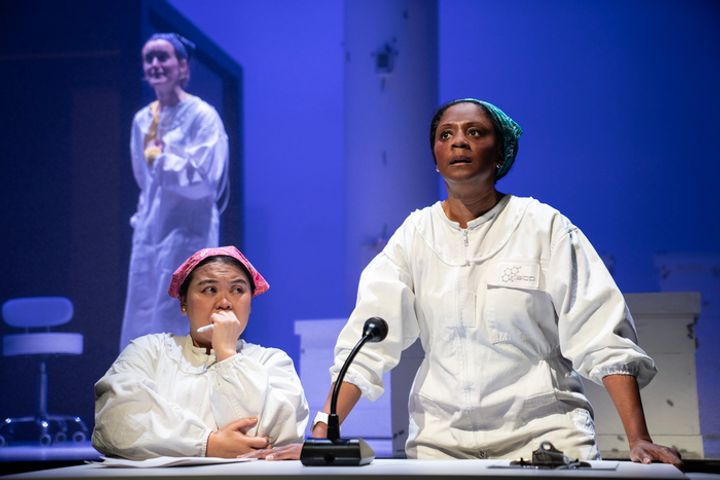
Connecting the dots of what The Apiary actually wants to say might be less sticky if Whoriskey’s production felt more fluent. Instead, there’s a broad, vaguely dissonant quality to much of the show’s theatricality — as if the production keeps elbowing you in the ribs, taking you out of it every time you try to sink in. This sensation manifests in the acting—Schilling’s ranting, largely two-dimensional Gwen feels like she’s in a completely different play from Matthis and Herlihy—and in the design. Spangler’s set is bulky and expensive-looking, seemingly committed to a kind of realism, and yet that soaring netting is speckled with what look like raisins — stationary black dots that are meant to be bees. Same goes for the hive frames that Pilar lovingly removes for testing: more black dots. The delicate vestiges of life and movement that remain in these creatures are of such central importance that seeing them manifested as clearly static set dressing is disconcerting. Realism has gone as far as it can go and has hit a wall: What could have happened on the other side?

.jpg?format=auto&width=365)