


Interview: Adam Pascal, Olivia Valli, Mykal Kilgore & More Talk JESUS CHRIST SUPER STAR
Cast Interview with Adam Pascal, Olivia Valli, Mykal Kilgore and director Patrick Cassidy
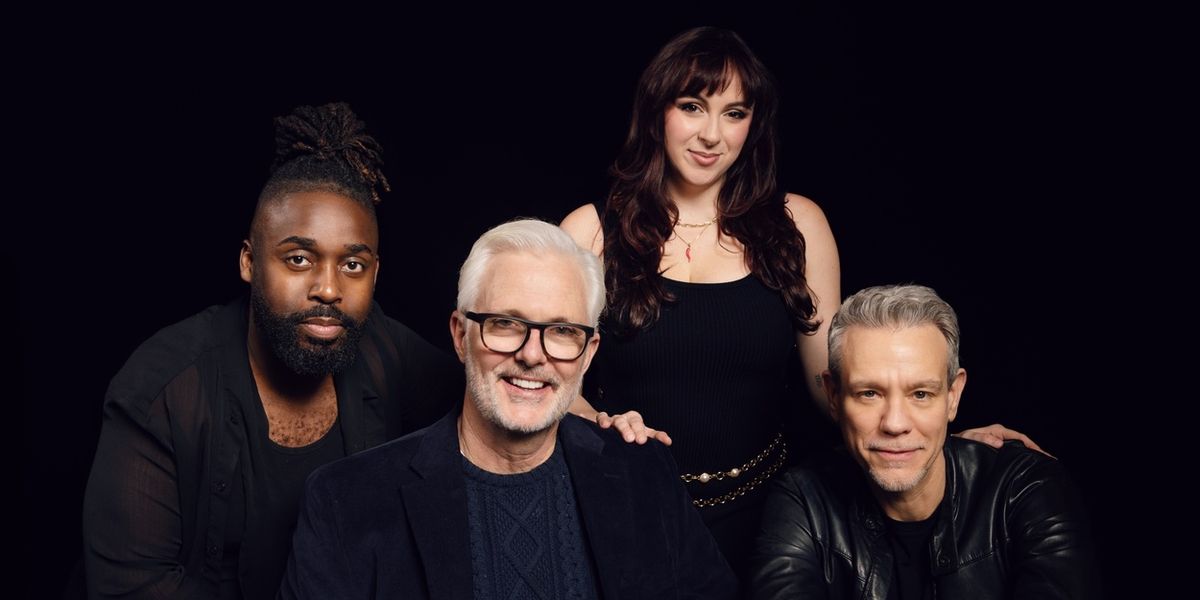
There is a distinct alchemy that occurs when a massive, legendary rock opera is stripped of its traditional stadium-sized distance and placed directly in front of an audience. At Studio Tenn’s Turner Theatre at The Factory in Franklin, Tennessee, director Patrick Cassidy has done just that, turning Andrew Lloyd Webber and Tim Rice’s Jesus Christ Superstar into a visceral, in-your-face exploration of celebrity, devotion, and mortal terror.
By blending heavy-hitting Broadway royalty with the formidable wealth of local Nashville talent, this production strips away the show’s five-decade-old mythological veneer to expose its raw, beating heart. Here, the ensemble is a tech-obsessed modern mob, turning adoration into a violent media spectacle, while the central trio anchors the tragedy in devastatingly quiet human stakes.
Please enjoy BroadwayWorld's interview with director Patrick Cassidy and stars Adam Pascal (Jesus), Mykal Kilgore (Judas), and Olivia Valli (Mary Magdalene) to discuss vocal longevity, the power of artistic stillness, and what happens when an icon is crushed by his own fanbase.
*Adam Pascal (Jesus)
You’ve spent decades delivering some of the most demanding rock tenors in modern musical theater, from Roger Davis to now. 'Gethsemane' is famously brutal on the voice, yet in this intimate space, you’re still aggressively hitting those optional high notes on your knees. How has your relationship with your own vocal instrument evolved to allow you to handle the vulnerability and physical exhaustion of this specific song night after night?
“I’ve been fortunate enough to have been consistently singing all these years, and I’ve also been fortunate enough to have not done any damage to my vocal cords. I know my instrument pretty well, and I know how to do what I do without hurting myself. Those optional high notes are actually something that I’ve never had the opportunity to do. There’s really no other show that asks for that, and I just so happened to know where to place that in my face. I’m a huge fan of Ian Gillen, and I would definitely say I modeled my vocal performance after him over any other singer.”
Unlike your work in 'Pretty Woman' or 'Aida,' where you portray men trying to conquer or navigate a rigid system, Jesus is an icon whose public image completely escapes his own control. In Patrick’s staging, the ensemble uses cell phones and flash photography, turning your followers into an aggressive, modern fanbase. How did you balance the immense 'Superstar' mythology with the internal, quiet exhaustion of a man who knows he is being crushed by his own celebrity?
“Well, it’s an ever-repeating pattern to build people up to icon status and then revel in taking them down, and the same person can be exalted and torn down multiple times. It's something we do as a culture with this character. The ultimate motivation at the time when we meet him six days before the crucifixion is fear. He's terrified to die. I really try to play him as mortally as I can. I’ve seen so many productions where Jesus is this archetypal mythologically portrayed character that to me is very one-dimensional. It wasn’t interesting to me to explore the character in that way.”
You are used to massive houses and touring stages, but the Turner Theatre puts the audience right in your face. When you are standing downstage delivering Jesus’ final moments of bleak resignation, how does that immediate proximity change your acting choices compared to playing to the back row of a massive Broadway theater?
“I love playing in the small, intimate space and having people right there. I wasn’t sure how I was going to feel about it, but I really enjoyed it. It doesn’t really affect my performance. I don’t think I would do anything different in a larger house but to meet the intimacy adds to the excitement. I remember people‘s reactions to Rent when we were at the New York Theatre Workshop, and one of the most consistent comments was the in-your-face intimacy of the space. It’s a special experience.”
Are there any upcoming projects you would like to share with our BroadwayWorld readers?
“I’ve got a bunch of directing projects coming up this summer and fall, Dear Evan Hanson starring Orfeh at the Harbour Lights Theatre in Massachusetts. I’m also directing a new musical called Our Little Secret that is having its premiere at the Mirvish in Toronto this fall.”
*Mykal Kilgore (Judas)
Judas is structurally written as the antagonist, yet your performance forces the audience into an overwhelming state of empathy—particularly during the second-act descent toward suicide. Because the score relies heavily on your musical cadences and riffs, how did you use your own background in vocal improvisation to map Judas’ transition from logical, frantic worry to absolute heartbreak?
“Because the score was written with soul and rock in mind, it’s almost 2nd nature. You come to the music with a bit of a cultural concept of what it means to add ornaments to music. As someone who grew up singing gospel and soul music and also has a real love for classical art forms, and ‘opera’, this feels like the best way to portray emotion and tell a story.”
Some traditional interpretations view Judas as an aggressive, driving engine of anger against the status quo, but your portrayal brings a deeply layered, internal complexity. How did you work with Patrick to find the power in Judas’ vulnerability and fear, ensuring he didn't just feel like a villain, but a tragic observer caught in a mechanism larger than himself?
“I’ve always seen Judas as a character that is seeing someone that they love, making decisions that they are afraid are going to hurt them. I mean, that is exactly what happened. He’s a human like anybody who has friends that are radical who can absolutely believe in what they believe in, but that doesn’t mean sometimes you wish you could get in the way of their righteousness, if for no other reason, then to just keep peace.”
From your very first notes, you have to establish the entire stakes, tension, and musical vocabulary of the production. Given the grunge, minimalist aesthetic of the set, how much of the world-building did you feel you had to do purely through the texture and grit of your own belt?
“In our staging, Judas speaks directly towards the audience for the first number of the show, and I think that sets up for our audiences that this is going to be an intimate night that requires a conversation between what’s happening on the stage and the people in the seats. Yeah, there is a sort of pressure to set up the evening, but it feels like I’m set up to do it.”
Are there any upcoming projects you would like to share with our BroadwayWorld readers?
“I’m in an exciting period in my life where I’m exploring all sorts of possibilities inside myself. Am I a writer? Am I a director? I think I will be trying it all!”
*Olivia Valli (Mary Magdalene)
Mary Magdalene is so often played either with detached reverence or a heavy emphasis on a 'fallen woman' trope, but your performance feels like an anchor of steady, compassionate devotion. Coming from highly stylized, high-energy roles like Elphaba in 'Wicked' or Mary Delgado in 'Jersey Boys,' how did you approach the task of stripping back those theatrical layers to find the quiet, grounded humanity required for 'I Don't Know How to Love Him'?
“I started this process determined to show that Mary, like all women, is so deeply complex and that her story in this show matters too. My version of Mary is about devotion, connection, and simply being a human being with a range of emotions. We forget that Mary, like everyone else in the show, is experiencing these events for the first time as well. Women are often only allowed to be one thing. They can only be quiet and never chaotic, they can only be caring and never strong, we cannot exist in multitudes, and that’s where I feel Mary can fall short. I decided early on that I had to show her humanity and let go of what people might expect from Mary. That is exactly how I tell a story in a high-energy show as well, because these characters are experiencing the things around them for the first time. You can’t let the spectacle get in the way of ground, honest, and authentic storytelling. I believe that one of the biggest powers an actor can have is to trust in stillness. That is Mary's superpower and the thing that feels so needed in the show. “I Don’t Know How To Love Him” is such a quiet yet complex moment in the show where we finally get to see Mary's inner world. It feels like a confession to the audience. So, with removing the need to perform, I feel like that song really hits home because I’m allowing a very relatable side of Mary to come out, which is the complexity of living someone.”
You and Adam previously shared the stage on the national tour of 'Pretty Woman: The Musical' under completely different character dynamics. How did that pre-existing professional trust alter the way you two developed the complex, non-verbal shorthand between Mary and Jesus in this rehearsal room?
“During Pretty Woman, Adam and I created such a strong bond because of the nature of the roles. We also became friends through the process, and we have such a great connection because of Pretty Woman. I think because of that, there is a trust and respect for one another that translates into something palpable for the audience to see. We are friends, and we cheer each other on so naturally that it is easy to read on stage. We decided early on that this relationship between Mary and Jesus is certainly love, but not exactly romantic love. It’s admiration and genuine care.”
In a production where the ensemble represents a volatile, modern mob mentality, constantly shifting from adoration to violence, Mary remains the singular constant. How did you conceptualize her place within Patrick's staging? Is she immune to the media spectacle surrounding Jesus, or is she just the only one seeing the man instead of the icon?
“I’m not going to lie, it was very difficult at first. Mary can be so ambiguous and often tossed to the side because people don’t know what to do with her. So I had to bring it back to what I would do. I’m a naturally empathetic person who picks up on everything a person is feeling. So I applied that to my version of Mary. Mary sees Jesus as the man who experiences the joys and the anguish of being the icon. She's naturally empathetic to her friend who is suffering. During rehearsals, I was moving so much, and it felt too chaotic. I wasn’t connecting with the story, with our cast, or with Mary. So, I tried stillness, and everything clicked. The more still I was, the more connected I was to the piece. I wanted to be the connective tissue that brings everyone together and sees every character's feelings beneath the surface. I wanted to be a Mary who tries to remind Jesus that she sees him simply as the man who is her friend, whom she deeply cares about.”
Are there any upcoming projects you would like to share with our BroadwayWorld readers?
“I’m headed up to North Shore in June to play the Narrator in Joseph and the Amazing Technicolor Dreamcoat! It’s my first time performing at North Shore. I’m so excited to get started!”
*Patrick Cassidy (Director / Artistic Director)
Middle Tennessee has an incredibly vibrant, proud, and discerning local theater community. When you are looking at potential shows to bring to The Factory, how do you read the specific pulse of this audience? What tells you that a classic piece like 'Jesus Christ Superstar' is exactly what the local community wants to experience right now?
“When I’m building a five-show season, I spend a tremendous amount of time thinking about our audience, their familiarity with titles, the balance of musicals versus plays, and what stories will resonate most deeply in this particular community. A big part of my process is pondering if our audience knows a piece and whether they will feel a connection to it. With Jesus Christ Superstar, there was already a rich cultural history that made it compelling. This is a show that has lived for over fifty years, beginning with the concept album that introduced audiences to two young, groundbreaking composers, Tim Rice and Andrew Lloyd Webber, whose music people became obsessed with long before the show even reached the stage. Then came the iconic film adaptation, which cemented its place in popular culture. I’ll admit, there was a bit of trepidation in choosing it. This is a rock opera centered on the final days of Jesus’ life, and historically, when the show first opened, there was controversy, criticism, and even picketing outside theaters. But culture evolves. Today, audiences are far more open to contemporary interpretations of spiritual storytelling. In fact, if you walk into many churches today, including right here in Middle Tennessee, you’ll find worship teams using rock instrumentation, theatrical lighting, and contemporary performance styles that aren’t far removed from the language of Superstar. I also felt that the scale and intimacy of Turner Theater made this the perfect environment for the piece. Rather than presenting it from a distance, we could create an experience that feels immediate, immersive, and deeply personal for our audience, allowing them to engage with this familiar story in a powerful new way.”
Bringing together Adam, Mykal, and Olivia gives you an immense amount of vocal power. When you were shaping the production, how did you guide these three distinct powerhouse energies to ensure they didn’t just sound incredible individually, but locked together perfectly to tell this specific, grounded story?
“Each of them was hired because of their extraordinary talent, not just vocally, but as actors and complete performers. The strength and individuality of their voices were absolutely one of the reasons I wanted them for these roles. But the way they blend together has less to do with vocal power and more to do with truthfully embodying these characters and their relationships to one another. Adam is one of my closest friends, and when I asked him if he had ever played Jesus in Superstar, he said no. In that moment, I knew he was the perfect fit. Mykal and Olivia followed, and I felt incredibly fortunate to bring them together alongside the remarkable talent we have here in Tennessee. What makes their performances connect isn’t simply that they each sound incredible on their own; it’s that they fully inhabit who these people are. Their chemistry, their humanity, and their commitment to telling this story in a grounded, honest way are what allow their voices and performances to lock together so effectively.”
This production is a spectacular blend of heavy-hitting Broadway talent and brilliant local artists. How do you balance bringing in outside stars with honoring and elevating the incredible pool of talent that already lives and works right here in the Nashville area?
“The artists here in Tennessee honor and elevate themselves because they are extraordinarily talented. For me, this has never been about “New York versus Tennessee.” The talent pool here is every bit as gifted, skilled, and inspiring as anywhere else. In fact, every performer we’ve brought in from Broadway or Los Angeles has said exactly that after having the opportunity to work and share the stage with the incredible artists here in Tennessee. My goal is always to cast our productions entirely with Tennessee performers. Only in certain circumstances do I look outside the state to recruit additional artists. When that happens, it’s not about replacing local talent, it’s about creating the strongest possible storytelling ensemble. What I’ve found is that bringing together performers from different backgrounds often creates a wonderful artistic exchange, but the exceptional talent that already lives and works here in Tennessee is, and always will be, the foundation of what we do.”
Tell us more about the new post-performance conversation series, Beyond The Stage, you are launching, inviting the public to explore ideas, themes, and questions raised by the shows that will be performed throughout the season.
“One of the things I’m especially excited about surrounding Jesus Christ Superstar is our “Beyond On the Stage” talkback event. We’ll be bringing together spiritual leaders from our community, including a rabbi, a pastor, and individuals who are deeply passionate and knowledgeable about the Gospels, to engage in an open conversation about the show and its relationship to the Gospel story. What makes this so compelling is that Jesus Christ Superstar has always sparked thought, discussion, and different interpretations. This talkback creates a space for audiences to hear a variety of perspectives from different faith traditions and backgrounds, ask questions, and engage in meaningful dialogue. I think it’s going to be a fascinating conversation, thoughtful, respectful, and deeply engaging. As the director of JCS, I’m genuinely looking forward to being part of that audience myself, listening, learning, and asking questions right alongside everyone else. That kind of shared exploration is part of what makes theater so powerful.”
What makes Studio Tenn’s production of Jesus Christ Superstar linger long after the final chord of the rock score fades is its stubborn insistence on the humanity of its characters. Through Adam Pascal’s fiercely mortal, fear-driven Jesus, Mykal Kilgore’s heartbreakingly empathetic Judas, and Olivia Valli’s grounding, still portrayal of Mary Magdalene, the production transcends the boundaries of a traditional revival. Under Patrick Cassidy’s direction, the show bridged the gap between Broadway excellence and Middle Tennessee's vibrant cultural landscape, proving that a 50-year-old rock opera can still perfectly mirror our modern obsession with building icons up just to watch them fall.
As Studio Tenn looks toward its upcoming season and its new Beyond the Stage conversation series, it is clear that theater in Franklin is not just about entertainment; it is a catalyst for community dialogue, artistic exchange, and profound human connection. Audiences have plenty of reasons to stay excited. Subscriptions are already buzzing for their upcoming 2026–2027 Season 17 lineup, which promises a magnificent mix of laughter, legacy, and spectacular music. Including, The Addams Family, a spooky, kooky musical comedy celebrating the wonderfully weird, It’s a Wonderful Life, A Live Radio Play, (marking the return of their sold-out, nostalgic holiday hit), Steel Magnolias, one of the most beloved, wit-filled Southern American plays of all time, Ring of Fire: The Music of Johnny Cash, a foot-stomping, high-energy journey through the life of the "Man in Black", and Something Rotten!, the hilarious, crowd-pleasing Broadway smash full of big dance numbers and Renaissance mischief, co-written by Wayne Kirkpatrick, longtime Nashville-based songwriter and Nashville Songewriters Hall of Fame inductee.
It is impressive that theater in Franklin is not just about entertainment; it is a catalyst for community dialogue, artistic exchange, and profound human connection. Keep an eye on BroadwayWorld Nashville for updates on incredible productions starring local and visiting artists as they take on their next exciting chapters right here in our own backyard.
See ya at the theater!

Sign up for all the news on the Fall season, discounts & more...
|
Giselle TPAC Polk Theater (10/02-10/04) |
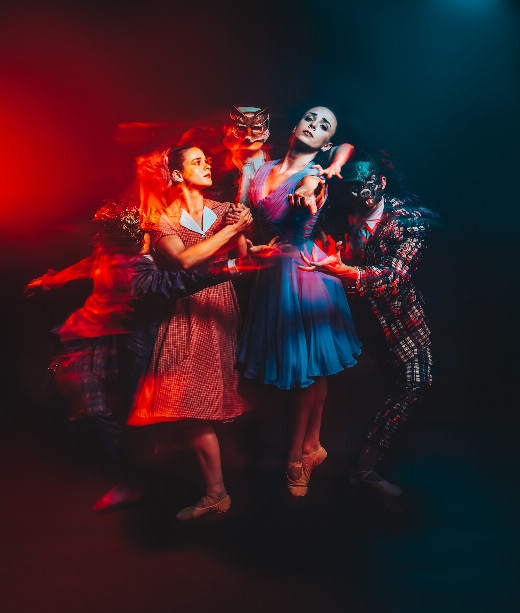
|
Attitude Tennessee Performing Arts Center (5/07-5/09) |
|
Les Miserables Playhouse on the Square (5/28-6/27) |
|
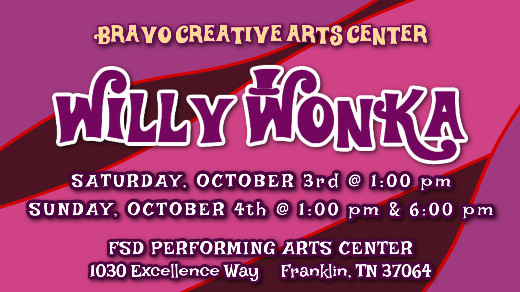
WILLY WONKA BRAVO CREATIVE ARTS at The FSD Performing Arts Center (10/03-10/04) |
|
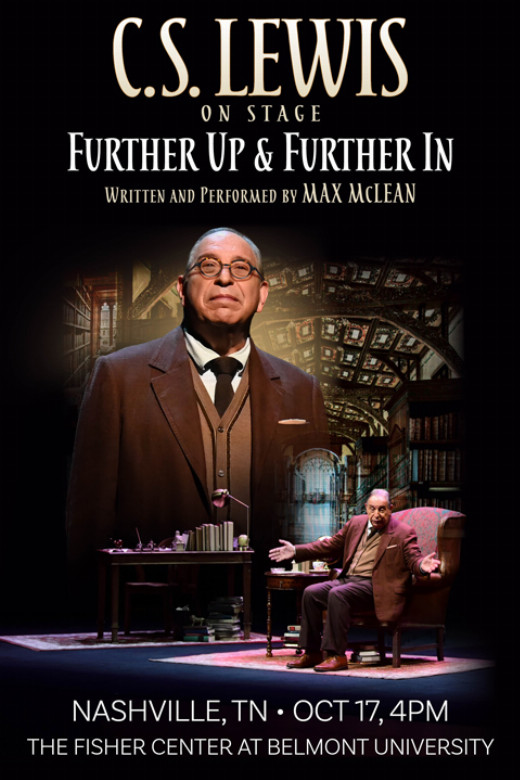
C.S. Lewis On Stage: Further Up & Further In The Fisher Center at Belmont University (10/17-10/17) |
|
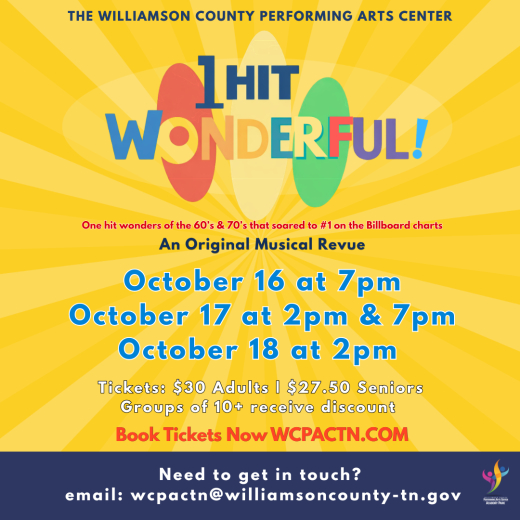
One Hit Wonderful! The Williamson County Performing Arts Center (10/16-10/18) |
|
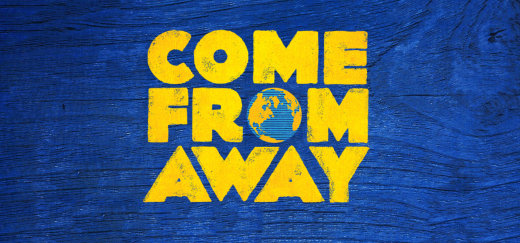
Come From Away Chattanooga Theatre Centre (9/01-9/30) |
|
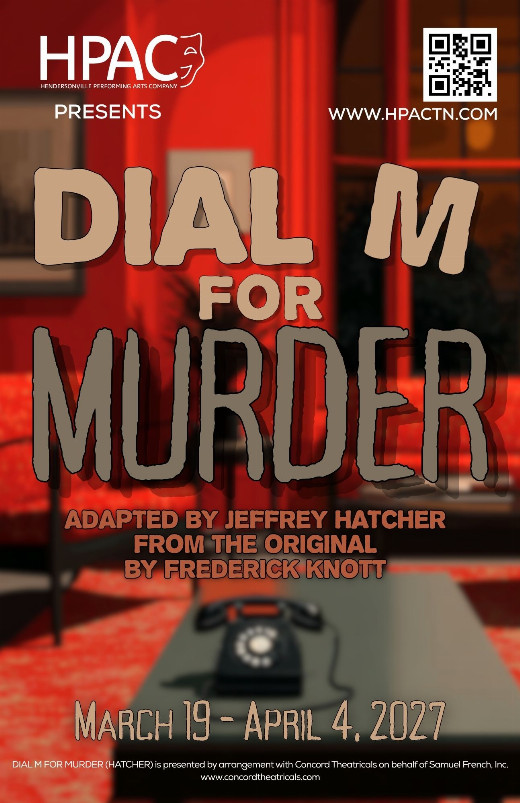
Dial M for Murder Hendersonville Performing Arts Company (3/19-4/04) |

|
Gunhild Carling at City Winery Nashville City Winery Nashville (11/01-11/01) |
|
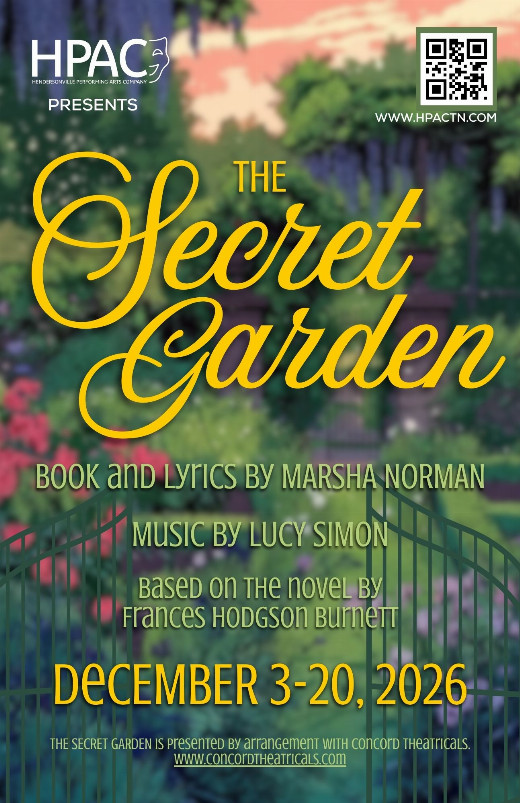
The Secret Garden Hendersonville Performing Arts Company (12/03-12/20) |
