


Review: Claybourne Elder Is Difficult to Ignore in IF THE STARS WERE MINE at 54 Below
The role Claybourne Elder was born to play: himself. The GILDED AGE star brings the show back to 54 Below in September

Claybourne Elder lived in my imagination long before he stepped onstage at 54 Below. Years of seeing him in Company, Bonnie and Clyde, Passion, and Sunday in the Park with George had fixed him there as a particular kind of Broadway specimen: brooding, handsome, carved almost to the point of myth, all masculine voltage and clean theatrical authority. With those chiseled features, that brooding brow, that formidable physical presence, who could blame casting directors for repeatedly reaching for the same pencil. Yet star quality, for all the abuse that phrase has suffered, becomes unmistakable when it is real, and Claybourne seems to possess it in abundance. More surprising, and much rarer, is the range beneath it, which the industry has not yet fully trusted. What this evening suggested, with increasing force, is that the roles for which he is so often prized, the handsome men, the dangerous men, the smoldering men, have only skimmed the surface. Presence, sex appeal, command: all of that remains. Last night offered something larger: wit, vulnerability, emotional dexterity, a sense of play, and a startling fluency with tonal shifts. In other words, not just a leading man, but something broader and more various than Broadway has lately seemed to know what to do with.
Last night, however, If the Stars Were Mine complicated the performer I thought I knew. More to the point, it made visible an artist Broadway may not yet have fully accounted for.
The evening announced this almost at once. When the omniscient voice introducing Claybourne referred to him as hilarious, I had a brief private moment of confusion. Hilarious? That was not the Claybourne Elder I had filed away in memory. Possibly I had missed the interviews, the side roads of his career, the roles in which this had already been visible. Possibly the oversight was mine. Still, what emerged over the course of the evening felt less like a familiar Broadway star trying out patter and more like a correction, delivered charmingly but firmly.
Claybourne Elder is funny. Not pleasantly witty, not merely charming, not just adept at tossing off a line between numbers, but funny, funny. Stand-up funny. Storyteller funny. The sort of funny that depends not on volume or desperation but on timing, pressure, and the confidence to let a line sit there a beat before the room catches up. For all the pleasures of the music, and there were many, the stories he told between songs, delivered with ease, intelligence, and disarming candor, proved every bit as compelling as the repertoire itself. Plenty of cabaret performers talk between numbers. Fewer know how to make an audience lean forward. Claybourne does.
A personal metric tends to govern my evenings in the theatre. The more notes I find myself scribbling in the dark, the more likely it is that something has gone wrong onstage. Pages of frantic observations usually signal trouble. Very few notes mean something else entirely: the performance has swept me past my own professional obligations. Last night required several stern internal reminders. Review, I reminded myself more than once. Write this down. I blame Claybourne Elder completely.
He opened with “I Want to Be Evil,” which turned out to be less an opening number than a mission statement, or perhaps a warning. The song announced an evening built on multiplicity. Any tidy notion of who Claybourne Elder is, or ought to be, was about to be dismantled before the entrees arrived. Yes, the performance seemed to say, I am that man you have seen before, the classically handsome one with the leading-man gravity. But I am also this man, and this one, and this one. Cabaret, at its best, lets an artist slip free of casting and authorship long enough to become more recognizably themselves. Claybourne seemed to understand that assignment down to the molecule.
This sort of ease, of course, is manufactured at punishing cost. Cabaret may feel intimate, but its intimacy is engineered with exquisite care. Songs must be selected, stories shaped, rhythms built, emotional turns earned, all while preserving the illusion that the evening is simply unfolding of its own accord. That is often where professionalism shows itself. Rehearsal disappears. Structure breathes. Spontaneity, sincerity, and ease are not accidents but achievements. When a performer makes that balancing act look natural, when the room feels both meticulously guided and wholly alive, one begins to understand what cabaret success actually looks like. Claybourne made it look easy, which is unfair to the rest of humanity.
Another discovery arrived with even greater force. What emerged last night was an actor of unusual exactness and range. Yes, of course, anyone who has followed his stage career already knows this. Consider me late to a fuller understanding. One could feel the craft at work, alive and visible beneath the ease. Beat by beat, mood by mood, Claybourne moved with a suppleness that only looks effortless because the technique beneath it is so secure. He could turn on a joke, pivot into memory, and then, without any visible machinery, deepen into feeling before the room had time to brace itself. On at least three occasions, he was in tears and so were we. His, one sensed, belonged to that mysterious place where technique and truth meet. Ours were the more helpless variety, the tears of an audience willingly taken somewhere real.
Riches accumulated quickly. Between numbers came stories, so many of them, and so deftly told that one hesitates to recount too much for fear of stealing the pleasure of their arrival. A review is supposed to be thoughtful. Reliving the evening, however, thoughtfulness is not quite the operative feeling. Delight is closer. Gratitude, too. Salt Lake City entered the room, as did his Mormon upbringing. “Yes, I was Elder Elder.” So did BYU, along with the pain and absurdity of being thrown out for being gay. So did family lore, sharpened by wit, including the marvelous detail of losing the role Judy Garland made immortal in Meet Me in St. Louis to his “also gay” brother and being relegated, as he put it, to “everyone else on the trolley.” Laughter came easily. Then, with the instincts of someone who understands how to alter the pressure in a room, Claybourne moved into something more tender: the memory of a man who gave a young theatre-loving boy two hundred dollars to buy a ticket to a Broadway show, and in doing so altered the course of a life.
Stories like these can sag in lesser hands. Confession is not the same thing as shape, and anecdote is not the same thing as narrative. Claybourne appears to know the difference. Each story seemed to arrive with purpose, each one revealing another facet of the man while also advancing the evening’s larger emotional architecture. By the latter stretch of the show, a portrait had formed almost stealthily. Performer, certainly. Also father, husband, son, dreamer, survivor, comic, romantic. A human being, in other words, not a type, which Broadway, when left unsupervised, has a habit of confusing with character.
The songs benefited from that same intelligence. Whether giving us “I Wanna Dance with Somebody” in ballad form, turning “Part of Your World” into something funny, intimate, and freshly legible, or introducing one of his self-described “creepy” medleys with the sort of gleeful mischief that made the room instantly his, Claybourne made newly legible the difference between interpretation and mere delivery. Technique mattered, of course. Phrasing mattered. Musicianship mattered. More impressive still was the way he inhabited each number from the inside out, locating a personal aperture into even the most familiar material. Nothing felt imposed. Nothing felt clever for clever’s sake. Songs were not displayed. They were lived in.
Special praise is due music director Rodney Bush, expert foil and “Best Friend,” whose musicianship and warmth helped shape the evening throughout. A lovely “Lonesome Goodbye” duet among Bush, Claybourne, and a violin gave the room one of its most quietly affecting passages. Yes, he plays violin too, because apparently the evening had not yet made the rest of us feel inadequate enough.
Broadway, being Broadway, loves to hand a beautiful man a silhouette and call it character. Someone should give Claybourne Elder the chance to play a role as expansive, contradictory, funny, bruised, and alive as the one he gave himself here. Put plainly for the producers and casting directors in the back: there is a performance inside this man that Broadway’s current imagination may be too narrow to anticipate. Given the right vehicle, he will not merely be excellent. He could become difficult to ignore. Hey Mr. Producer. I am talking to you sir.
Forty years in and around the theatre does not leave one easily startled. Genuine surprise becomes rare. Genuine transformation rarer still. That is why evenings like this matter. Not merely because they entertain, though this one certainly did, but because they correct the record. Claybourne gave the room not only talent but generosity. He let us see the wit, the hurt, the intelligence, the self-awareness, the absurdity, the resilience. He trusted the audience to follow him through all of it, and we did, gladly. Cabaret can sometimes become an exercise in anecdote, nostalgia, or self-display. This felt richer, closer to an act of self-authorship. One left 54 Below feeling not merely that one had seen an excellent show, but that one had met, more fully, the artist himself.
Good news awaits those who missed the sold-out performance. Claybourne informed the audience that he has been asked to bring the show back in September, which means another opportunity to witness what this evening argued for so persuasively. A new CD is also now available, and it deserves an audience beyond the room. But, as Claybourne himself pointed out with winning candor, buy the CD. Spotify listens are not exactly paying the bills.
Oh, and for those of you concerned, Claybourne ended the evening with “The Trolley Song.” Take that, brother!
Learn more about the artist at www.claybourneelder.com
Claybourne Elder will bring this show back to 54 Below on September 8 and 9. Tickets are available on 54 Below's website here.




Sign up for all the news on the Fall season, discounts & more...

|
Jensen Freeman: Neon Nights Laurie Beechman Theatre (9/26-9/26) |

|
The Beat Goes On Don't Tell Mama (10/08-10/08) |
|
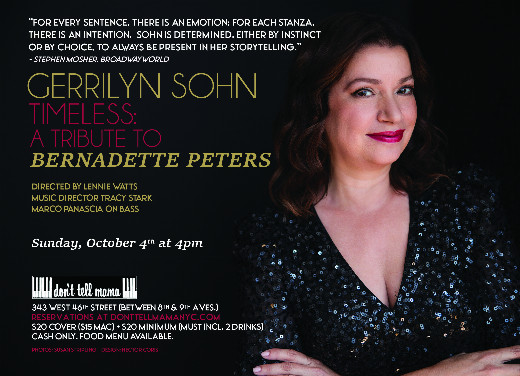
Timeless: A Tribute to Bernadette Peters Don't Tell Mama (10/04-10/04) |

|
Natasha Castillo: Darin to be Different...The Not So Splish-Splashy Side of Bobby Darin Don't Tell Mama (9/27-9/27) PHOTOS VIDEOS |

|
Kate Douglas Joe's Pub at The Public Theater (10/05-10/05) |

|
The Bowery Boys: Ghost Stories of Old New York Joe's Pub (10/31-10/31) |

|
Elizabeth Bougerol & Her Band New Album Release Show Joe's Pub (11/12-11/12) |

|
Justin Vivian Bond Joe's Pub (12/12-12/12) |

|
Oliver Richman: Song a Day 1000 Joe's Pub (9/26-9/26) |

|
Sapphira Cristál: Sapphi Don't Sing The Blues 54 Below (10/16-10/16) |

Reader Reviews
To post a comment, you must register and login.