Himangini Puri Wants Women’s Stories to Stop Being Treated Like Exceptions
The poet, screenwriter, and choreographer is using movement, language, and film to make room for emotionally complicated characters who rarely get the center of the frame
Written by Connie Etemadi
Some characters are treated as if their lives are too late, too specific, too quiet, or too difficult to carry a story. Himangini Puri does not believe that. She has built her work around the opposite idea: the people pushed to the edge of a frame often have the most interesting things happening inside them.
Puri is a writer, poet, choreographer, screenwriter, and multidisciplinary artist whose work moves through dance, poetry, performance, teaching, and film. Her creative path has changed shape more than once, but the question behind it has stayed close to the same.
Who gets seen fully? Who gets softened for other people’s comfort? Who is allowed to be strange, funny, selfish, wounded, loving, wrong, and still worth following?
“I want people to feel seen in ways they did not expect,” Puri says. “Not because the character is perfect, but because something in them feels true.”
That interest has made her especially drawn to women whose stories are often flattened. She writes female-centric films and characters that many women can recognize. In her view, the assumption that women’s lives are less cinematic says more about the industry’s imagination than about the women themselves.
One of Puri’s current features makes that belief clear. The nearly complete screenplay follows a 90-year-old female protagonist determined to fix everything but herself. The premise carries humor, denial, stubbornness, and emotional avoidance, all sitting inside a character who would rarely be treated as the engine of a film.
Puri is not interested in writing her as a symbol. She wants her to be active, difficult, funny, and alive on the page.
“I do not want older women to appear only as wisdom machines,” Puri says. “They can be chaotic. They can be wrong. They can want things badly. That is what makes them human.”
That desire to complicate the frame has followed Puri across mediums. She began as a dancer, trained in Kathak, contemporary dance, and ballet, and spent years learning how the body can tell a story before language arrives. Later, poetry gave her another way to approach what movement could not fully hold.
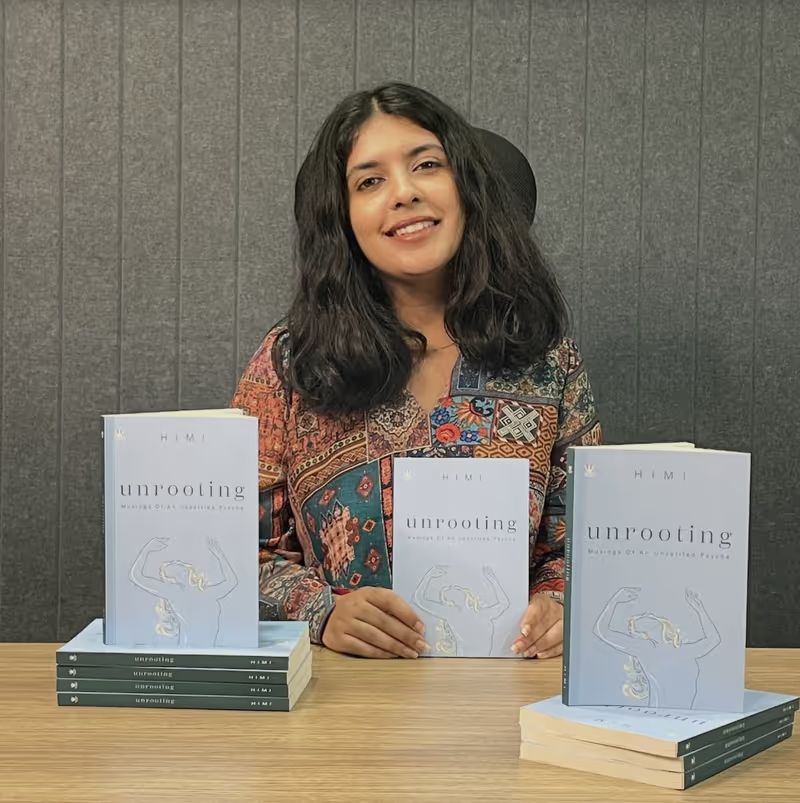
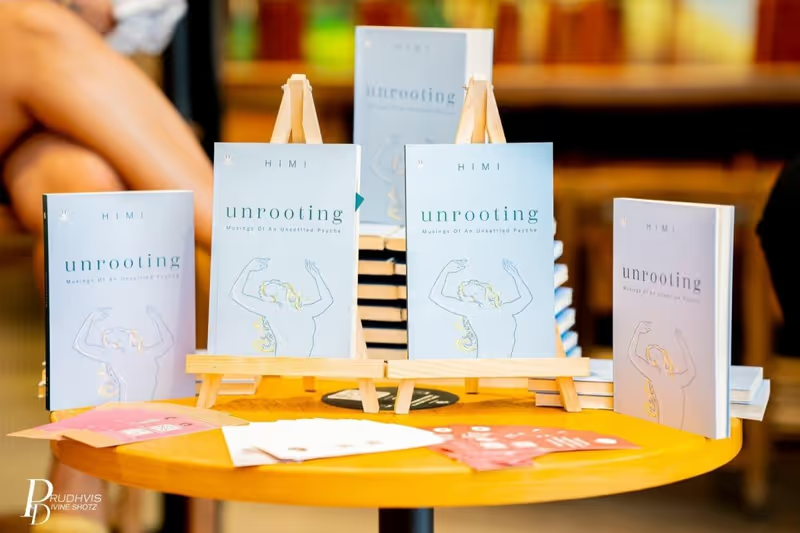
The shift became public after Covid disrupted the performing arts world. Puri had written privately before, but the pause in live performance pushed her to take poetry more seriously. Her book, Unrooting, Musings of an Unsettled Psyche, reached Amazon number one bestseller status for a month and holds strong reader ratings on Amazon and Goodreads.
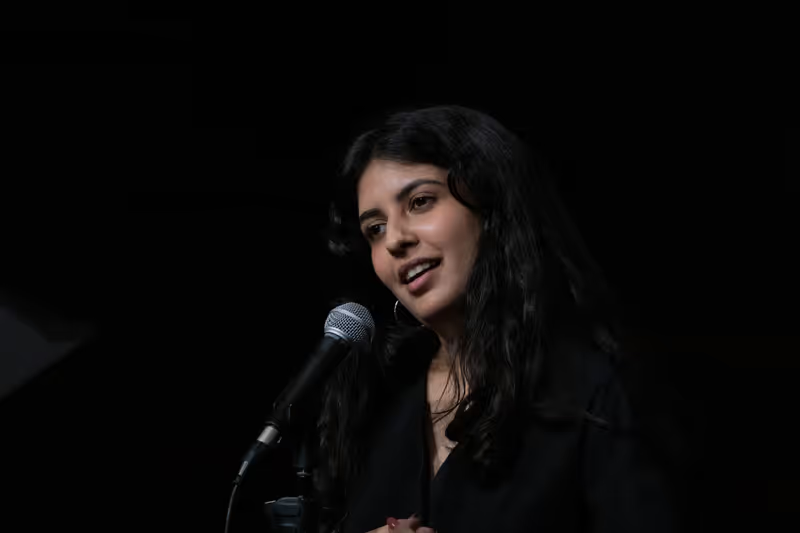
The credits help locate her career, but they do not explain the reason she keeps writing. She spoke on the Power of Poetry at TEDx in 2024, performed at the Festival of Libraries 2023 by invitation from the Indian Ministry of Culture, and won Silver Poetry Performance of the Year at IFP Season 14 for “Heavenly Body,” which drew more than 1,000 entries. Those moments show that her work has traveled, but the larger point is what she keeps trying to make visible.
“I did not stop being a dancer when I became a writer,” she says. “I think I became more honest about needing different languages for different wounds.”
Screenwriting became another one of those languages. Puri was approached by young producers to write a screenplay, something she had never done before. The result was Heer, a dark comedy television show. She wrote seven episodes and sold the project to Junun Motion Pictures, becoming head writer on the series.
That experience made film feel less like an unfamiliar industry and more like another way to ask the same questions. Who is allowed to be complicated? Who gets misunderstood? Who gets a full inner life instead of one useful trait?
“Some stories need movement. Some need a poem,” she says. “Some need a scene where two people say the wrong thing and reveal everything.”
That last version has become increasingly important to her. Puri specializes in poetry and screenplays, especially dark comedy. The genre suits her because it can hold contradictions without cleaning it up too quickly. People can be wounded and ridiculous. They can be cruel because they are frightened. They can make terrible choices and still expose something recognizable.
Her feature Nevermind, a story of two exes, brings that emotional territory into sharper focus. Puri wrote the film to explore the feelings people often leave unspoken after someone exits their life. What happens to the love that remains after a relationship ends? Where does it go? Does it return when the person unexpectedly appears again?
The film follows two former partners, carrying their own secrets, on a journey to scatter his mother’s ashes in India while both risk the “perfect” lives they have built back home in Los Angeles. The premise gives Puri room to examine love after its official ending, not as nostalgia or romance alone, but as something unfinished, inconvenient, and difficult to name.
“I am interested in what people do with the love that has nowhere obvious to go,” Puri says. “Sometimes a relationship ends, but the feeling does not disappear on command. It changes shape. It hides. Then life brings the person back, and suddenly everything you buried has a voice again.”
Nevermind also reflects Puri’s interest in people who are not emotionally clean. The characters are not simply choosing between past and present. They are carrying grief, loyalty, memory, guilt, desire, and the fear of disrupting lives that look stable from the outside. The journey to India becomes more than a physical trip. It becomes a confrontation with everything they thought they had resolved.
For Puri, that kind of story belongs at the center of the frame because it is recognizable. Many people know what it means to move on publicly while remaining privately attached to something they never fully understood.
“We are very quick to ask people to move on,” Puri says. “But I think there is a whole emotional life that happens after the goodbye. That is where I wanted to sit with Nevermind.”
Puri came to Los Angeles in 2025 to study screenwriting at UCLA and has completed the Professional Program in Screenwriting. Her work was also published in the Texas-based literary magazine Voices de la Luna in 2024. She is also working on a coming-of-age novel.
Her view of the industry is shaped by both optimism and impatience. She sees more stories about people of color gaining traction. She is glad filmmakers are becoming more independent and making work instead of waiting forever for studios to move first. Still, she does not think one or two films centered on underrepresented people should be treated like victory.
“One film is not a revolution,” she says. “Two films are not enough either. If we want to break stereotypes, real stories have to be made all the time.”
That is the larger argument inside her work, but Nevermind gives it a more intimate form. Representation is not only about who appears on screen. It is also about which emotions are allowed to be complex, which relationships are allowed to remain unresolved, and which women are permitted to want things that disrupt the safe version of their lives.
Puri wants more women of color, older women, and emotionally complicated women to stand at the center of stories without the story having to justify why they belong there. She also believes writers have a responsibility to think beyond the page. She wants to write work that is emotionally specific, but also possible to make.
To her, that practicality does not weaken the art. It gives it a better chance of reaching people.
“Art does not solve problems the way policy does,” Puri says. “It changes the imaginative space where people begin to understand them.”
That may be the clearest way to understand her work. Puri is not trying to explain women into acceptability. She is trying to write them with enough truth that the audience has to sit with them.
Every time someone watches a film she has written, she wants them to leave with more empathy than they arrived with. Not a neat lesson. Not a perfect answer. Just a wider view of who can carry a story, who can surprise us, and who was interesting all along.
For more information on Himangini Puri, visit her Instagram.
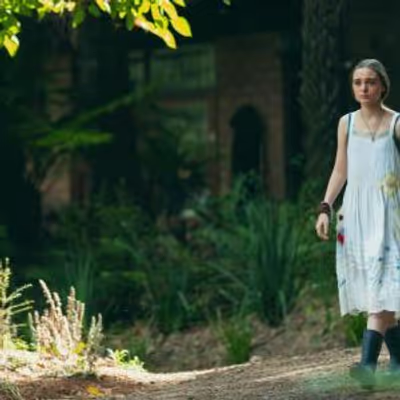
Photo Credit: Himangini Puri


Sign up for all the news on the Fall season, discounts & more...
.jpg?format=auto&width=300)