


Interview: Todrick Hall Wants MIDNIGHT to Change Minds and Hearts
The multi-hyphenate artist brings his deeply personal new musical to New York following two sold-out London engagements.

For Todrick Hall, the accomplished multi-hyphenate artist whose work spans theatre, music, television, choreography, digital media, and live performance, Midnight is more than another addition to a career that has taken him everywhere from Broadway and the West End to recording studios, television screens, international concert stages, and millions of social-media followers. Hall’s entry into the musical theater canon is the culmination of everything that came before it, including some chapters he might once have preferred to forget.
Following two sold-out engagements in London, Hall’s original musical arrives at the Daryl Roth Theatre this fall, with previews beginning September 12 and the official opening set for September 27. Written, directed, and choreographed by Hall, who also stars as Rail, Midnight is set in the 19th-century American South and follows twelve interconnected lives, six Black and six white, through a wholly sung-through score that blends gospel, R&B, pop, rock, folk, opera, and musical theatre.
The idea began during the pandemic, when Hall found himself navigating a difficult interracial relationship between two families with dramatically different political perspectives. “I set out to write something that was timeless and timely,” Hall recalls. “I also, as a massive theater nerd, was kind of a little bit disappointed by the things I was seeing on Broadway. And rather than complain about it, I said, ‘Todrick, you are one of the people who has been given the gift to actually do something about this.’”
Rather than merely identifying what he believed musical theater was missing, Hall challenged himself to create it. “There is something you could contribute to the musical theater canon,” he told himself. “And rather than spending your time on phone calls with your theater friends complaining about how much you didn’t like the shows that were there, you should use that same effort and energy to write something.”
The result is Midnight, a musical that examines race, class, identity, love, and empathy through a historical lens that Hall believes remains inseparable from contemporary America. “In order to really dissect how something can be still relevant today, I felt like I had to go back to the time that the seed was planted,” Hall explains.
Yet, he was equally conscious of creating something that invites audiences into the conversation rather than lecturing them. “I didn’t want my show to seem like a show that was written by an angry Black man because, while I am angry, I do know that you catch more bees with honey,” Hall says. “And I didn’t want anybody to come into the theater, spend their hard-earned money, and feel like they had their fingers wagged in their face, that people were preaching to them, or hitting them over the head with a woke stick.”
Finding that balance became essential to Midnight. Hall wanted specificity without sacrificing universality, ultimately creating a story where he hopes audiences can recognize both themselves and one another. “If I could contribute something to the world of musical theater that made Black people, white people, gay people, straight people, men, and women sit in the room and say, ‘Wow, I feel like I’m seen, and I’m seeing other people for the first time from this perspective,’ then that’s theater. That’s necessary,” he says. “That’s a story that is really relevant right now and that is really needed in our country.”
Hall’s own experience as a queer man also shaped the musical’s exploration of empathy. “There are a lot of people in my family that I’ve had to be patient with, and I’ve had to endure things that they have said out of ignorance, not from a place of hate,” Hall remembers. “Oftentimes we think that they need empathy for us, but we have to also offer that same empathy to them because they’re doing the best they can with the ingredients that they’ve been baked with.”
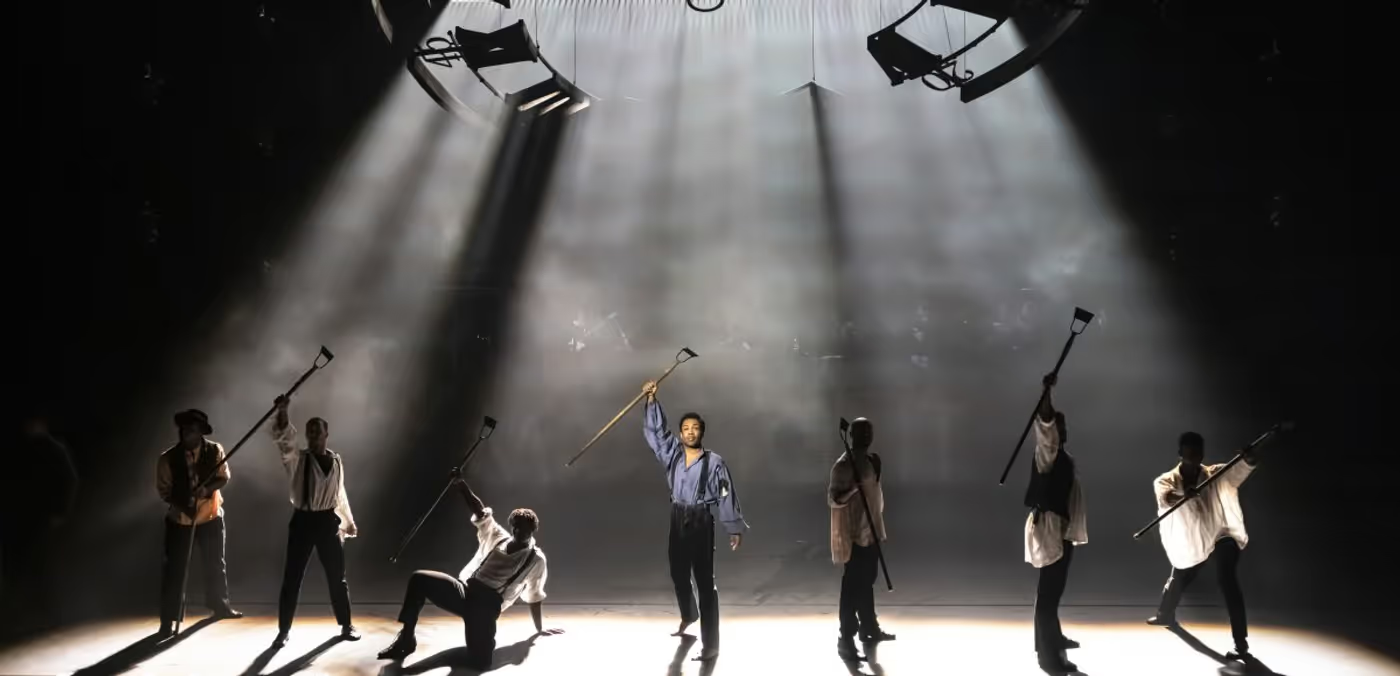
Photo by Pamela Raith Photography.
Musically, Midnight reflects Hall’s eclectic career. The same artist who built an enormous digital audience by filtering familiar material through unexpected genres and unique lenses has created a theatrical score unafraid to move between musical worlds.
Hall approaches his multiple creative responsibilities similarly. Rather than viewing writing, directing, and choreographing as separate jobs, he sees them as interconnected pieces of a single creative identity. “It’s like I’m baking a cake, but I’m also decorating the cake, and then I’m also serving the cake,” he explains. “It feels more like that to me than that I’m wearing different hats. I have one hat, and that’s the creator. That hat encompasses a lot of different things.”
In many ways, Hall sees Midnight as the convergence not only of his artistic successes, but also of the more difficult experiences that shaped him. “Someone actually came to watch a run-through and they said, ‘Everything that you have done up until this point has prepared you for this,’” Hall states. “Even, dare I say, the darkest chapters of my life where I have faced online controversy have helped me prepare. It taught me a lesson in empathy that I did not have when I was on the other side.”
Hall admits there was a time when he, too, could read a headline about another person and form an opinion without considering what might exist beyond it. Experiencing that judgment himself changed his perspective and, ultimately, informed the artist who created Midnight. “Now that I’ve experienced it, that empathy caused me to write this type of show,” he says.
Also, the show’s evolution has been collaborative. During its London development, Hall filmed audiences during performances, watching their reactions rather than the actors to identify moments when their attention shifted. He also actively solicited feedback. “I want to make a show that is like the people’s musical,” he emphasizes. “I want the people who are watching the show to say, ‘My input helped make this show be the success that it is.’”
That audience connection remains central to Hall’s hopes for New York. He does not necessarily need everyone to love Midnight. He does, however, want them to feel something. “I would rather be a show that people either loved or hated with a strong reaction than a show that is just middle of the road,” Hall admits. “I hope that it changes people’s minds and hearts because that’s what art is supposed to do.”
Yet, changing minds and hearts does not necessarily mean convincing everyone who enters the Daryl Roth Theatre to leave agreeing with him. The more immediate goal is to make indifference impossible. If Midnight sends people into the night still wrestling with what they have witnessed, Hall believes the musical has done its job. “My hope is that they have a conversation no matter what,” Hall says. “Even if people walk away and they say, ‘It wasn’t for me,’ but it sparked a conversation with them, then that’s what I think art is supposed to do.”
Those conversations do not have to be explicitly political. Despite the weighty subjects Midnight confronts, Hall hopes audiences also consider something more elemental, which is how they treat one another and how they choose to spend the limited time they have together. “They don’t have to be deep political ones, but they should be conversations about humanity and how we want to spend our life,” he explains.
That idea is distilled into one of Hall’s favorite lines from the musical: “Hold your loved ones close while they’re close to hold.”
Regardless of what people think of Midnight, for Hall, one measure of the musical’s success has already been decided. “I come from a very, very poor family, and it has been a huge journey for them to understand and accept me the way that I wanted to be accepted,” he reveals. “Most of my family has never been on a plane, and 35 Black folks from Plainview, Texas are getting on a plane and flying to New York for their first time ever to come and watch me—their gay cousin—tell this story in New York City.”
Whatever happens next, that moment belongs to him. “Nothing that any reviewer or anybody could say will negate this. It is all worth it because that is happening for me.”
The North American premiere of Midnight begins previews on September 12 and officially opens on September 27, 2026 at Off-Broadway’s Daryl Roth Theater (101 E. 15th Street, New York). Tickets and additional information are available at www.MidnightOffBway.com.

|
Powered by

|
|
Broadway Close Up: Bound for Broadway Merkin Hall at Kaufman Music Center (11/16-11/16) |

|
Sunday brunch with Alejandro Meola Jazz On Main (9/06-9/06) |

|
Zeju Zheng Trio Jazz On Main (9/03-9/03) |

|
The Packaging Tree The Packaging Tree (8/25-8/25) |
|
Broadway Close Up: Broadway in the 50s Merkin Hall at Kaufman Music Center (12/07-12/07) |
|
Still Life with Dowland and Britten Ascension Episcopal (10/16-10/16) |
|
GUSTAVO CASENAVE TRIO Jazz On Main (9/19-9/19) |

|
In the Course of Love and Joy St. Paul's Episcopal Church (4/09-4/09) |
|
Shake Rattle & Roll Dueling Pianos Chelsea Table & Stage (8/29-12/31) |
|
The DuPonts Jazz On Main (9/25-12/04) |