THE LOST BOYS Costume Designer Ryan Park Explains How He Created the Show’s 80s Vampire Style
Park is Tony-nominated nominated for Best Costume Design of a Musical.
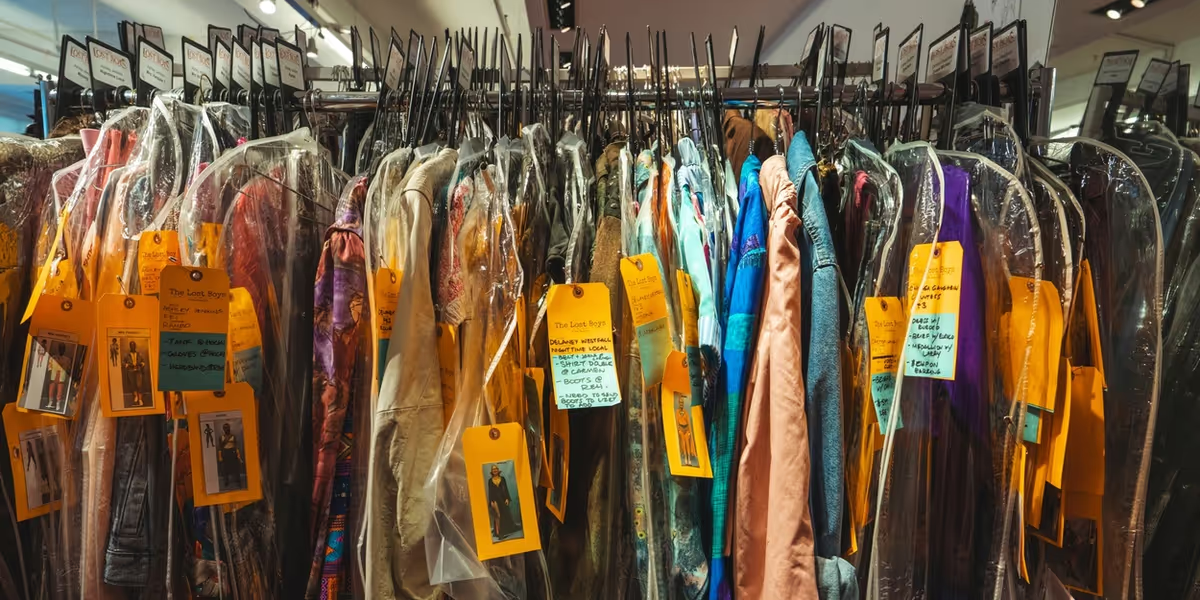
In Broadway’s biggest spectacle this season, 80’s punk fashion is back and completely taking over the Santa Carla boardwalk. In The Lost Boys, everywhere you look, you can catch mohawks, mullets, studded leather jackets, neon corsets, high-waisted swimsuit bottoms, electric guitars, and of course, blood-soaked fangs.
The new musical, based on the iconic cult classic 1987 film of the same name, follows the Emerson family as they move from Phoenix, Arizona, to Santa Carla, California, after Lucy’s divorce, and her teenage son Michael falls in with a gang of *spoilers* vampires. The creative team- led by veteran director Michael Arden- set out to create a world that not only honors the source material but stands on its own.
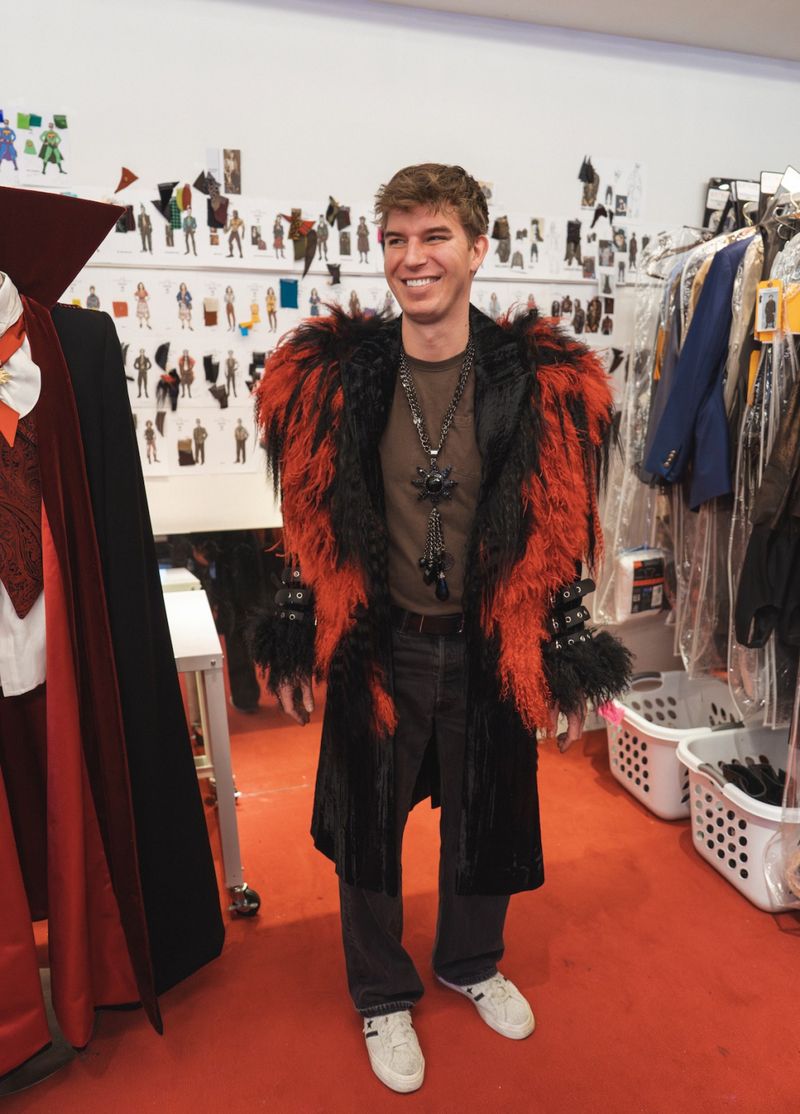
A key player in creating that visual world is Tony-nominated Costume Designer Ryan park, who is making his design debut with this production. Park has worked as an associate to distinguished designer Catherine Zuber for almost ten years and has assisted on countless Broadway productions. This is also the second Arden show he has worked on this season, having served as the Technical Costume Designer on Queen of Versailles.
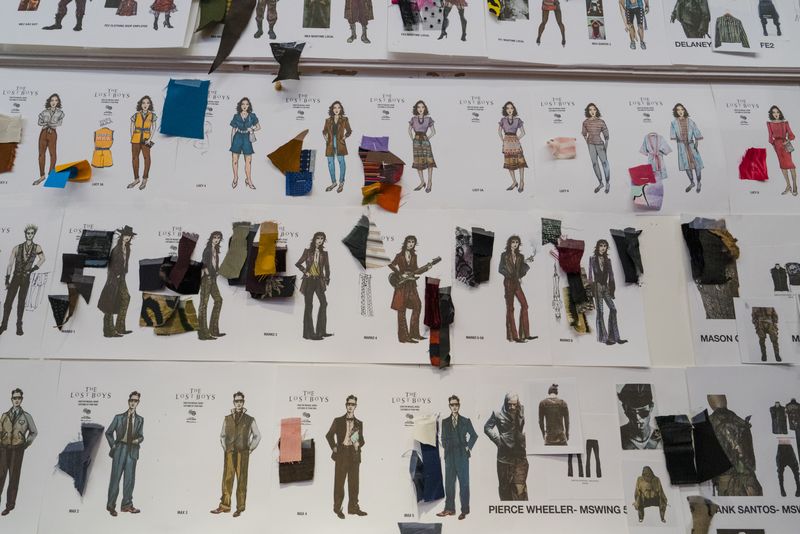
The look of The Lost Boys is a collage of many facets of 80’s and 80s-inspired media. You have the titular vampire, David, and his gang, a homage to Mötley Crüe led by an otherworldly combination of Billy Idol and David Bowie. You get Sam Emerson and the Frog Brothers, who give Dustin Henderson & Co. from Stranger Things. Even Max, the video store owner in his blue-gray suit, is reminiscent of the principal from Ferris Bueller’s Day Off. And we can’t forget the shirtless, shiny saxophone guy from the original movie that they rightfully kept in the production. But despite the pop culture references, the creative team aimed to ensure the characters still looked like real people. “In the early stages of talking about the characters, we wanted them to be representative of the 80’s but not comical,” says Lost Boys hair and wig designer David Brian Brown, “not caricature.” Brown himself used old yearbooks as references for his hair designs, to get the essence of what communities actually looked like then.
We sat down with Park to discuss the inspirations behind these striking looks.
Congrats on your Broadway costume design debut and congrats on opening. That’s amazing. How did it feel seeing your work come together on opening night?
If I had to sum it up, I was very proud, and that feeling of being so proud came from knowing all of the contributions of my team and the amazing people that made the garments or accessories or the hair and makeup team. It’s cliché to say it takes a village, but I think the number of people who contributed is overwhelming when you step back and look at everyone’s collective work.
Can I ask how many people were on this team that you worked with?
Michael Schaffner is my associate, and then Elivia Bovenzi, Michael O’Herron, and Amanda Jenks were assistants, and our team started at the end of October, so for us it was a pretty brisk task getting everything together for fittings in January. So that was our immediate team, and then there are probably 20-25 different vendors, tailors, shoemakers, milliners, and craftspeople that all contributed.
 How did you become a part of this project? I know you worked with Michael Arden on Queen of Versailles as well.
I’ve known Michael, and we’ve worked together on various projects. Michael is so amazingly creative and in working together we put forth the offering of the design and then we are constantly changing things to at the end of the day clarify and have the most impactful, clear and honest visual storytelling. I think that’s where we work incredibly well together, and what sparked the idea that I could be here doing this.
What, aside from the obvious starting point of the 1987 film, was your starting point for the costume visuals?
Definitely, with a property like this, the touchstone visual is the film. There are so many people who are such fans of this iconic movie and the movie’s aesthetic. I think when we started we all knew we wanted to do our version of the show that honored the original film visually, but still have an honesty that makes sense for contemporary audiences. I worked with David Brian Brown, our amazing hair and wig designer, and we knew that it would be a mistake to not have David have that bleached-out mullet, like that was key.
The way I approach design in general is I read the script or watch the workshops, and listen to the music- I am so inspired by music. And you absorb all of those things and start gathering editorial images, or period research, or I love books. And after talking to Michael and the producers about what their overarching vision is, certain images will just pop off the page and then I will collage those things together.
Could you recount maybe what some of those were that popped out to you?
Yeah, I don’t think it’s a spoiler, but in the original film, The Lost Boys are a sort of motorcycle gang, and in our version, they’re a rock band. So we started diving into 80’s rock music culture, punk culture, counter culture, and Kiefer Sutherland had mentioned this along the way that Billy Idol was one of the inspirations for David. And I looked at these images of Billy Idol, and I mean, it was perfect. It’s sexy, it’s dangerous- it has all the qualities that you think of with a vampire.
Yeah, I wanted to ask, the vampire gang has such an iconic, distinct look, but so do the other groups, like the Emerson family, the Frogs, and even the ensemble on the pier. How did you go about creating a different visual energy for those groups?
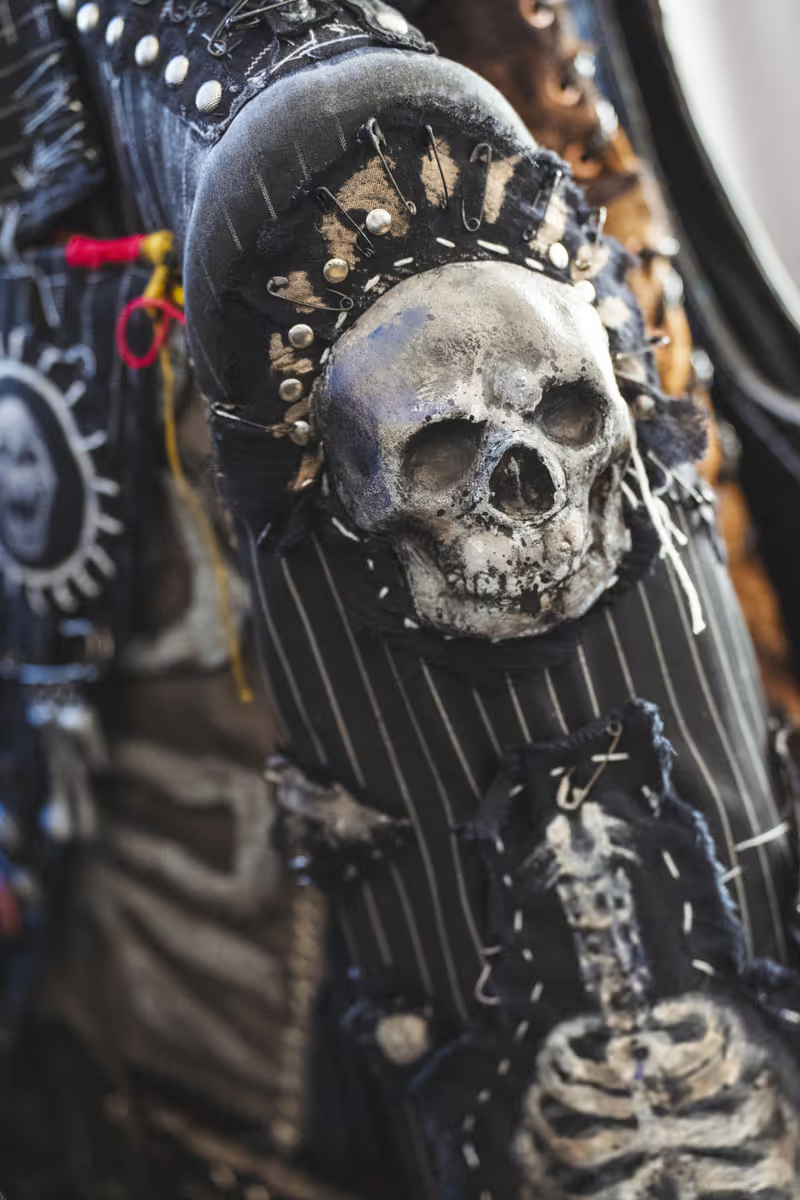 I think my job is to really support the characters and the story and the visual organization of everything. So it’s interesting that you point that out- I’m always interested in how a lot of films from the 80’s have this interest and exploration of light and dark, or like soft and warm in contrast to dangerous and edgy, so I knew that on stage I really wanted to see that counterpoint there. Like Lucy is warm and earthy, and Sam too. And then the vamps are kind of like anemic and devoid of that warmth and color. But they’re still layered, I know it looks like a lot of black, but there’s a million different tones and colors and textures to retain a sense of depth there.
Is there a specific garment that when you were watching the movie you went “yes that has to be in the show?”
It’s kind of silly, but from the opening sequence, there is a scene where Lucy, Sam, and Michael are driving in Santa Carla, and we are given a montage of all the different inhabitants of the boardwalk, and a woman walks by in a white bikini bottom with red polka dots, and we don’t even see her face, but I was like “we need to have that in the show.” It’s great when you have the opportunity to show different types of people and different layers to the inhabitants of the world.
Was there a particularly challenging character to find the look for or a particularly challenging piece to construct?
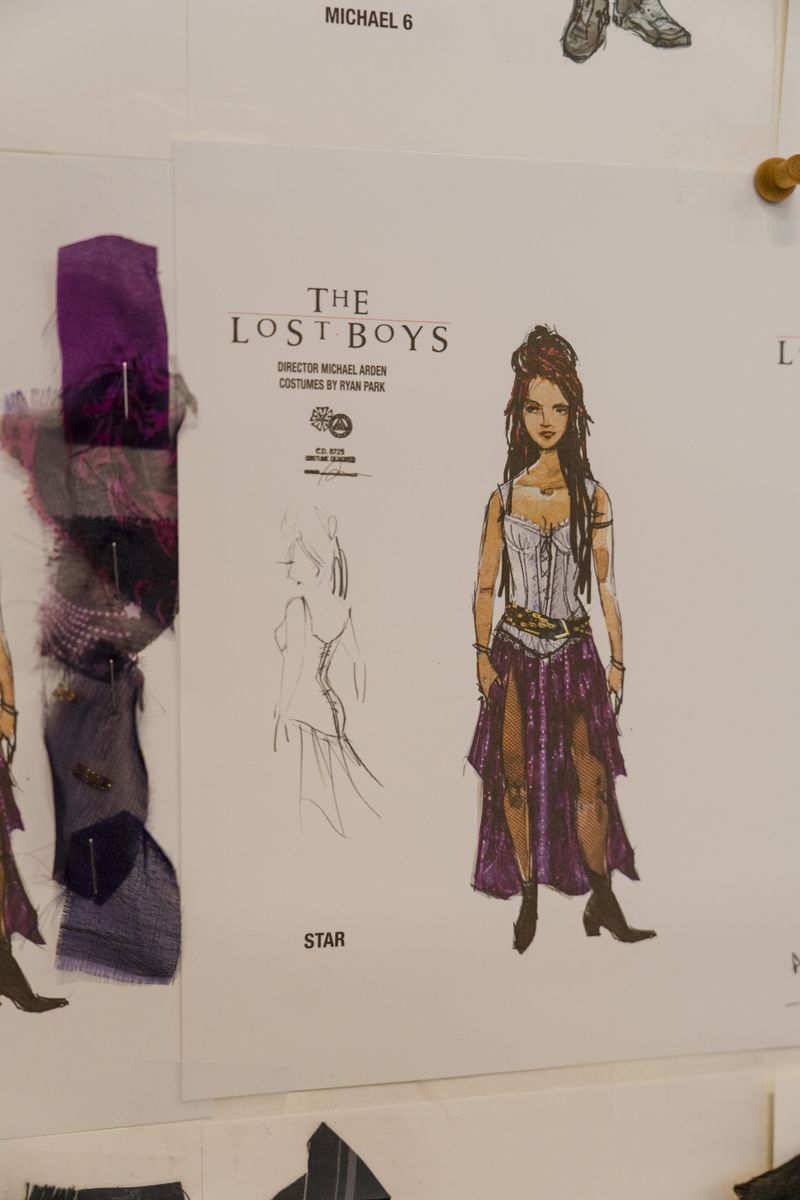
I would say that we started with something different for Star than where it is now. We started with a much more edgy look, like the rest of The Lost Boys. And we thought that we were missing some of the softness and the innocence that Jami Gertz character had in the movie. And so I went back and I resketched and we remade clothes for Maria to give Star a more bohemian look that allowed her to be more approachable at the beginning.
The show has a ton of aerial work and special effects. I was curious if any of those difficult things to choreograph affected your designs at all?
It definitely does. Hiding a harness is not the easiest thing in general. The Lost Boys are in and out of these harnesses, so they have pants without a harness, and then they put on the same pair of pants with a harness because of how fast they have to change, so fine-tuning all of that was definitely a puzzle, but a fun challenge.
I know the show went through several changes during the preview process. Did anything about the costumes change?
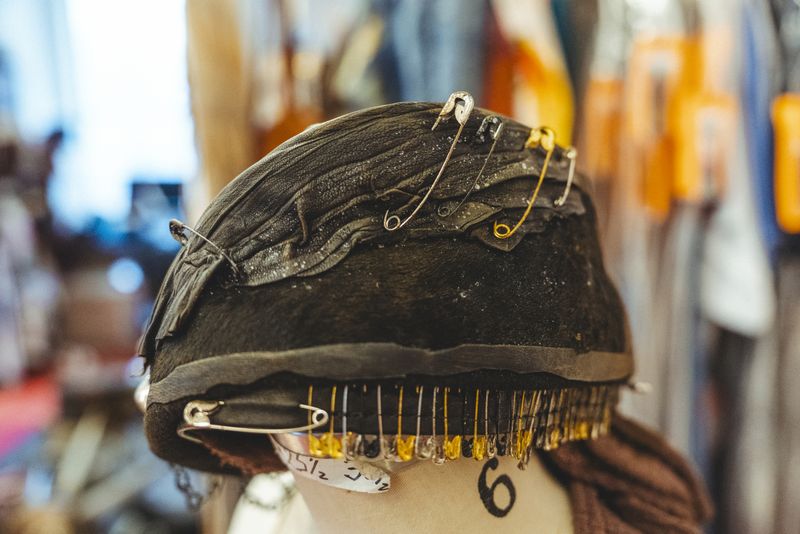
Yes, I try not to get too attached to anything, because we had no out-of-town tryout, so you have to keep everything in a sort of draft version. We actually had a whole set of costumes- we called these characters “the missings”- it was the ensemble. And they were sort of these conceptualized ghosts that populated at different points in the show, and a lot in the vampire’s lair. And their part kept getting smaller and smaller and now they’re not really in the show. And these costumes were beautiful and thrilling, and we hand-painted them. They were really punk-inspired, with safety pins, duct tape, and tracks of hair all over them. But they didn’t end up being necessary in the show.
You’ve worked with legendary designer Catherine Zuber for many years. I wanted to know how working with her informs your own work and your process.
She is the best and having the privilege of working with her and being able to watch someone who is so committed to their craft. She is always in the pursuit of the best possible representation of an idea. And that’s the one thing I always hear her say- it really has to be perfect, and you have to not settle for something that’s mediocre.
I have some quick, rapid-fire questions. What’s the first costume you ever made?
I don’t even know what that would be. There’s a photo of me from maybe like three years old, where I have a wooden spoon and a basket on my head. And I think it’s that- just creative play and using your imagination to explore different worlds. It’s kind of funny to think about that photograph because I still kind of do the same thing. It’s really just playing dress up. You can look at something so small and simple or something like this giant production and it’s all just using clothes to create a fantastical world.
If you could pick one item of clothing that screams 80’s rock and roll, what would it be?
I mean, it has to be a leather jacket.
It has to be, right? And what is next for you?
A vacation… No, I mean, what people might not realize is we accomplished a lot while in previews, but for the next few months, there are so many understudies and swings, that we’re simultaneously winding down and just getting started. And I think with a show like this where all of the ensemble members are so individualized, fleshing out the design for the amazing swings is kind of like a second chapter. So that’s what we’re working on now.
Photo Credit: Avery Brunkus
Prefer BroadwayWorld in Google Search?
Add us as a preferred source so our stories show up more often in Top Stories and Google’s AI answers — for you.

Sign up for all the news on the Fall season, discounts & more...
BroadwayWorld Merch
Shirts, mugs, phone cases & more
Powered by

|
.jpg?format=auto&width=300)