SOMM Recordings to Release TELEMANN: PARIS QUARTETS, VOL. 2 in October
Rachel Brown, Adrian Butterfield, Gavin Kibble, Sarah McMahon and Silas Woolston reunite for the period-instrument recording.
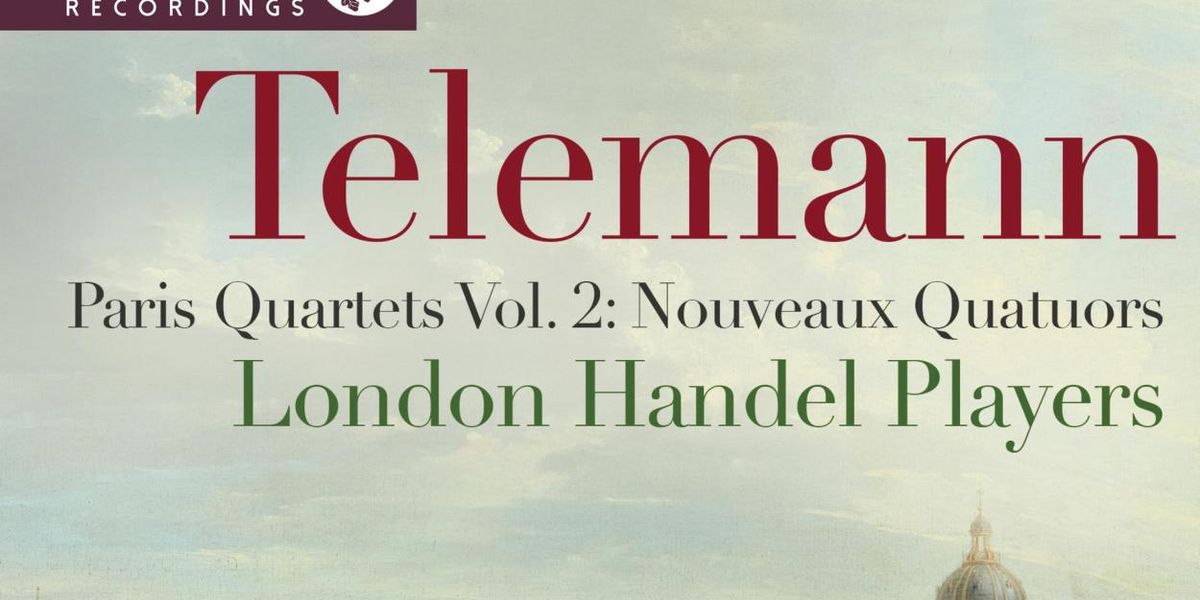
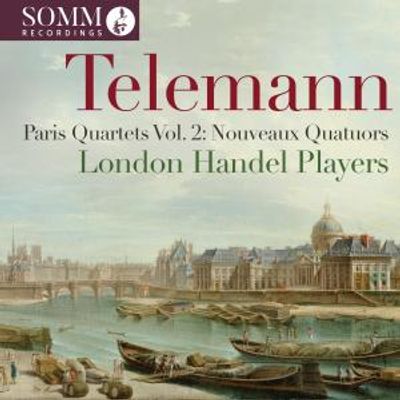
SOMM Recordings will release Telemann: Paris Quartets, Vol. 2 (SOMM 0732-2) on 16 October 2026.
In celebration of the 25th-anniversary of London Handel Players in 2025, SOMM Recordings released Telemann 'Paris' Quartets, Volume 1 (SOMMCD 0698). Critics lauded the album for its deep affection and impeccable musicianship, with Gramophone highlighting flautist Rachel Brown's 'easy agility' and the group's rich, inviting tone, and BBC Music Magazine praising their attention to subtle, expressive details. Now, SOMM is releasing Telemann 'Paris' Quartets, Volume 2 with LHP, featuring once again leading period-instrument specialists Rachel Brown, flute; Adrian Butterfield, violin; Gavin Kibble, viola da gamba; Sarah McMahon, cello; and Silas Woolston, harpsichord.
In 1737, Georg Philipp Telemann paid a long-awaited celebrity visit to Paris at the invitation of four prominent French musicians: flute virtuoso Michel Blavet; Franco-Italian violinist Jean-Pierre Guignon; viol player Jean-Baptiste Forqueray the younger, and an unidentified cellist-harpsichordist known in the historical records as Prince Edouard. In preparation for this visit and in admiration of the musicians, Telemann had composed six Quadri, for flute, violin, viola da gamba or cello, and continuo.
Telemann was one of the first great self-publishers, and his publication of the Quadri was such a success that the Parisian publisher Le Clerc brought out an edition without the composer's permission. This, finally, was the spur for Telemann to take an eight month leave of absence from his full schedule in Hamburg to visit Paris. While there, he composed a second set of quartets—the six Nouveaux Quatuors recorded here. It was in the second half of the twentieth century that the editors of the Telemann Musikalische Werke collectively named these two sets of quartets the 'Paris quartets.'
Like the earlier set of Quadri, the six Nouveaux Quatuors are scored for flute, violin, viola da gamba, and continuo, with an optional adaptation of the gamba part for cello. The set comprises six suites, each with six or seven movements, and Telemann exploits countless ways of combining the instruments to create a huge variety of textures.
All twelve quartets were played during Telemann's Parisian visit by the four musicians who had invited him, with the composer himself at the harpsichord. Paris was taken by storm, and news of the quartets spread throughout Europe, with subscribers to the publication including musicians like Charpentier, Mondonville, Fasch, Pisendel—and a certain Mr Bach of Leipzig.
Telemann's sojourn in Paris left a lasting impression on him. Two years after returning to Hamburg, he reported on the effect of his quartets: 'The admirable performances of these quartets … would be worth describing were it possible for words to be found to do them justice. In short, they … procured for me in a very little time an almost universal renown and increased esteem.'
Also Releasing 16 October 2026
SOMM Recordings celebrates the rich cultures of Cyprus with music inspired by this Mediterranean island and the legend of Othello, as conductor-composer Nimrod Borenstein and the Cyprus Symphony Orchestra perform works by Samuel Coleridge-Taylor, Antonin Dvořák, Franz Schubert, and Borenstein himself, on Legends of Cyprus: Othello (SOMMCD 0733). Previous Borenstein collaborations with SOMM include his label debut featuring three of his piano compositions (SOMMCD 281), and the release of his Shakespeare Songs, Mandolin Concerto, and Oboe Concerto (SOMMCD 719). The CySO is both a strong presence in the musical life of the island and a national symbol that represents the Republic of Cyprus internationally.
The album's title work, Legends of Cyprus, composed by Borenstein for the Cyprus Symphony Orchestra in 2025, evokes an entire world of feelings, atmospheres, and magical stories. The composer describes the piece as a continuation of his exploration of richly contrasted orchestral colours and emotional worlds, but within a more concentrated single-movement form—a form akin to 'what the short story is to the novel.'
Shakespeare set four of the five acts of Othello on the island of Cyprus, where the tragedy of Iago's manipulation of the Moorish general into believing the infidelity of the innocent Desdemona plays out. The gifted and tragically short-lived Afro-British composer Samuel Coleridge-Taylor was commissioned by the actor-manager Sir Herbert Beerbohm Tree to write incidental music for a 1909 production of Othello at His Majesty's Theatre in London. Three years later, Coleridge-Taylor drew from his theatre music a vibrant five-movement orchestral suite.
When Antonín Dvořák arrived in New York 1892 to take up the post of Director of the National Conservatory of Music, he brought with him Nature, Life, and Love, a cycle of three concert overtures. He had composed the third, Othello, earlier that year and conducted the premiere of the trilogy as part of a farewell concert in Prague. Although named a concert overture, Othello is close to being a symphonic poem in its dramatic musical interpretation of Shakespeare's play and its frenetic climax of the tragic events.
Rosamunde, Princess of Cyprus by the German playwright Helmina von Chézy concerns the attempts of the heroine to reclaim her throne despite the efforts of the governor to thwart her. The play closed after two performances in 1823 and is all but lost, though the music written by her friend Franz Schubert—known as his Incidental Music to Rosamunde—remains an absolute triumph of the Romantic era. It consists of nine numbers, and included on this disc are the famous Entr'acte No.3 and Ballet No.2.
SOMM Recordings is also presenting Vol. 1 in a new series that offers remastered performances of George Szell in New York (ARIADNE 5051), releasing 16 October 2026. This first volume features live performances of Franck's Symphony in D minor and Sibelius's Symphony No. 2 from CBS Radio air checks made at Carnegie Hall with the Philharmonic-Symphony Orchestra of New York—an earlier moniker of the present-day New York Philharmonic Orchestra. These recordings come from the extensive music collection of producer and master sound restoration and remastering engineer, Lani Spahr, who also provides liner notes for this album.
When George Szell (1897 – 1970) was appointed the Cleveland Orchestra's fourth music director in 1946, and spent the next 24 years of his tenure honing it into one of the finest music ensembles in the world, his name became synonymous with the orchestra. To this symbiotic relationship, he brought his formidable experience with a variety of orchestras in both his native Europe and the United States.
Szell's first conducting experience in America was in 1930, when he made his debut with the St. Louis Symphony. In October 1939, he and his wife, Helene, arrived in New York, having decided to wait out the war in the United States. Though initially finding himself in the unusual position of having no work, Szell started to receive guest-conducting offers from orchestras around the country, including the Los Angeles Philharmonic. His star began its rapid rise in New York with his engagement at the Metropolitan Opera in 1942, and he made his debut with the Philharmonic-Symphony Orchestra of New York on the Fourth of July 1943. His relationship with the Philharmonic would span 27 years.
Szell conducted the Symphony in D minor by Cesar Franck over 20 times in the United States. His first performance with the Philharmonic in New York was on 28 February 1948, and the last was 6 April 1970. This present live recording comes from 6 December 1953.
From the early 1950s, the Symphony No. 2 in D major by Jean Sibelius was a staple of Szell's programming, and he performed it more than 60 times. He conducted it with the Philharmonic in Carnegie Hall on 15 and 16 January 1953, and again on 18, whence this broadcast originates.
In the minds of many, the orchestra that George Szell honed in Cleveland would never be equalled for its disciplined execution, unparalleled clarity, and unanimity of phrasing. Lani Spahr makes the observation that 'when listening to these recordings it becomes obvious that the Philharmonic was, at this time, a superior orchestra, top to bottom, to what Szell was in the process of building in Cleveland.'