


Review: TOM AT THE FARM, Barbican Theatre
A politically charged tale of homophobia where style triumphs over substance.
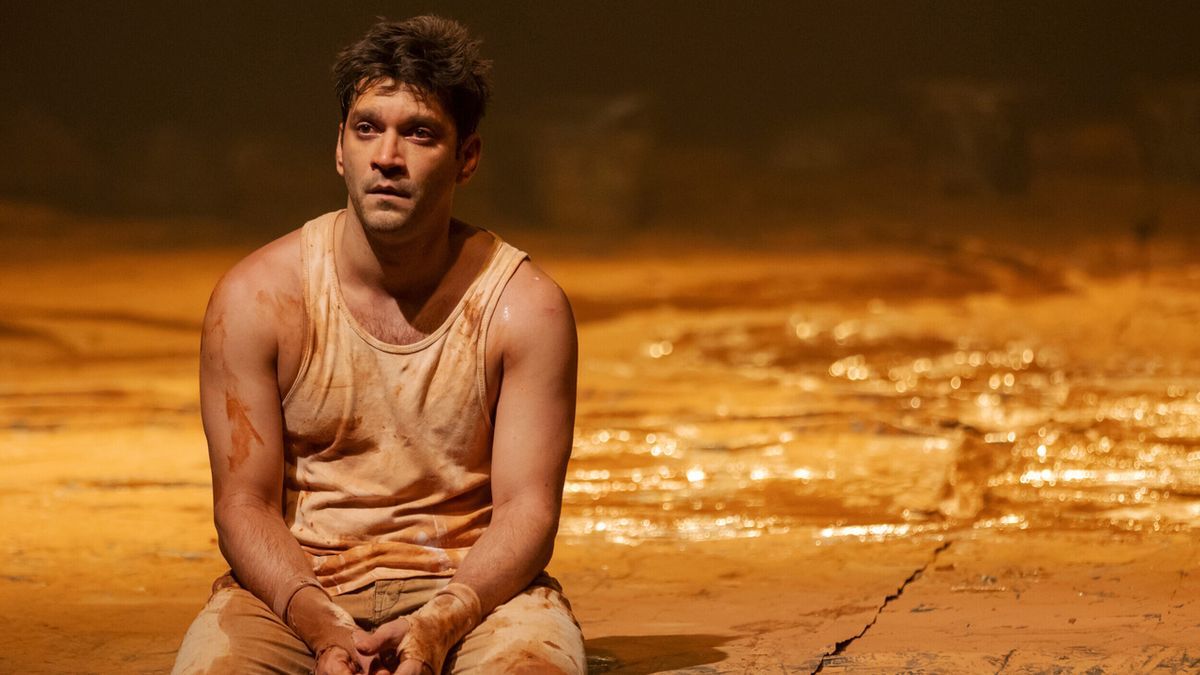

Armando Babaioff's Tom at the Farm sets itself a challenge from the start. A tale as old as time, staged on an iconic scale and approached through a complex and sensitive lens, it has all the ingredients to make for compelling theatre. At each hurdle, there are flashes of real power yet, somewhere between style and substance, there is a disconnect. For all its promise, this production falls short of fully realising what it sets out to achieve.
Tom travels to a remote farm for the funeral of his boyfriend, only to discover that the family know nothing of their son’s relationship with him. What follows is an uneasy entanglement of grief, desire, masculinity and homophobia, as Tom forms a complicated bond with his boyfriend’s brother. There is a suggestion that the two men begin to see something of the deceased in one another, blurring the boundaries between mourning, attraction and identity. But while the ingredients are there, the production never quite brings them together into anything majorly affecting.
Part Wuthering Heights, part God’s Own Country, this is a familiar tale viewed through an interesting lens - a country in the midst of civil unrest. It doesn’t necessarily need to reinvent the wheel, but it does need to give us a reason to look at it differently. Frustratingly, the production repeatedly introduces fascinating ideas only to abandon them before they have the chance to take hold.
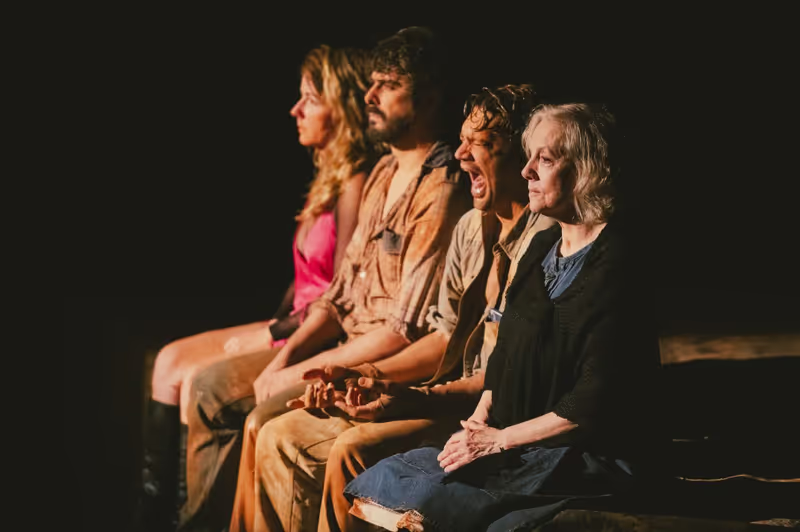
Photo Credit: Alex Woloch
There is much to admire physically. The movement, choreographed by Toni Rodrigues, is excellent, with a dance sequence providing one of the production’s most visceral moments. Aurora dos Campos’ mud infused set is effective, and Tomás Ribas’ lighting design is particularly strong - offering real focus to some of the more sensitive scenes. The piece if performed in Portuguese and the surtitles, projected throughout, offer an arresting visual dimension of their own; there is something mesmerising about having the words and their meaning laid bare in front of you, allowing certain moments to land with a striking directness. However, there is a disconnect between the production’s visual confidence and its dramatic substance. Style can only carry a show so far, and eventually the substance needs to catch up.
The problem is that nothing is allowed to breathe. Tom’s shifting perception of his deceased partner, his potential attraction to the brother, and the complicated emotional territory between the two are all introduced within minutes and are never explored with the patience or precision they deserve.
The same problem extends to the production’s treatment of homophobia. A particularly violent scene is introduced only for the tension to be dispelled through banter between the characters moments later. The homophobia that permeates the story is repeatedly folded into this same register, leaving us uncertain whether the intention is to demonstrate how normalised such prejudice has become, or whether the production simply doesn’t know how to sit with its consequences.
What does it mean for Tom to be confronted with a family who refuse to acknowledge the person he loved? How does the brother reconcile his own masculinity with his growing proximity to Tom? How does the political and cultural landscape of Brazil inform these relationships? Playwright Michel Marc Bouchard’s text raises these questions, but Rodrigo Portella’s production rarely stays with them long enough to offer any meaningful insight.
And yet, I can’t say it wasn’t a good show. My partner and I, two queer men who have surely experienced homophobia in our own lives, left the Barbican and immediately launched into a lengthy debate about what the production was trying to say. We both found ourselves researching Brazil’s current political landscape, eager to understand the context and implications of what we had seen. Only then did I begin to appreciate the tensions Brazilian queer communities are facing in the coming weeks, and the urgency of the context surrounding this production.
There is something commendable about a piece that inspires that curiosity, and the team behind Tom at the Farm have clearly brought a story with the makings of something worthy of our thought to the stage. But I wish the production trusted itself as much as I trusted the creators behind it.
Tom at the Farm runs at the Barbican Theatre until 17 October
Photo Credit: Victor Pollak
Sign up for all the news on the Fall season, discounts & more...




Reader Reviews
To post a comment, you must register and login.