


Review: THE SECRET GARDEN at MacHaydn Theatre Is a Force of Nature
The revival of the 1991 musical runs one more week
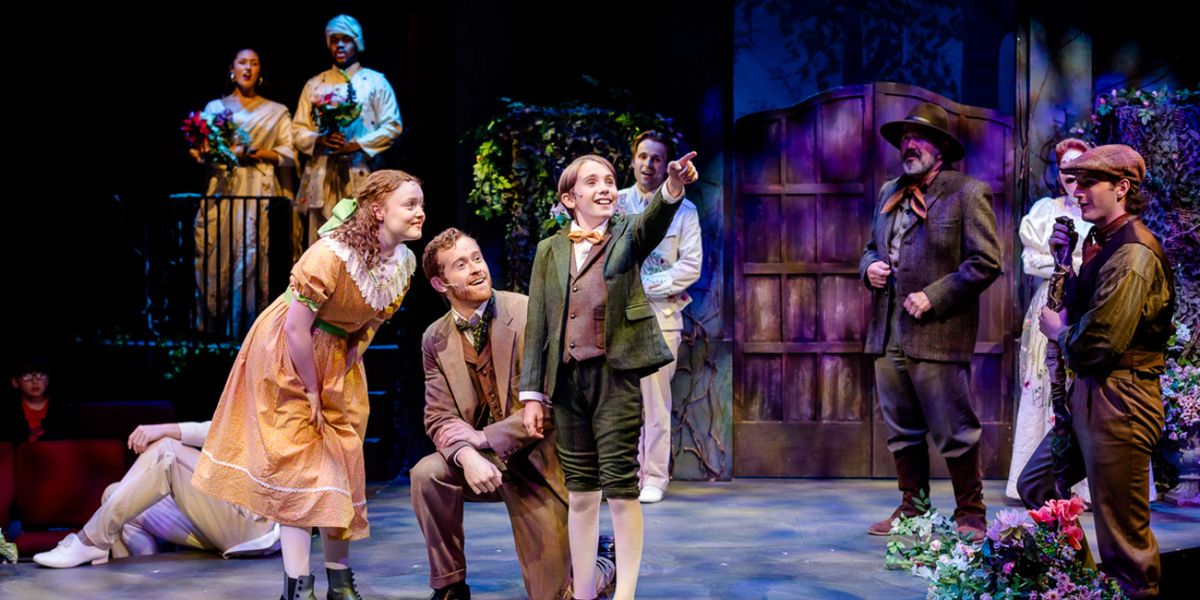
Critics hoard their superlatives, and for good reason. Spend them too freely and they stop meaning anything. So I want to be careful here, and I want to be early: the production of The Secret Garden now playing at the Mac-Haydn Theatre is the best work I have seen on a summer stage this season.
It runs one more week. Get tickets!
The Secret Garden is not a commercial brand. It has been a beloved novel for a century and a fine film more than once. Agnieszka Holland's 1993 version is still the one to beat, but it arrives with no franchise behind it and no jukebox score. And so I suspect there are seats sitting unsold this week, held by people waiting for something louder. I'd like to tell those people, gently, that they are about to miss the thing they say they're looking for. They will also miss the fact that Lucy Simon wrote tunes that follow you into the parking lot, "Come to My Garden" chief among them, a melody that begins as a lullaby and ends, by the close of the evening, as the anthem of the whole show.
Because here is what director John Saunders has understood, and it is rarer than it sounds: The Secret Garden is not a children's story about a girl who finds a key. It is a ghost story about a house full of adults who cannot bury their dead, and about a child who is the only person in it bold enough to insist on being alive. Saunders stages the Dreamers (the ghostly ensemble) not as a gimmick but as a pressure system, a weather of the unburied, crowding the living to the edges of their own rooms. The dead are always present. That is the show, and he has found it.
That reading depends entirely on the world Mary is torn out of, and here the production is on very sure footing. Aubrey Dunbar's Fakir and Tzintli Cerda's Ayah are not decorative. They are the mystical spine of the piece, the couple who carry India into Yorkshire, watchful, unhurried, present long after they should have faded. Beautifully played, both of them. The supernatural in this production is credible because they make it so.
At the center of it, a force of nature.
I want to be precise about Wild Handel's Mary Lennox, because "force of nature" is what critics say when they've run out of nouns. I mean it structurally. Handel plays Mary as an irritant; sour, imperious, impossible, a girl with no charm and no interest in acquiring any, and refuses, for a long while, to soften her. It is a brave choice and an unglamorous one, and it is the right one, because it means the thaw is earned rather than announced. She does not perform the transformation; she undergoes it. When the change finally comes, it arrives in the smallest places, and you find you have been watching a whole person assemble herself in front of you. Handel has a startling instrument and, more startling still, the discipline to hold it back. She carries the evening without ever appearing to carry anything.
Elizabeth D'Aiuto's Lily is the show's center of gravity: a soprano of unusual purity and control, patient, unpressed, and crucially, never sentimental. That is the trap in this role, and she never steps into it. How lucky we are that she has taken a break starring as Marion in the national tour to entertain us all in Chatham.
Then the brothers. Kevin Egan's Archibald Craven is a magnificently ruined man, a tenor with grief in the grain of it, and Logan Pavia's Dr. Neville Craven matches him, beautifully sung, coiled, unsettling in exactly the right measure. When they reached "In Lily's Eyes," the two voices locking into thick, wounded harmony, they stopped the show. Not metaphorically. The applause came up and kept coming.
The surrounding work is of the same order. Kitty Baker's Mrs. Medlock is stoicism as a survival strategy, every line clipped, every feeling shut in a drawer somewhere upstairs, and more affecting for it. Nina Laing's Martha finds the exact tone the part requires and holds it without a single false note: warm, plainspoken, entirely without syrup. And when the house has closed around Mary and everything she loves is about to be taken from her, Laing plants her feet and sings "Hold On," which is not comfort and does not pretend to be. It is instruction. It's the storm, not you, that's bound to blow away. A housemaid with no power in that household hands a frightened child the only thing she has, which is the knowledge of how to outlast a thing, and Laing delivers it with a force that frames the entire show. Hudson Brown's Dickon is spot on, a beautiful, easy voice and an accent he wears rather than performs, entirely at home in the natural world and unbothered by everything outside it. And Colin Czornobil, as Colin, is a young actor to watch; there is real intelligence in what he is doing in that sickbed, and real fear underneath it.
Honorable mention to Jessica Cerreta and Jacob Atkins as Rose and Captain Albert Lennox, Mary's ghostly parents. Lovely presence, excellent voices, and a hovering sorrow that never tips into sentiment.
The ensemble is magnificent, and I mean the whole company: Law Peachy-Williams, Will Forrest, Jack Gemmell, Michael Daly, Grace Mauldin, Bella Pavia, Kevin Weldon, Maxwell Vann. They move as one organism and they sing like a far larger company than they are.
Connor Crotzer Scartascini's music direction (with Ethan Swanson assisting) treats Simon's score with the seriousness it has always deserved. Anthony Michael Velez's choreography is smart enough to know when not to dance and charming when it does. Alvia Cross's scenic design and Andrew Gmoser's lighting make Misselthwaite feel less like a set than a true place in time. Bethany Marx's costumes are exquisite. Chloe Wiederhorn's props, George LaChance's sound, Summer McCormack's hair and makeup, every department is pulling in the same direction. A specific bow to Production Stage Manager Samantha Wood, because a show this intricate does not run this cleanly by accident.
One small note, offered in the spirit of a production I admire: the body mics ran hot on Saturday, a brightness on the consonants that occasionally put a hard edge on a soft moment. A trim, not a flaw, and the only thing in this review that isn't praise.
It helps, too, that the Mac-Haydn is such a pleasure to sit in. The house is intimate, nearly in the round, and it puts you close enough that a whisper carries, which matters enormously in a piece built on sorrows people won't say out loud. Come early for the snack bar, or earlier still and make an evening of it; the restaurants in this corner of Columbia County are among the best reasons to live here.
I don't use the word unmissable often, and I'm aware of what it costs to use it. I'm spending it here on purpose. The Mac-Haydn has had a long run of good work, genuinely an embarrassment of it, and this is the best of it.
The Story, Briefly:
Mary Lennox, an unloved and unlovable child, is orphaned by a cholera epidemic in colonial India and sent to Yorkshire to live with an uncle she has never met. Archibald Craven's estate, Misselthwaite Manor, is a house in permanent mourning: his wife Lily died ten years ago and he has not recovered, and his brother Neville, a doctor and a man with reasons of his own, presides over the wreckage. Mary discovers two things that have been locked away since Lily's death: a walled garden, gone wild, and a cousin, Colin, kept bedridden and half-convinced he is dying. Refusing to be managed, she sets about bringing both back to life, helped by the housemaid Martha and her brother Dickon, who has a way with growing things. What she is really doing, and what this production understands, is forcing a house of the living to stop taking its instructions from the dead.
Where It Comes From:
Frances Hodgson Burnett published The Secret Garden as a novel in 1911, after serializing it the year before. It was not the great success of her lifetime (that was Little Lord Fauntleroy), but it has outlasted everything else she wrote, and "children's classic" undersells a book that is fundamentally about grief, neglect, and the stubbornness required to survive both.
The screen keeps returning to it: MGM's 1949 version with Margaret O'Brien, which famously bloomed from black-and-white into color when the garden did; Agnieszka Holland's severe and beautiful 1993 film; and a 2020 adaptation with Colin Firth and Julie Walters.
The musical opened on Broadway in 1991 at the St. James, with music by Lucy Simon and book and lyrics by Marsha Norman, the Pulitzer winner for 'night, Mother. Norman took the Tony for Best Book; Heidi Landesman won for scenic design; and eleven-year-old Daisy Eagan, playing Mary, became the youngest woman ever to win a Tony Award, a record she still holds. It ran more than seven hundred performances. Simon, sister of Carly Simon, died in 2022, and her score (lush, strange, thick with Victorian and Celtic ghosts) are worthy members of the classic musical theatre cannon.
Go!
The Secret Garden runs one more week at the Mac-Haydn Theatre in Chatham. Tickets are on sale now. Don't wait.
And there is plenty more worth subscribing for. Here is the rest of the season:
On the Mainstage
• Newsies, July 23 to August 9
• Beautiful: The Carole King Musical, August 13 to 23
• Hairspray, August 27 to September 6
Special Events
• Daddy Long Legs, July 29 and 31
• Showstoppers, September 2 and 4

|
Così Glimmerglass Festival (7/17-8/14) |
|
|
Così Glimmerglass Festival (7/17-8/14) |

|
Fellow Travelers Glimmerglass Festival (7/18-8/16) |

|
Madame Butterfly The Glimmerglass Festival (7/11-8/17) |

|
Oklahoma! The Glimmerglass Festival (7/10-8/17) |
|
Annie Jr. Foothills Performing Arts Center (7/24-7/26) |
|
Late Nite Catechism The Stanley (10/17-10/17) |
|
Jersey Boys The Stanley (10/14-10/15) |

|
Clyde's Capital Repertory Theatre (4/23-5/16) |
|
OFC Creations Theatre Presents: Miss Saigon OFC Creations Theatre Center (5/06-5/23) |
Reader Reviews
To post a comment, you must register and login.