


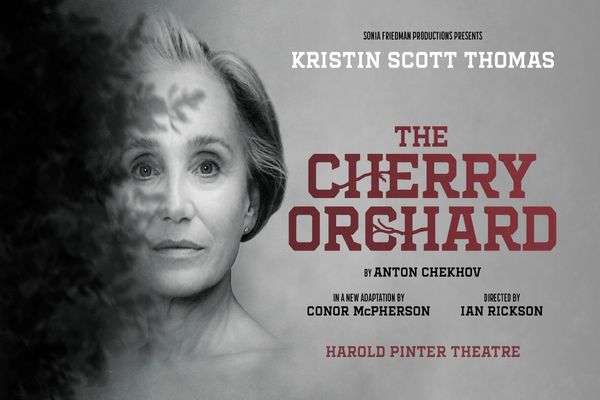
Review: THE CHERRY ORCHARD, Starring Kristin Scott Thomas, Harold Pinter Theatre
Gorgeous, if somewhat soulless, adaptation of Chekhov's masterpiece


Even inside the old manor house, it’s cold on a Russian night in May. That’s a hostile environment for a building to survive, even if a skeletal staff maintains it. So when Madame Ranevskaya returns from a voluntary exile in Paris, broke and lonely, she sees herself in this ageing, still noble family home. She also sees her past, gloriously in the shape of the ancient cherry orchard outside the window, but also tragically in the nursery of her son, drowned at 12 years old.
Lopakhin has a very different set of associations, his past rooted in his grandfather’s serfdom and his father’s physical abuse, his present that of a self-made man, a merchant who can’t dress well, can’t speak well nor even read and write well, but is in possession the money the mortgaged estate requires to survive.
He recalls an act of kindness when he was a hormoned-up teenager. Ranevskaya, a little older and a lady, comforted him and dressed his wounds when his nose was broken, an intimacy that would live long in the mind of a man. He has been in love with her ever since and still not married, though it’s supposed to happen with Varya, Ranevskaya’s adopted daughter and clearly, cruelly, second choice.
As a businessman also knows he has that debt to pay back to Ranevskaya; being a man he wants to stand above his family history and fight back against his father, now dead. He can help Madame and defeat his history by owning the estate. But he also, naively, expects gratitude and a more equal relationship with the grand, but bankrupt, Madame that might… Well, a man can dream - and dream he does.
That’s the emotional powderkeg on which the not-lovers sit, surrounded by characters who represent Russia tilting towards revolution at the end of the 19th century, railways, the arteries that opened up that vast land, the engines of social and political change.

Being Chekhov, this cavalcade of humanity is also drawn with such sympathy and wit that any of them could sustain a play of their own. The great man was to die - at 44, the life of a physician ministering to the peasantry an inevitably short one - so this was his last play. We’ll never know if he planned to tell us more of Anya’s new life after her return to Paris; of the man on the make, Yasha, with his dream of a tailoring shop on the Champs-Élysées; or of the full-time student and part-time revolutionary, Petya.
Kristin Scott Thomas gives Madame an all but insufferable hauteur on her arrival back in the house, Chloe Lamford’s set including a nice detail, children’s heights marked on a wall. She bathes in the warm glow of nostalgia, pointedly ignoring the nervous Lopakhin (Stephen Mangan very good at that awkwardness) who represents her cold future. She also knows that the man is literally the sum of his success, the monied new middle class in human form, the wave that is pushing her aristocratic elite aside. She is too refined, perhaps too kind, to do more than that, but how can she make conversation with a man whose every word stabs at her soul?
Not so her brother, the pompous fool, Leo (Peter Wright going for the grotesque) who says aloud what Madame is surely thinking, but Lopakhin and Yasha, a nicely arrogant Noof Ousellam, can ignore him, his day long gone. Firs, a tremendous turn from Karl Johnson, is the old retainer who longs for a mythical past, when everyone knew where they stood, and isn’t shy to express it swearily in Conor McPherson’s very 21st century adaptation of Helen Rappaport’s literal translation.
This occasional jolt into present day vernacular does allow the bleak comedy to come through (the man for whom the theatre was named would surely approve) with the balance of the first half especially on the second element of the tragicomedy. But Firs, for all his longing for old school oppression (a feeling many older Russians share today with regard to Soviet times), is also suffering from dementia, which rather dries the laughs in the back of the throat - or it does for some of us.
The women, not just Madame, carry the poignancy and possibilities in the play. Vinette Robinson is a bundle of hard work, frustration and incipient disappointment as Varya, coming to life in the party scene, but, in the play’s brutal final scenes and to devastating effect, realising that her once mapped out future will never happen. Anastasia Martin shows Anya’s possibilities shrinking as her mother shies away from responsibilities and is drawn to Petya (a dishevelled Jack Riddiford) because she longs to be an outsider too and he’s the only one she knows.
Starting from a much lower base, Dunyasha has more opportunities in the emerging world, Megan Cusack feisty and flirty as the housemaid asserts her personality. She talks back to her social superiors and coquettishly leads men on, only to turn on her heel and walk away. There’s a madame and a madam in this production!
The Cherry Orchard is a state of the nation play - any time, any place - but it’s also a monument of literature, making the heart soar and dip as you see these fragile men and women make mistakes and take their chances. But Ian Rickson’s production doesn’t quite catch all the heights and depths of the emotions, the technical efficiency rather limiting the stakes. Do we really feel Madame’s despair as the orchard is cut down in plain sight as she stands next to her luggage, never to return? Do we really feel Lopakhin’s insensitive triumph, guilty but holding back a smirk? Do we really feel Firs’ isolation in a new world come to crush him at last?
Perhaps we only get that punch from poor Varya’s crumpled face, so it is there, just held at arm’s length in a production of the second greatest play by the world’s greatest playwright - which just goes to show how high the bar is set.
The Cherry Orchard at the Harold Pinter Theatre until 9 January
Photo images: Johan Persson

Sign up for all the news on the Fall season, discounts & more...
|
Powered by

|







Reader Reviews
To post a comment, you must register and login.