


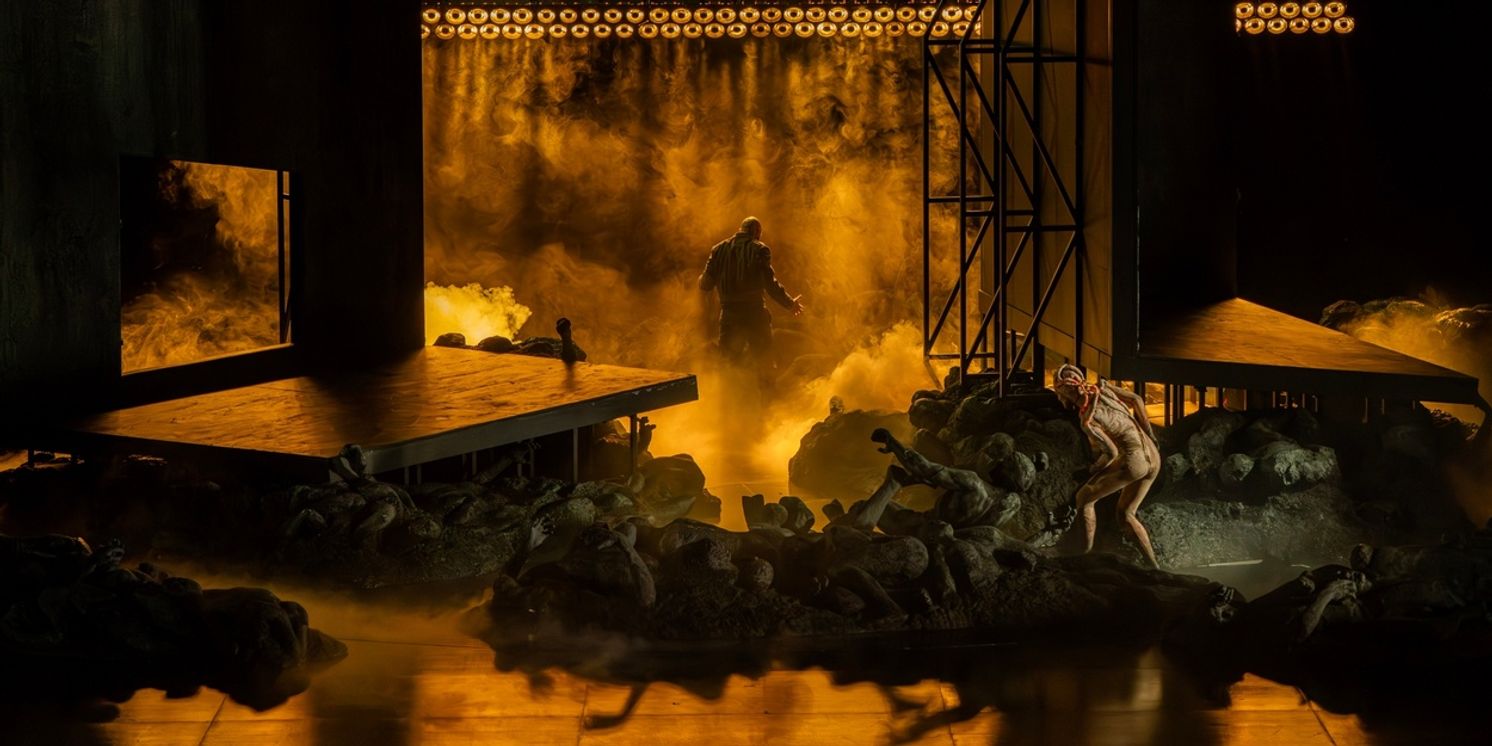
MEDUSA at La Monnaie opens with a sound that feels like it’s coming from somewhere far away, then closer, then right at your throat. An eerie choral orchestration approaches in waves, growing louder and heavier, until the stage itself seems to answer it. A black set begins to move, pivot, and breathe, with fingers hanging from its surfaces. Then Medusa appears in white, framed by long red hair, while her two sisters, Euryale and Stheno, orbit her in black robes and strange headpieces, like omens.
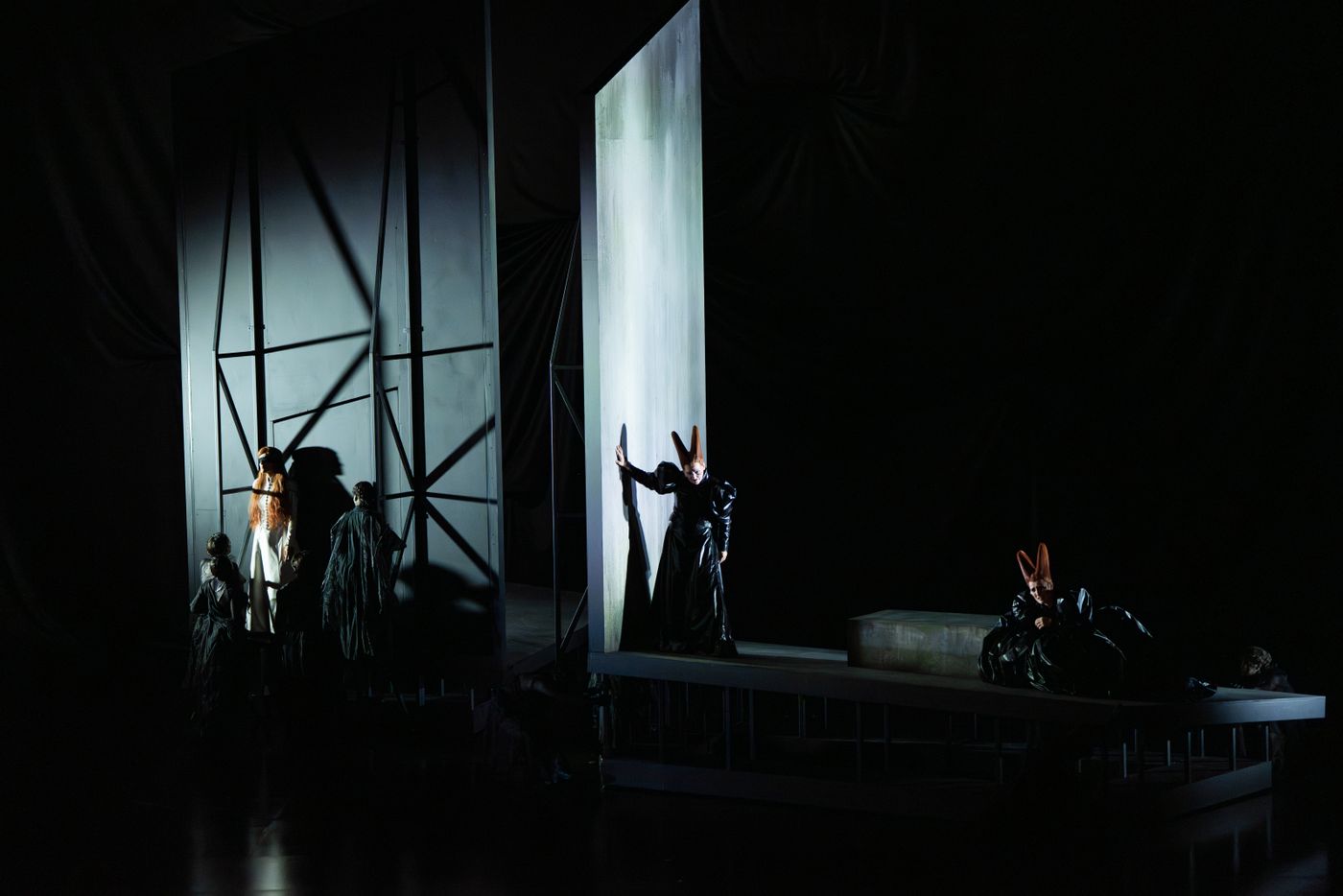
It’s a first scene built around dialogue and tension, rather than action, and Lydia Steier solves the obvious risk immediately. The set never stops carving the space. Figures push and pivot the architecture, creating constant visual dynamics that keep the eye engaged without distracting from the singers. The black cloth background reads as sea and wind and darkness, all at once, with folds that echo through the costumes as a clear design language. Flurin Borg Madsen’s sets stay minimalistic and expressive, and they keep the scene alive even when the text chooses stillness.
Iain Bell’s score feels entrancing from the start. It’s cinematic in the strongest sense. If you removed the voices, most of this orchestral writing could sit under a thriller, suspense, or horror film without losing any impact. That’s a pleasure to hear in an opera house, especially when it’s delivered with such musical color and contrast. Under Michiel Delanghe, the La Monnaie Symphony Orchestra sounds amazing. It keeps the tension alive, shapes crescendos with precision, and supports the stage action with a steady, constant and dramatic pulse.
A lullaby lands as one of the evening’s early emotional anchors. Bodies coil around Medusa, creating a physical language of movement and danger, as if the air itself is tightening. Then the action shifts to Athena’s temple and the production pulls a bold card, real fire, centre stage. It’s a stunning choice. I loved that! White grey walls catch orange shadows from the flame, and a golden chorus of priestesses appears behind it, masked and gleaming. The temple feels cold. The fire feels sacred and lethal at the same time.
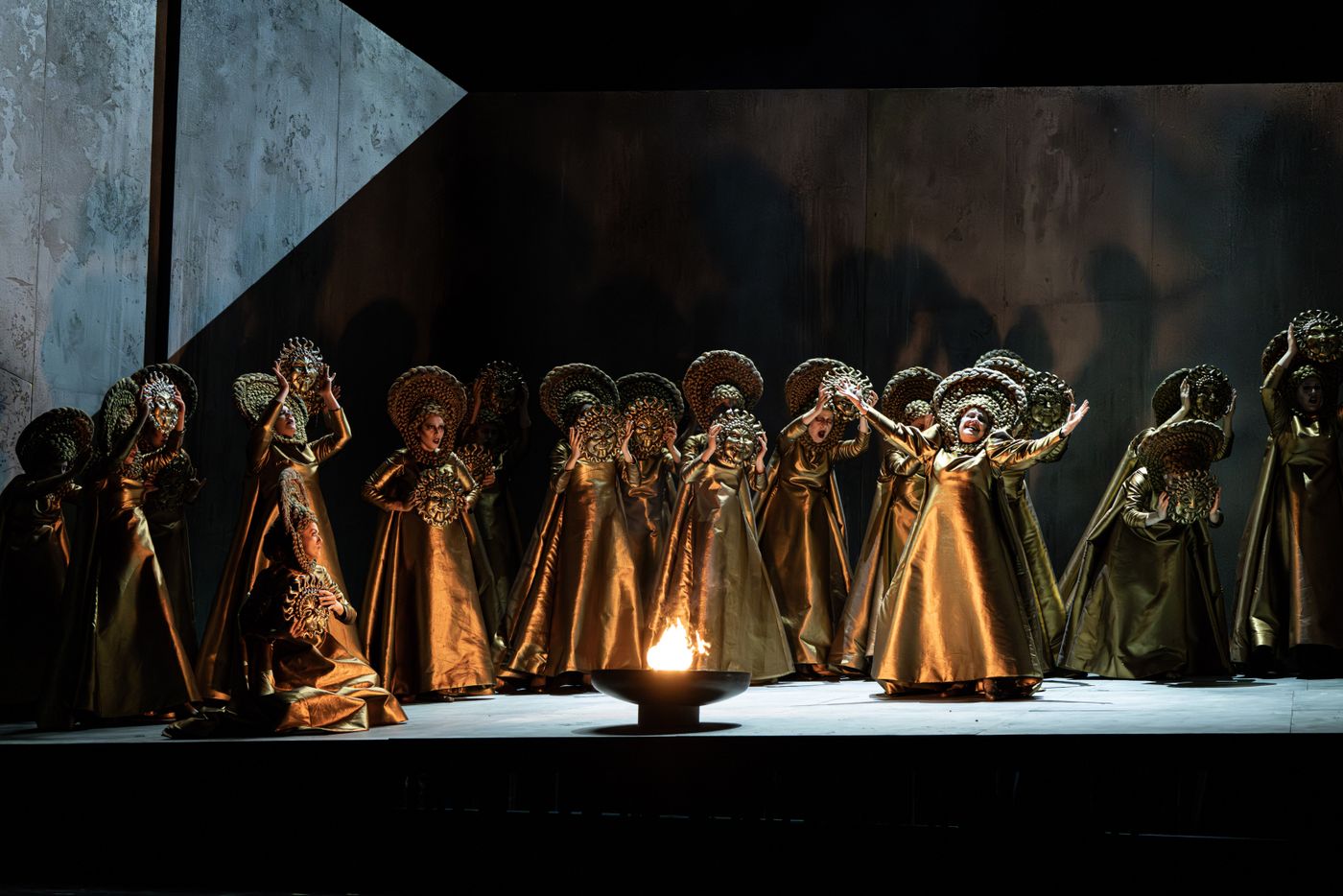
Anu Komsi, as the High Priestess, navigates a complex vocal line with sharp, cutting authority.
Poseidon walks on stage from the wings, dressed in immaculate white, with a modern simplicity that surprised me. Konstantin Gorny sings the role with commitment, yet I expected a much more spectacular reveal. Visually, the choice reduces the god’s mythic scale. If this was intentional, it felt more like a statement than a piece of the story. Dramaturgically, it may be a deliberate move, pulling Poseidon closer to the present as a symbol of the violence men can inflict. Either way, it’s a choice the staging commits to, and it didn’t work for me.
The assault scene is handled with pure theatrical intelligence. It builds through cat and mouse tension, with Medusa’s growing desperation rising in clear crescendos of unease. The moment is disturbing, as it should be, and it’s staged with enough stylistic care that it remains clear without turning exploitative. Without this scene, the story’s psychological tragedy collapses. In a cultural climate where theatre often self edits out of fear of discomfort, La Monnaie and the production team deserve the highest credit possible for presenting this moment with courage and clarity. The scene makes the tragedy unavoidable, and it drives Medusa’s arc with brutal honesty.
Claudia Boyle’s Medusa is extraordinary here and throughout the evening. She shows depth, colour, and real skill in portraying pain, despair, and shame. Her acting is on a level opera audiences don’t always get, and it feeds the voice rather than competing with it.
Athena’s appearance is the opposite of Poseidon’s. Mary Elizabeth Williams arrives huge, towering, golden, hovering above a broken Medusa. The staging uses scale inventively, and it makes the judgment feel crushing. The punishment that follows includes one of the most striking vocal acting moments of the night, from Anu Komsi, where the sound fof her voice fractures into shouts, sung tones, laughter, and a cracked loss of speech., as madness creeps into her body. Tension keeps rising as the priestesses are blinded, and the act ends as a genuine horror sequence, with Medusa’s transformation held back just enough to leave the audience suspended while the set breaks and splinters under Athena’s gaze.
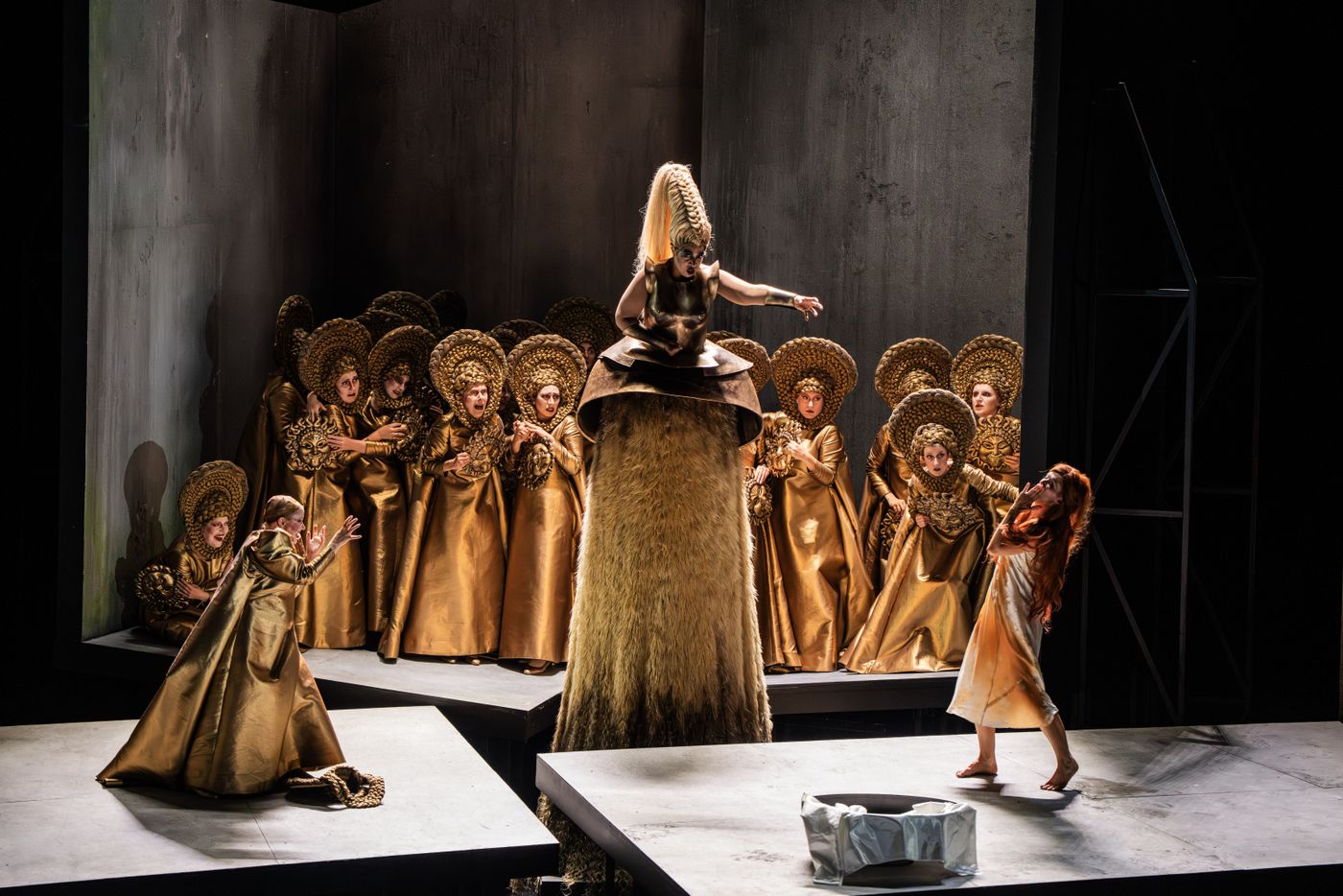
Elana Siberski’s lighting and Katharina Schlipf’s costumes are among the production’s strongest achievements. Apart from the two modern male costumes, which didn’t work for me at all, the rest builds tragedy through a purified visual unity that feels beautiful, shocking, simple, and somehow transcending.
Act Two begins in a tableau that hits like cold air. The stage is filled with bodies turned to stone. The stillness is so complete you can see the stone dust rising in the light. It’s a powerful contrast to Act One’s constant movement, which felt like the sea. Here, everything is dead, fixed, petrified. A solo violin accompanies Medusa’s movement, a beautifully chosen colour that suggests lost innocence and isolation. Then the entire stage begins to revolve, creating a film like sensation of a camera making a full arc around her.
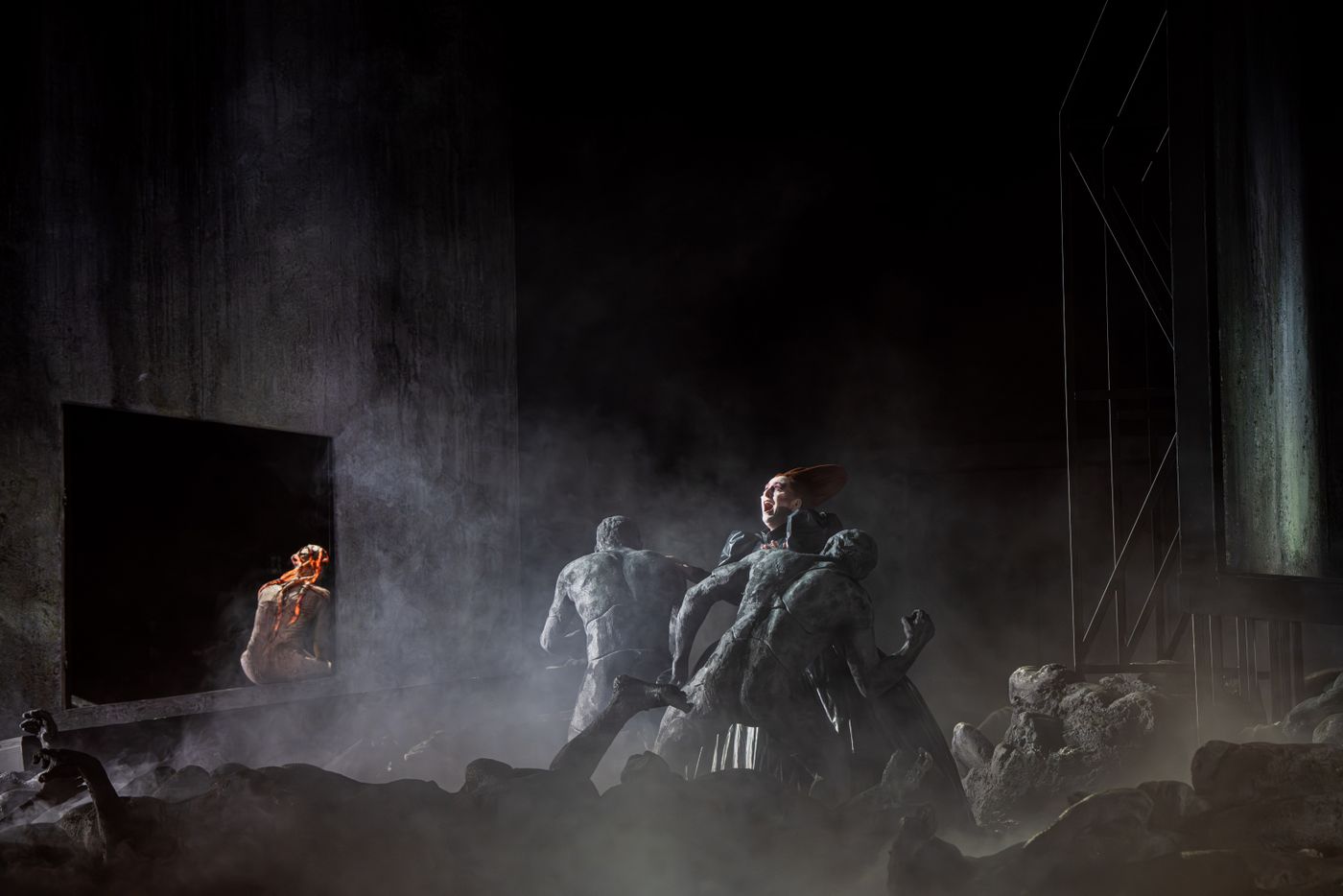
Medusa’s physicality is outstanding. She moves like a hybrid of human and serpent, with a body that holds rage, fragility, and despair in quick succession. The one design element that underwhelmed me personally was the serpent hair. I wanted the snakes to feel alive. Here they relied on lighting shifts, with red illumination appearing at moments, which didn’t match the production’s otherwise high level of invention. In our age, an animatronic headpiece with constantly moving serpents would’ve made her character even more spectacular in this second part. One should never be afraid to invent what doesn't exist.
One of the most spectacular sequences of Act Two is the turning of a sailor to stone. A bar of lights descends like rows of snake eyes. When Medusa fixes her gaze, a strong light floods the scene and catches the smoke in colour. When it dims, the transformation is revealed, and Medusa shatters the stone body into pieces. It’s a brutal image, and it’s staged with real beauty.
Josh Lovell sings Perseus very well, yet his acting style felt exaggerated compared to the rest of the cast’s grounded, detailed approach. His modern costume, a simple black vest and trousers, also sat awkwardly against the production’s spectacular visual universe. The same modern costuming choice for Poseidon created a similar separation for me. It didn’t feel accidental. It felt visually dissociative.
The ending left me slightly underwhelmed, though I’m not fully sure where the final weight slipped. It may have been an orchestral climax that didn’t land with the force the earlier acts trained us to expect. It may have been the final staging rhythm. That being said, the evening still holds as a major achievement.
MEDUSA is a brilliant production. It’s courageous, new, and sharply modern in how it frames tragedy. Bell’s score merges operatic writing with a filmic sense of tension, and Steier’s staging has the courage to confront the story’s darkest truth head on.
One last note, aimed at the audience rather than the artists. Some people booed the performer playing Poseidon during curtain calls. He played a villain. This isn’t pantomime. If anything, he deserved huge respect for taking on a profoundly difficult role with commitment, control and great acting.
Final rating: 9/10 (Strongly recommended for audiences who want opera that feels cinematic, contemporary, and unafraid).
Photo Credits: Simon Van Rompay
Reader Reviews

Videos