


Review: JESUS CHRIST SUPERSTAR at the Carrollwood Cultural Center
Closes Sunday, March 22nd!
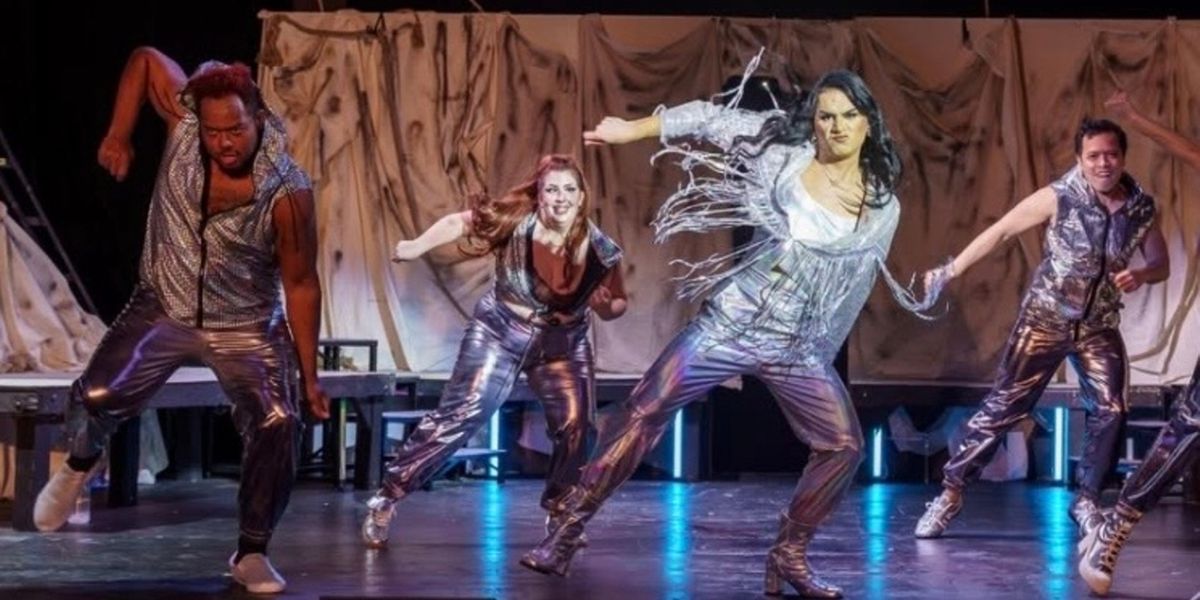
Before it was ever a Broadway show, the rock opera JESUS CHRIST SUPERSTAR started as a much-debated concept album. Written by two young, then-unknown Britishers—Andrew Lloyd Webber with the music and Tim Rice with the lyrics—the double album became a touchstone to my generation. But the modern-day puritans pooh-poohed it. They didn’t trust that a rock score—the “devil’s music” as some of them thought—could rightfully carry the message of God; they wanted their religious music to be reverential with either gospel singers or country crooners leading the way.
JESUS CHRIST SUPERSTAR hit the zeitgeist jackpot when the newfound Jesus Movement emerged that same year (a sort of “Jesusmania” to the young who turned away from drugs and found God). Blooming from the Sixties Flower Children, this movement reached its apex in 1970 with songs like “Spirit in the Sky,” “Put Your Hand in the Hand” and George Harrison’s Krishna-fueled “My Sweet Lord” pushing their way through the crackle of AM radio. Leading the way that year was JESUS CHRIST SUPERSTAR, which spawned two hit singles (“Superstar” and Helen Reddy’s version of “I Don’t Know How to Love Him”).
I remember when the album was first released days before my eighth birthday, and I overheard the heated arguments between my parents and my sisters about it. My mother thought any album with the words “Jesus Christ” and “Superstar” in the title had to be blasphemous, but she and my father did what any good parent would do before they would say yes or no to give us permission to listen to it: They researched the work. They attended a performance of JESUS CHRIST SUPERSTAR (long before it hit Broadway) and came out so moved that not only did they give their okay for my siblings to buy the record, but they allowed my sisters to attend that performance the next week as well.
The album, which focuses on the last week of Christ’s life, became an instant favorite of mine and I could actually perform a one-man show of it while in the third grade (probably still can). I danced to “Simon Zealotes,” wept through “Gethsemane,” laughed in “King Herod’s Song,” and remained horrified and deeply saddened by the cruelty displayed in “Trial Before Pilate” where Jesus lost (but to Christians like myself, ultimately won).
So, any company that puts on JESUS CHRIST SUPERSTAR is worthy of a celebration from me, and that’s certainly the case with the current production at the Carrollwood Cultural Center.
It’s 56 years after the album’s debut, and yet the show is still controversial. Last year in Los Angeles, Cynthia Erivo played Jesus to much applause and to some derision from patriarchal purists. The same holds true here with the casting of a strong black woman as Jesus in the Carrollwood Cultural Center’s production. Patty Smithey, one of my favorite local performers, inhabits the part with pathos, ferocity, yearning, power and grace. But I’m sure such casting ruffled the feathers of those who miss the point of the show (as well as the Bible) and want the person portraying Jesus to be boringly old-fashioned, cookie cutter, male and white.
Having a woman of color play the part universalizes the role, makes it more catholic (note the small c, not a capital C). People from all walks of life can identify with Christ’s divinity, making the role more welcoming and, a word that will cause ire with a certain segment of our country, inclusive. With Ms. Smithey in the title role, the material elevates itself into something beyond another Ted Neeley interpretation of JCS (not that there’s anything wrong with that). It tuns this timeless show into a very timely one.
There are some moments in this production that may not sit well with people who like their gospels safe and easy to swallow: It’s set in modern times, with cell phones recording Jesus’ final days. The Roman Guards in this JESUS CHRIST SUPERSTAR are not your usual steel-armored Praetorian police. In this, they are dressed like ICE Agents, their faces covered in black masks.
But this JESUS CHRIST SUPERSTAR is also a lot of fun to watch. At the start, the famous Overture plays and the cast, with the villains leading the way, walk down the aisle like a rollicking Entrance Procession in church. The apostles interact with the audience, like we’re at a party, which is appropriate for the early sections of the show. And then “Heaven on Their Minds” plays, led by the amazing Evan Lomba as Judas, and we are in for the fastest two hours of our lives.
This JESUS CHRIST SUPERSTAR is a lot of things; boring isn’t one of them.
Most of the cast are superlative. Evan Lomba’s Judas is such a unique, fascinating interpretation of history’s most misunderstood betrayer—part camp, part emotional wreck, all Lomba. At times the role comes across like Joan Collins meets the Spider Woman, and at others it’s like a rock star from an Eighties hair band has joined the show. Lomba hits outrageous notes, riffs unlike anyone in this universe, and sings fast and furious. My only qualm is that in some of his softer moments, the music plays too loud and his mic is not at the level where it should be, and it’s hard to hear.
But Lomba, who also choreographs (it’s a dance-heavy show), really gets to strut his stuff in “Superstar,” which is like a gospelized Vegas floor show. It’s the song Lomba was born to play, owning the stage so dynamically here that he could put Cher to shame.
Jessica Hill makes for a lovely Mary Magdalene, and her version of “I Don’t Know How to Love Him” is phenomenally moving. I don’t know if I see the sense of the fallen woman in her interpretation, the former prostitute who Christ befriends and saves, but she’s an incredibly strong presence.
David Groomes is haunting and correctly doesn’t overdo the villainy of Pontius Pilate. The key to the part, which Mr. Groomes grasps, is to humanize him, which makes his final fatal decision carry that much more weight. We are all like Pilate at one time or another in our own lives, making tough decisions, and hopefully we won’t be so wishy-washy, lacking empathy and easily offended when handing a verdict. (Unfortunately, in this production, in Pilate's most human moment—“Pilate’s Dream”—there was a mic explosion that immediately took us out of this haunting ode.) It’s quite a journey the character takes, seeing Christ as a mere irritation and then later having him beaten and realizing that this is where history will always define him (as one of mankind’s bad guys; no one aspires to be Pontius Pilate, at least I hope not). And Mr. Groomes’ delivery of his very last word—“Puppet!”—is a doozy.
Jackson Stoe is quite talented, but we never feel the sense of command and power with his Caiaphas, the high priest. He seems to have the exact same expression—dispassion verging on boredom—throughout the show. Caiaphas is surrounded by other priests (including the always reliable Luis Graham and Crais Ruska) as well as two people playing Annas, his worm-like colleagues (well-played by Katie Castonguay and Erin Ruska). They come across as the Flotsam and Jetsam to Caiaphas’ Ursula. Am I wrong to find it quite odd that the audience applauded and cheered the villains’ big number, “This Jesus Must Die”?
Topher Larkin’s King Herod is a meta-hoot, dazzling and unapologetically campy. There was a technical glitch on the night I went, and thank God (literally) that it occurred during this number. Mr. Larkin takes the improv reigns and runs with it. And the song is a glittering, goofy villain romp, perfect for Mr. Larkin’s joyously over-the-top performance. His improv abilities wound up saving the show; this is why I love live theatre.
Christian McLaurine works up quite a sweat as dance captain and is roaringly good in his version of my favorite song from the show, “Simon Zealotes.”
My pick for Best Apostle goes to Tavin Groomes as Peter, who is sensational in every moment of this production, not just onstage, but while roving through the audience. He’s such a vibrant force, an energetic wonder, alive and full of constant verve.
Andy Correa has a splendid moment as part of the jeering crowd who gets Jesus’ blood literally on their hands. Devon Bittinger is a wondrous dancer, with her very own memorable pole-dancing routine in the temple, which has been turned into a strip bar and flea market (where sellers hawk Jesus merch like t-shirts and caps), much to Jesus’ dismay. Jill Ricardo hovers around the set, separate from the action but always observing it; she is playing Jesus’ mother, Mary, and it’s an interesting addition to the story, very Catholic (with a capital C).
The ensemble is a motley crew of performers and lots of fun, including Jaylene Almodovar, Neil Bleiweiss, Ashley Buttafucco, Josh Eberhart (also responsible for the lighting design), Barb Gasper, Kelsey Lopez, James Madden, Kristin Nelson, Teresa Richardson, Victoria Tribble and a newcomer to our area’s stages, Donovan Dykes.
And then there’s Patty Smithey. What can I say about her performance as Jesus? It hits all levels—lighter than air at times and yet emotionally draining; tornado ferocious and then quietly caring; passionately strong and yet full of grace. Her chill-inducing “Gethsemane,” the Act 2 showstopper, is a marvel that leaves you holding your breath; it’s quite an emotional wallop. The song, certainly one of Andrew Lloyd Webber’s best, builds and builds until it hits its climactic moment, and the audience was left in tatters. We had just experienced something profound, moving, both deeply human and yet otherworldly. Ms. Smithey’s work here was properly rewarded with a prolonged ovation that only stopped because we had to get to the rest of the show.
The music is pre-recorded except for the guitarist, Dan Mockensturm, who rocks downstage right for the show's duration. The music direction by the always-wonderful Latoya McCormick is strong, getting wonderful harmonies from her cast (when they weren’t being undermined by mic issues). Josh Eberhart’s lighting is effective (with lots of new lights and visual effects added to the CCC stage). Paul Berg’s costumes are cooly contemporary, with the hooded Judean baddies donning sunglasses, looking like they are prepping for a Black Mass or auditioning for a new Men in Black flick.
There are some minor problems with the production—some messy choreo, some questionable moments. For example, Judas turns Jesus over to the authorities by kissing him (as written in the Bible), but he’s supposed to do this as a pre-determined sign for the high priests to arrest Jesus; but in this version, there are no Romans or priests around and yet Judas still kisses the victim of his betrayal…why? And at one moment, a high priest sings, “Judas, thank you for this victim; stay awhile and you’ll see him bleed.” The problem? Judas is nowhere around the stage when this is mentioned (I looked and I could not find him; again, why?)
But there’s one main issue that cannot be pushed aside: The sound, especially the microphones. This is a show where its power was undermined by this. For example, in Mackley Fogarty’s wonderful video of Jesus’ arrest, the voices were not mixed properly and were very hard to hear, and the scene didn’t have the force that it should have had if the voices meshed correctly. I’m sure these mic issues will be ironed out as the show continues its run.
Director Paul Berg has guided a glorious production, sometimes flawed but always engaging. He has a vision that works in today’s world, including having the apostles always dancing, always in motion, while the high priest villains stand solemnly still. His vision, especially at the end, turns this production into a sort of musical version of chicken soup for the soul that we need in this day and age.
And Berg's interpretation of the final moments of the production still haunts me. At the end, when Christ is put on trial and crucified, we see a split in crowds, a clear division, similar to the current split in our electorate. On one side are Jesus’ empathetic chosen ones (Mary Magdalene, Peter, Simon, and Jesus’ mother), mourning and crying and pleading; on the other, the taunting crowd who jeer and want to see this Jesus die, their cellphones gleefully capturing each detail of his pain. One side is pro-Jesus and deflated, seemingly defeated; the other are pro-Pilates and pro-Herods who join in a mob mentality and, cackling in celebration as someone is tortured and killed, lack all empathy and humanity.
But then something miraculous happens. At the end, after Jesus’ crucifixion, those jeering folks, the rabid crowd, slowly change and at the end, they join the mourners in kneeling before the cross while the show’s final music, “John Nineteen: Forty-One,” plays. One by one they kneel, and in an instance of sheer brilliance, even the guitarist joins in. You’ll find yourself wiping your eyes at the extreme power of this moment, one that I won’t soon forget.
This is what this finale meant to me: Everyone, including those who taunted and jeered Jesus and showed no compassion for our Lord, has the power to be redeemed. They can right a wrong; they can change the direction of their lives and of the world. And if they can change and find the right path, then maybe there’s hope for everyone else. Maybe at long last there’s hope for our shattered world.
JESUS CHRIST SUPERSTAR at the Carrollwood Cultural Center runs thru March 22. Photo Credit: Chaz D Photography.

Sign up for all the news on the Fall season, discounts & more...
|
Misery Jobsite Theater (10/14-11/08) |
|
|
Jonathan Van Ness: Hot & Healed Comedy Tour 2026 Seminole Hard Rock Tampa Event Center (11/19-11/19) |

|
Peter and the Starcatcher Shimberg Playhouse, Straz Center for the Performing Arts (11/05-11/22) |
|
The Rocky Horror Picture Show Spooktacular Tour with Patricia Quinn Straz Center Ferguson Hall (10/22-10/22) |

|
Job The Fringe Theatre (4/29-5/16) |
|
Much Ado About Nothing Jobsite Theater (1/13-2/07) |
|
Constellations The Off-Central (10/15-10/25) |
|
Nocturne The Off-Central (9/25-9/27) |

|
Destroying David The Off-Central (11/12-11/22) |

|
Big Fish Eight O'Clock Theatre (4/30-5/09) |

Reader Reviews
To post a comment, you must register and login.