


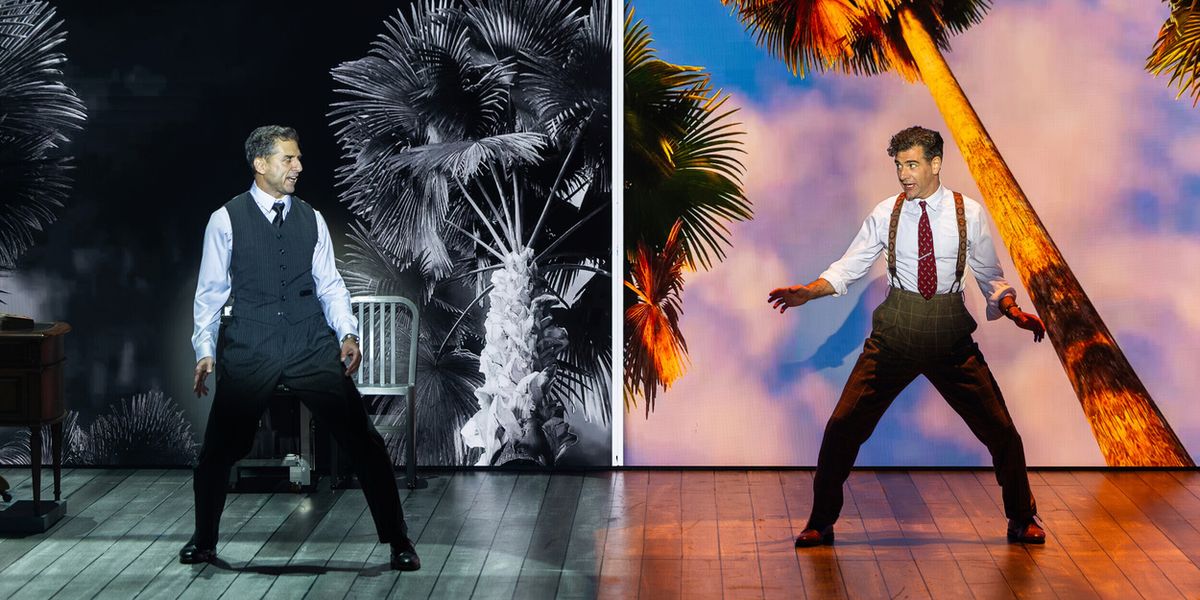
It is hard to believe that City of Angels debuted nearly four decades ago. Born out of the late-1980s resurgence of film noir send-ups, the show demands rapid-fire lyrical precision and a swinging jazz score that balances tough-edged detective lore with a biting satire of early Hollywood. With music by Cy Coleman, lyrics by David Zippel, and a razor-sharp book by Larry Gelbart (creator of TV’s MASH*), it remains a formidable piece of musical theater.
Under Hunter Foster's sharp direction, Ogunquit Playhouse’s current production delivers a towering technical achievement. Ogunquit goes all-out on staging details—from palm trees framed along the ceiling of the theater to an intricately carved Art Deco proscenium and what even looks like a fully operational iron lung on stage.
Set in late-1940s Los Angeles, the plot operates on a clever cinematic split screen. We follow Stine (Ben Jacoby), a cynical New York novelist lured to Tinseltown to adapt his detective story, as he butts heads with tyrannical studio boss Buddy Fidler (Stephen DeRosa). As Stine sits at his desk typing his story, his screenplay comes to life on stage as a film noir classic starring gumshoe extraordinaire Stone (Tony Yazbeck).
The visual contrast is pure stage magic: the "real" Hollywood world is bathed in saturated Technicolor, while Stine's fictional movie is rendered in sleek, moody black-and-white. It feels like watching a crisp classic film juxtaposed with the sudden emergence of color television—a feat brilliantly executed by scenic designer Nate Bertone, lighting designer Jose Santiago, video/projection designer Bryce Cutler, sound designer Kevin Heard, and Costume Designer Jen Caprio.
Ogunquit elevates every musical beat as well, particularly through The Angel City 4—a wandering quartet (Meghan Olivia Corbett, Rick Faugno, Sam Foti, and Aaron Michael Ray) who scat, harmonize, and provide a sleek vocal soundtrack throughout the evening. Their tight, period-perfect jazz transitions keep the show's energy swinging smoothly between scenes.
Yet, as entertaining as both worlds are visually, the film noir side easily steals the spotlight. The 1940s cinema sequences are luscious with mood, slinky brass riffs, and a tongue-in-cheek danger that only a classic Sam Spade style gumshoe can deliver. By comparison, the real-life Hollywood scenes occasionally get bogged down in studio politics that lack the raw magnetism of the detective realm.
That contrast plays out in the numbers. In the noir realm, the saucy duet "The Tennis Song" between Yazbeck’s Stone and Lili Thomas’s sultry Alaura Kingsley steams up the stage as they volley double entendres back and forth. Another standout pairing, Gabby (Alysha Umphress) and Oolie (Danielle Wade), bemoan the cluelessness of their men in the witty duet "What You Don’t Know About Women."
On the other hand, "It Needs Work" between Stine and Gabby feels less like a theatrical high point and more like an uncomfortable intrusion into a private family argument.
The production truly ignites in some individual performances.
Danielle Wade practically steals the production in her dual turn as Donna and, most notably, Oolie—Stone’s sharp-tongued, fiercely loyal secretary. She is equal parts funny and heartbreaking, nailing both the Girl Friday repartee and the jaded "other woman." Her epic rendition of the blues number "You Can Always Count on Me," is delivered with effortless belt-register control.
On the Hollywood side, Stephen DeRosa, as mogul Buddy Fidler is a scene-stealing highlight, chewing through Gelbart’s sharpest takedowns with glorious, self-absorbed gusto.
The undisputed peak arrives when creator and creation collide in their separate worlds. As Stine sits stage right at his typewriter, the movie actors on stage left literally move in reverse with backward-sounding dialogue whenever he stops to edit. This leads into the heart of the show, the dynamic between Jacoby’s Stine and Yazbeck’s Stone. Watching the duo trade vocal blows creates an unforgettable theatrical spark—leaving the audience to wonder whether that epic holding of the final note in “Your Nothing Without Me” and the reprise, “I’m Nothing Without You” is written into the score or is it just a subtle display of onstage singing rivalry in this satisfying musical theater bromance.
City of Angels is another success in the theater’s 94th season on the coast of Maine. Include a stop here on your travelling plans.
|
Come From Away Maine State Music Theatre (8/05-8/22) |
|
Disney's Frozen Maine State Music Theatre (7/15-8/01) |

|
Rainbow Kitten Surprise Thompson's Point (9/13-9/13) |
|
Million Dollar Quartet The Public Theatre (8/26-9/13) |

|
Stroll Haunted Yarmouth 2026 Royal River Community Players (10/14-10/25) |
|
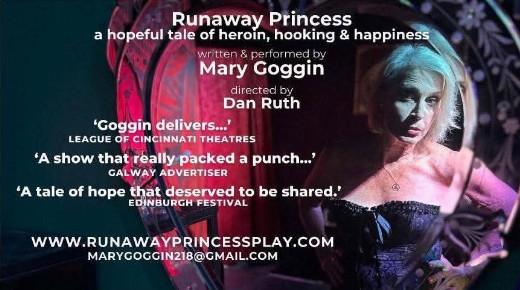
Runaway Princess by Mary Goggin The Playhouse At Waterville Station (8/07-8/09) |
|
The Wizard of Oz! Community Little Theatre Corp (8/07-8/16) |
|
Unabashedly Waterville Opera House (8/28-9/06) |
|
Disney & Pixar's FINDING NEMO: A 60-Minute Family Musical Children’s Museum & Theatre of Maine (6/27-8/23) |
|
The Wizard of Oz! L/A Community Little Theatre (8/07-8/16) |
Reader Reviews
To post a comment, you must register and login.