Review: AMERICAN OPERA INITIATIVE: THREE 20-MINUTE OPERAS at Washington National Opera
Abounding in creativity, music and promise in a new space

The separation of the Washington National Opera from the overrun-and-soon-to-close Kennedy Center has meant next season’s eight planned productions, including five full length operas, will occur on five different stages in the D.C. area.
And the annual American Opera Initiative’s annual showcase of three new 20-minute operas Friday was staged not at the formerly prestigious performing arts center as in years past, but in the nearly industrial space where the new pieces were partly created, the company’s rehearsal studio in Takoma Park.
The broad space, with whitewashed cinderblocks and folding chairs along the edges was actually an edgy, unconventional setting, more akin to a performance space in New York City. With video screens, subtle lighting and the dozen or so players in the Washington National Opera Orchestra playing on one end, the singers from the Cafritz Young Artist Program could roam freely in the center, with strong voices singing unamplified.
The little operas themselves are The Miracles, borne out of nothing, collaborations between composers and librettists who mostly just met, jumping off on ideas that are almost always modern, fresh, unconventional, taking on subjects and approaches rare in an opera world usually given to delivering familiar classics.
Each of the offerings in the 2026 roster began with disarming ideas, fleshed out as much as possible in such a limited time in song and verse, but each with creative scores and singular commitment from the singers.
It’s helpful that each of the works is accompanied by a short, professionally done film in which the creators explain their approach and some of the singers discuss their work in helping embody entirely new characters.
The first piece, “The Curse of the Magi,” with music by Christopher Dietz and libretto by Faiza Alex Manaa, twists a familiar O.Henry tale into even darker territory, when a couple whose marriage is on the rocks (portrayed by soprano Anneliese Klenetsky and bass-baritone Robert Frazier), unwittingly go to the same advisor(mezzo-soprano Michelle Mariposa) for help. But she’s not a therapist or relationship counselor, it turns out, but someone who sets up arranged murders.
Such surprising savagery isn’t exactly new in opera, where everything from “Tosca” and “Carmen” explored murderous themes. But in modern dress, in a civilized society when we’d usually expect rom-com results, this seemed extreme, though the broad comedy of the scheming Mariposa seemed to make it work.
The weirdest and maybe best of the three may have been “The Mold and I” from composer Dan VanHassel with libretto by Hannah Nikka Odsinada, about a woman (soprano Lauren Carroll) emerging from the pandemic, getting ready to move out of her apartment in order to live with her boyfriend (baritone Chandler Benn). But you know how COVID made people a little crazy, with all that isolation and fear. She was so used to her apartment, its quirks and even its mold, she’s tempted to stay.
That’s especially true when tenor Nicholas Huff, embodying the mold by wearing a marvelously long, scrolling robe blotched with black spores, starts imploring her in song. As strange as it may seem, the tug-or-war love triangle felt perfectly suited for their resulting songs.
The final opera seems a bit too ambitious for its limitations in time. In “Mickey Dee and the Eclipse,” composer Dave Ragland and librettist Anita Gonzalez introduce a handful of characters, each with their own personal challenges, who happen to be eating or working at a neighborhood McDonald’s.
It’s a special day at the Golden Arches, though, as an event that occurred even more recently than the pandemic is about to surround them: the 2024 solar eclipse.
Its cast includes soprano Viviana Goodwin, baritone Thandolwethu Mamba, bass Atticus Rego and the returning mezzo-soprano Michelle Mariposa, now a single mother trying to hold on to her teenage daughter as she admits she wants to know her father.
Amid the drama comes the eclipse, clothed in a sparkling Caribbean carnival costume and sung by tenor Hakeem Henderson, whose advice sounds as authoritative as it is tuneful. It’s asking a lot for lives to be changed by the celestial event, but it’s a nice notion.
Too bad the lighting for the event couldn’t have accommodated some sort of ceiling projection to hint at the arrival of the eclipse. But that may be the inherent limitation of limiting the scenes to 20 minutes.
No doubt the future will bring expansion of such creative ideas, and the likelihood we’ll be treated to further work by each of the talented people involved — on whatever local space the Washington National Opera (or any other top company) will stage it.
Running time: About 75 minutes, no intermission.
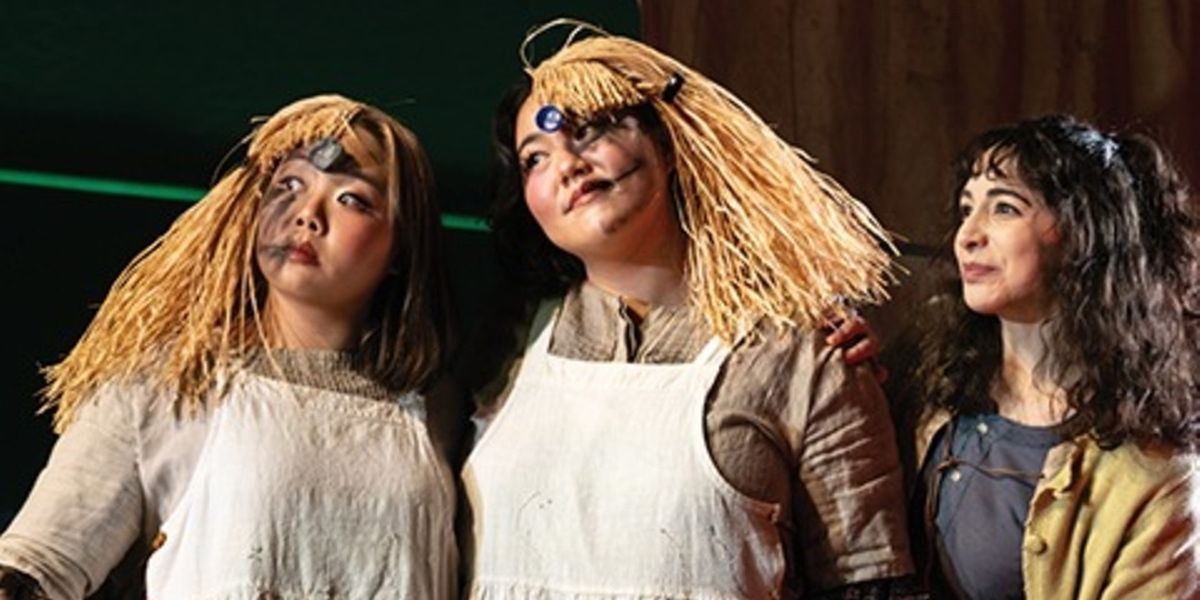
Photo: Michelle Mariposa, Tiffany Choe and Kresley Figueroa in a 2025 American Opera Initiative production “Mud Girl” that has noting to do with the 2026 showcase, but it was on the cover of the evening’s program.
The American Opera Initiative Three 20-Minute Operas was presented May 22 at the Washington National Opera Rehearsal Studio. Information online.
Reader Reviews
Videos
|
OR Atlas Performing Arts Center (5/15-6/07) |

|
A Festival of Favorites and Firsts Theater J (5/30-6/06) |

|
Once NextStop Theatre (5/21-6/21) |

|
Wendell Pierce in Othello Shakespeare Theatre Company (5/19-6/28) |
|
The Motion Arena Stage (5/06-6/14) |

|
Doja Cat at Capital One Arena Capital One Arena (11/11-12/11) |

|
Josh Johnson DAR Constitution Hall (10/02-10/02) |
|
Lysistrata Dance Loft on 14th (5/23-6/07) |

|
Purlie Victorious Studio Theatre (5/06-6/14) |
|
Ford''s Theatre presents: Come From Away Ford's Theatre (9/10-10/18) |
| VIEW ALL SHOWS ADD A SHOW | |