


Review: THE MOTION at Arena Stage
An utterly convincing rollercoaster of life, death, and the world around us.
 Click for Tickets!
Yes or no to this statement: theater is a powerful and persuasive tool that, when wielded consciously, can be a force for positive change in the real world.
Well, it’s hard to say, really. There has been no shortage of important and issue-based plays this past DC theater season, just like every other season in a city that uniquely craves topical analysis and commentary while eschewing light entertainment. What else could be expected from a town so deeply mired in the center of influence and power, where every screen in bars and in restaurants and gyms and storefronts is perpetually tuned to CNN and MSNBC. It stands to reason that such a city's theater would also seek to become its own source of influence and power.
Which it has, with increasing fervor, responding to each exponentially multiplying step in the whirlwind cascade of current events—each war, each economic downturn, each societal regression and authoritarian turn—with the call that theater is more important now than ever before. But with each crisis, and the corresponding works of commentary that follow, it becomes clearer that we are not one biographical ode to an unsung figure of history or one non-fictional investigative delve into some buried scandal away from practical solutions to the pressing crises that threaten our city, our country, and our world.
It’s exactly this central dogma that remains unquestioned: whether this type of activist theater is even effective in its intentions, or only so much self-righteous preaching to the converted. This is no easy question for theater to ask — as the hammer to the nail of all societal ills the most straightforward path will always be to simply keep pounding, harder and harder.
It’s also not an easy question for a review to answer, so for our present purposes let’s downgrade it to something less ephemeral and more grounded, practical. Yes or no: should you go see The Motion?
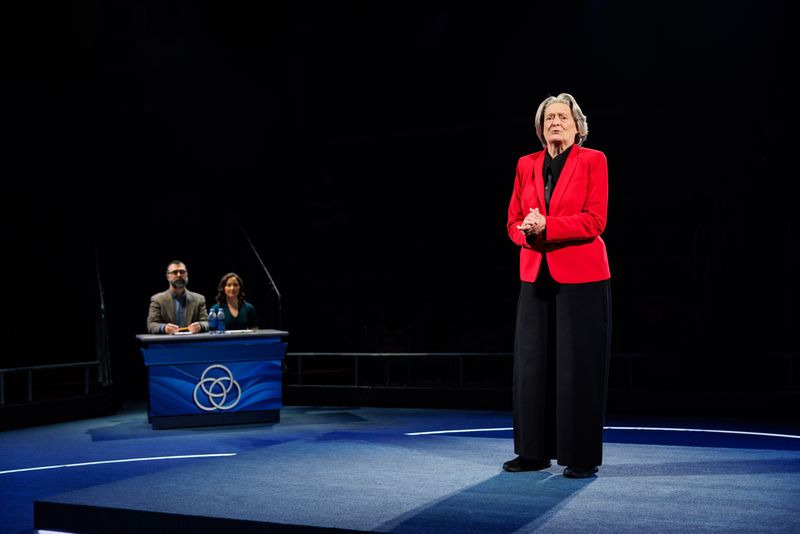
Arriving at Arena Stage after its world premiere last year, Christopher Chen’s The Motion begins, ostensibly, as a live debate on whether or not to "ban animal testing now." On the “yes” side there is Dr. Alan James (Barzin Akhavan,) a self-identified—and self-satisfied—good and humane doctor, and Prof. Lily Chan (Peregrine Teng Heard,) a sharp-witted professor of bioethics at Stanford University. On the "no" side there is Dr. Sarah Matthis (Nikkole Salter,) a charismatic, no-nonsense senior fellow at the Hawkins Center for Bioethics, and Prof. Neel Bharara (Nehal Joshi,) a dour, confidant professor at the Motion Institute at Johns Hopkins University. Moderating is Jackie Donovan (Nancy Robinette,) who appears, at least initially, to be a bit befuddled by the entire matter and easily drowned out by the loud, overbearing personalities of the doctors and academics surrounding her.
Each debater makes their introductions and then the audience takes a preliminary vote on the question at hand with red/green placards placed under each seat. Pivotally, no results are announced and the debate simply continues onto opening statements and it is all pretty much exactly what you would expect. The characters are all well-recognized and trodden archetypes—the good-but-naive doctor versus the right-but-not-nice doctor, the feisty professor against the world-weary one—and the arguments are limp-wristed: animal testing is barbaric, animal testing saves countless lives, and so forth.
Such an opening really threatens to be the kind of shallow, self-righteous theater that the worst kind of Great Debate-style plays can so often be — and The Motion knows it. There’s this thick coating of snark layered over its first phase; this unspoken question floating through the air, asking “wouldn’t it suck if this was the play?” And yes, having sat through many of those, it would indeed suck.
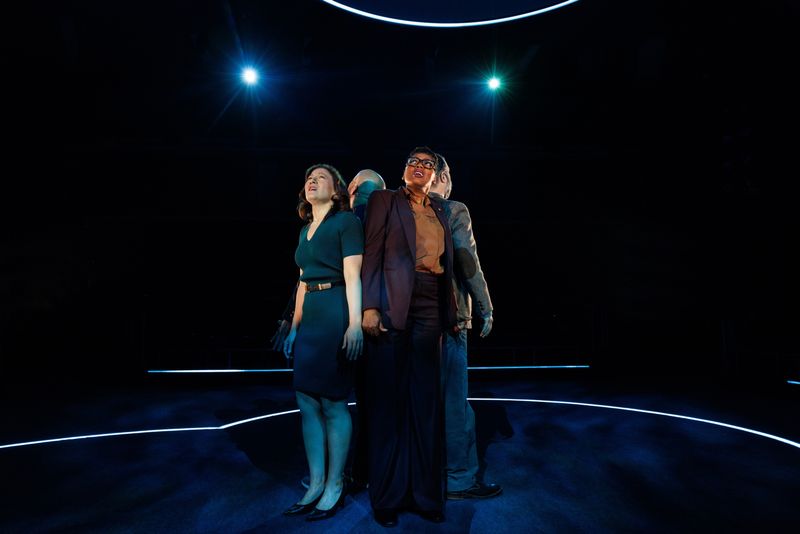
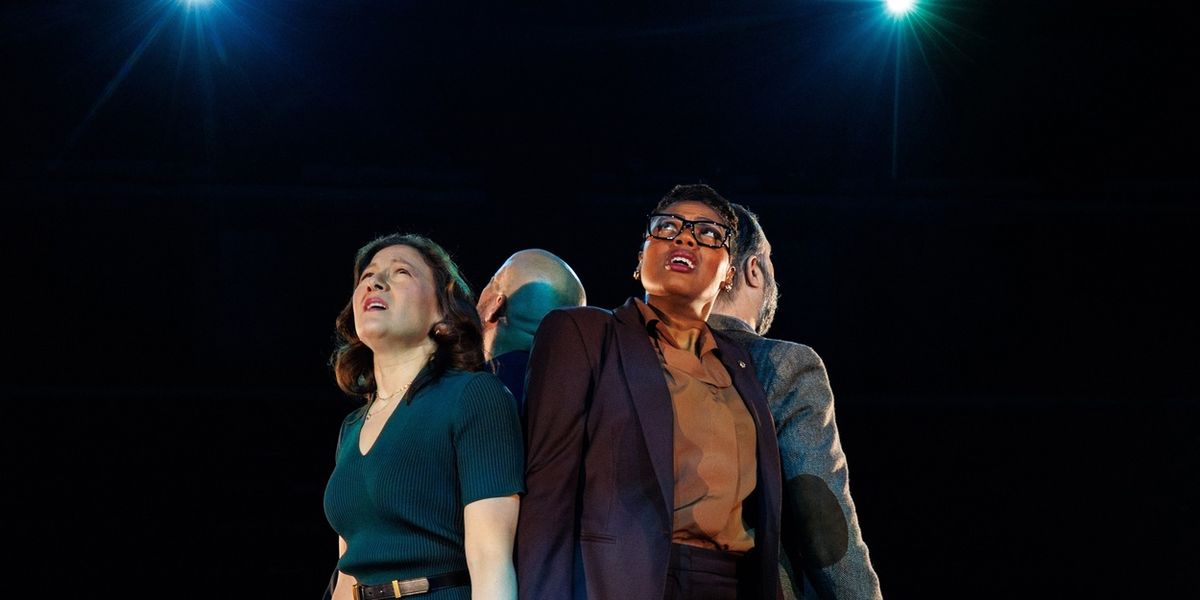
How thankful—and indubitable—then when, not long after opening statements, the entire thing literally implodes upon itself: the debate, the set, the play, everything. It turns out that there is a larger experiment at play here and every variable—who are the experimenters, who are the test subjects, what is the hypothesis—is unknown. The divides between the characters melt away and they are transported to someplace otherworldly where high-minded, semantic quandaries like what constitutes consciousness are swapped for foundational, innate ones like how will we choose to live, to love, to lose.
These sudden jerks in perspective force us to reckon with ever more difficult and interesting questions. How quaint and pointless that initial debate starts to seem. What exactly is really at stake in such exercises? Let’s say the audience is moved to ban animal testing now — what then?
We are flung further and further up scope and scale until we are less interested in persuading and converting our political foes and more interested in delving into what value these moral dilemmas truly hold for us in the first place. We are propelled past semantic arguments and straw men and bad faith until nothing is left but life and death and what we make of it.
What differentiates theater from debate? What differentiates art from propaganda; prose from politicking? Fully fleshing out multi-dimensional characters for an audience to sit with is like granting us the ability to read minds, to understand people on levels we'll never reach in our daily lives. The pitfalls of life and death are absolutes; there is no avoiding them. We cannot snap animal testing out of existence in an instant with a vote. But a theater that seeks not to educate or persuade or prompt us into action, but pushes us to reckon with our realities, helps us to better understand ourselves and those around us, is no less necessary and meaningful.
Chen’s script is incredibly clever, subtly so, full of quiet parallels and intertwining threads; packed to the brim with these puzzling ideas that start small but continue unfolding somewhere in the background through tangents and misdirections until they become impossibly gargantuan. But what is most impressive is the profound trust throughout the script. The trust in the audience to sit through its highly segmented and disparate phases and to hold their judgment until the riddles fully reveal themselves. The trust in the director and actors to make the extended wordless sequences sing. The trust for each design team that takes up this challenge to make Chen’s fantastical impossibilities real.
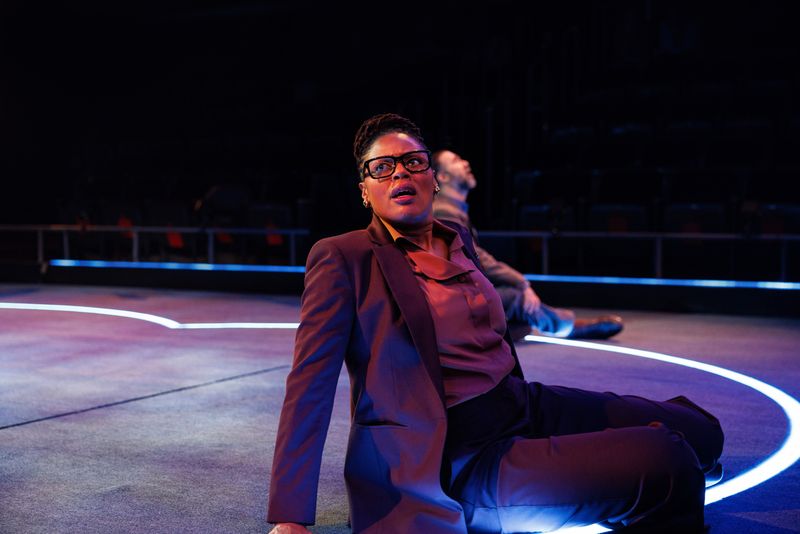
Arena has met that challenge with grace and style. Director Hana S. Sharif’s conceptualization of how the many spaces of the The Motion will take shape and transform is strong and remarkable, but beyond all those fun flourishes lie a deep confidence in exactly how this ever-shifting epic must feel at every given moment. At a touch under two hours and with no intermission, the play is an unstoppable tour de force containing many soft, even silent moments, and yet it never slows, never halts, never falters.
With its intimate, five-person cast, every performance must carry the weight of that powerhouse. Akhavan, Heard, Salter, and Joshi are all faced with the mighty task of embodying immediately convincing stereotypes that must then gradually morph into deeper, more conflicted characters, all while holding onto an invisible throughline that connects each phase. It feels impossible and yet, to a one, they achieve it, and more.
Robinette’s role as the moderator seems initially light for an actor of her caliber, but by the end it reveals itself to be an unexpectedly crucial one that carries the weight of the work’s central question on its shoulders. In what little stagetime she has, Robinette makes a lasting impression in an understated, pitch-perfect, delightfully comic turn.
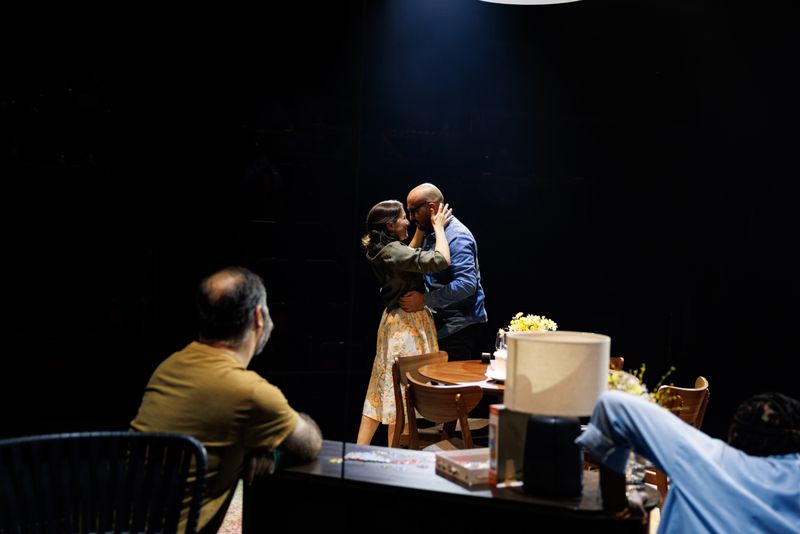
The production design only elevates the affair. It feels uncommon to see such an extravagant sense of play, such a love of theater magic, in straight plays at the present, but these are exactly what The Motion requires and so that’s what the team delivers. Tim Mackabee’s gravity-defying set and Jason Lynch and Xavier Pierce's inventive lighting work seamlessly together to transform all angles, corners, and nooks of the Fichandler Stage in brand new ways that barely seem possible. But more than that it’s all the magical little details and gimmicks that really breathe life into the work, precisely matching the nuances in Chen’s writing. It’s by no means necessary for so much attentive care to have gone into the merest glimpses of moments that many in the audience could easily miss, and yet in a manner supremely human and perfectly inefficient, that’s exactly where the most care seems to have gone.
When all the pieces are added together, the result is something shockingly rare: genuinely surprising. On every level and in every sense The Motion is a truly joyful work that holds unending little gifts to experience as it twists and warps and melds its reality spectacularly. Chen and Sharif have reached deep into the artistic expanse and have pulled out a masterpiece from a completely different time and space that is overflowing with contradictions. It is unassuming yet immense, it is jubilantly silly but also achingly heartfelt, it is audacious and absurd and all of these things at once. It’s the world, our world, if only a slice of it, presented in a beautiful little self-contained pod.
Much more could be written but the meat of The Motion deserves to remain a surprise until it can be experienced first-hand. As to the primary question in hand: give The Motion the opportunity to convince you.
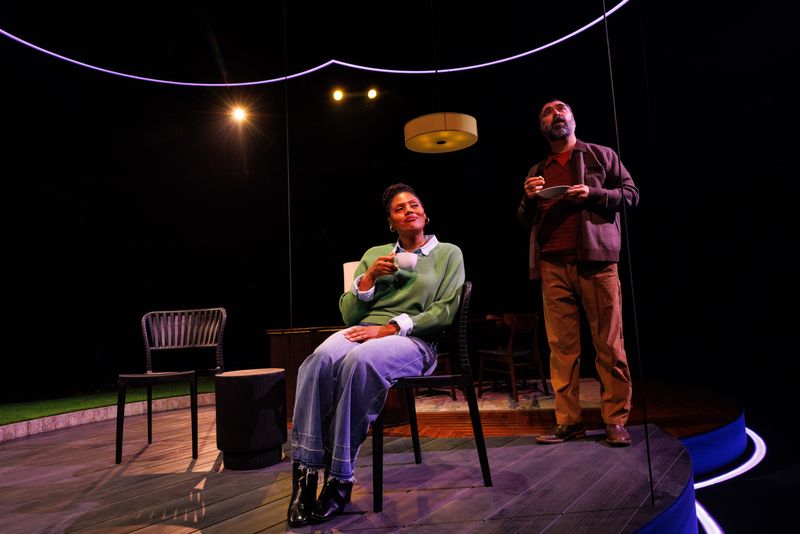
The Motion plays at Arena Stage at the Mead Center for American Theater through June 14, 2026. Runtime is approximately 1 hour and 45 minutes without an intermission.

Sign up for all the news on the Fall season, discounts & more...
|
Brian Henson's Puppet Up! Lincoln Theatre (9/30-9/30) |

|
GARBO: EL ACTOR QUE SAVÓ AL MUNDO (Garbo: The Actor Who Saved The World) GALA Hispanic Theatre (9/03-9/27) |

|
Mr. Burns: A Post-Electric Play Clarice Smith Performing Arts Center (10/09-10/18) |

|
Special Event: ARTS By George!: Jeff Goldblum and the Mildred Snitzer Orchestra Center for the Arts (10/03-10/03) |
|
The Second-Best School Shooting NextStop Theatre (9/17-10/11) |

|
Coming to America: An Immigrant Cabaret ExPats Theatre (9/30-10/18) |

|
Some Like It Hot Bernard Family Theatre, Olney Theatre Center (9/18-11/08) |

|
Stonewall's Bust The Writers Center (10/09-10/25) |

|
"Treasure Island Reimagined: Jane Hawkins and the Pirate's Gold" The Alden Theatre (10/13-10/13) |

|
Moxie Events presents "The Fleetwood Mac Experience" F. Scott Fitzgerald Theatre (10/23-10/23) |

Reader Reviews
To post a comment, you must register and login.