Interview: MEXODUS Sound Designer Mikhail Fiksel On Building the Show’s Immersive, Live-Looping World
Meet Tony Award-winning sound designer Mikhail Fiskel and hear an exclusive clip of the new Audible Original recording of Mexodus, available for streaming now!
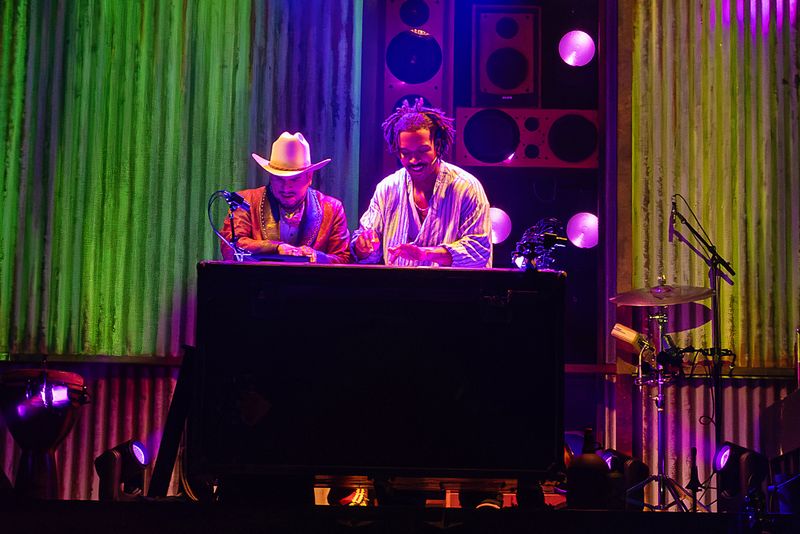
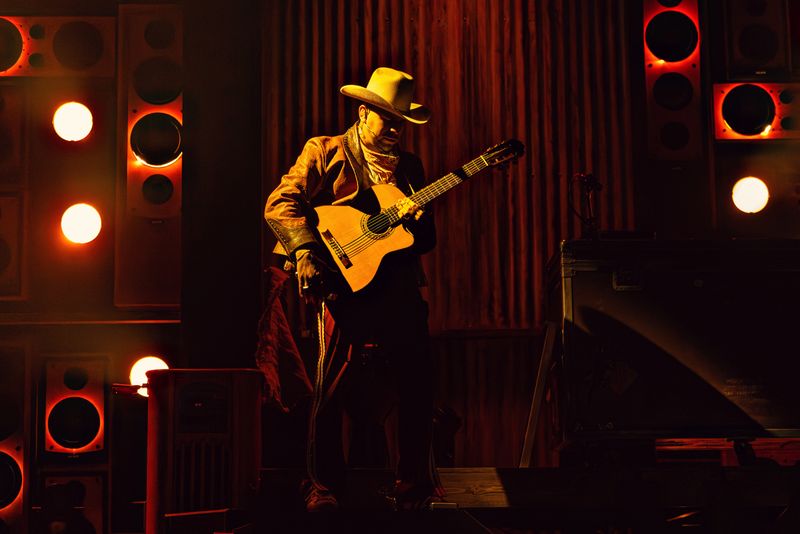
At a superficial glance, the off-Broadway smash Mexodus is a two-person affair. Supertalents Brian Quijada and Nygel D. Robinson step forth to bring the story of the Southern migration of American slaves to life through the astounding use of a technique known as live-looping.
But behind the moving story of unlikely allies unfolding onstage is something far more complex: a live-built soundscape where music, storytelling, and theatrical movement are created simultaneously, in real time, shaped at every moment by the vision of Tony Award-winning Dana H. sound designer Mikhail Fiksel.
The piece expands on live looping, a technique often associated with solo musicians layering sound at a stationary device, and reimagines it as a fully theatrical language.
“Typically when you watch a looping performance, it’s just musicianship,” Quijada told BroadwayWorld. “You watch a single performer behind a machine. Misha was the one who was able to make the entire stage a looping machine.”
“It unchained us from a single machine, from a single looping point,” Quijada continued. “That broke open the possibilities of what the theatrical version could be.”
As Robinson put it, “Misha’s sound design will be studied in universities. It’s insane what is happening.”
That shift places sound design at the center of the production’s structure, shaping not only what the audience hears, but how the piece is built and performed. “[The sound team] have to be there day one or day two, because it informs blocking. It informs everything,” Robinson said.
“This is a collaboration unlike any other,” Quijada added. “If you think of it as all connected, then I know I need to hit that button over there—and that informs my blocking, which informs what I’m saying.”
In our interview with Fiksel, he breaks down how the looping system functions in practice, the technical and creative collaboration behind it, and the role sound design plays in shaping every aspect of performance in Mexodus.
Meet Mikhail below and check out the new Audible Original recording of Mexodus, streaming now!
Photo Credit: Marcus Middleton/Curtis Brown
How did you find sound design?
I got into sound design a bit by accident—kind of through the side door. I started as a DJ in college. I had a lot of friends in theater, did some theater myself—like everyone else, dabbling in acting—but I didn’t really know sound design was a job. At the same time, I had a background in music, especially classical piano from when I was still in Russia. When I moved to the States, that expanded into other instruments, and I discovered electronic music and DJing. Music has always been a big part of how I interact with the world.
Eventually, someone asked me to sound design a sketch comedy show. I didn’t really know what I was doing, but I sort of fell into it. Before I knew it, I had a table full of sound-making toys—turntables, keyboards that made cat noises, computers—and it became clear, to me and everyone else, that this was something I could do.
Can you take me back to how you first met Brian and Nygel? Where were you in your career at the time, and what did you make of this idea they had for a live-looping musical when you first heard about Mexodus?
I had known Brian for a while—we kind of orbited each other in the Chicago theater community. I actually met his brother first, then him, and I had designed a couple of shows he was in. We stayed loosely in touch.
Then the pandemic happened, and I started seeing the songs they were posting. I was just enjoying the work, but something stuck with me. Then Brian reached out about something unrelated—he was running a summer program and invited me to guest teach. While I was there, I said, “I’ve been following these Mexodus songs. I think this should be a concept album. Let me help you make it.”
I’ve always been interested in audio storytelling—audio theater, musicals, concept albums—and this felt like the perfect intersection. Meanwhile, they were already working toward a live-looping musical, so we started talking more seriously about it.
Did you have any relationship to looping at that point?
Yes and no. I wasn’t coming from the traditional loop-station world, but I had been DJing and performing live for a long time, using software like Ableton Live, playing with live musicians, doing some looping and live sampling. Looping is really foundational to electronic music and DJing, so I was already working in that space.
Brian and Nygel were using more traditional loop stations—hardware that lets you create and layer loops in real time. What became interesting was expanding that idea. Instead of thinking about looping as just a device, we started thinking about the entire stage as a looping instrument—something more flexible, more complex, more integrated into the storytelling.
mexopening_bymarcusmiddleton_9593.jpg?format=auto&width=800)
That ties into the storytelling, especially through the Foley looping. It’s one thing to watch them build music live, but when Brian crumples a piece of paper and, through looping, it becomes the sound of a crackling campfire, that’s when the magic of the concept really reveals itself. Can you talk about how you developed that language for the show?
I’ve always been fascinated by what Foley does theatrically—what I call “sonic puppetry.” I’ve worked with companies like PigPen Theatre Company, where everything is very handmade, and the sound design becomes part of that handmade aesthetic.
We started exploring what it means to loop Foley—not just for single sound effects, but to build entire environments. So instead of just a one-off sound, you’re creating an atmosphere: a fire, crickets, birds, an entire sonic landscape. That’s where it gets really exciting.
What struck me about Mexodus is how collaborative it feels at its core—it doesn’t seem like a process where design is layered on later, but something built collectively from the beginning. Was this your first time working that way, and what did that change about how you approached the sound?
No, that’s actually something I’ve done a lot, and I really enjoy it. I’ve worked on projects where I’m in the room from the very beginning, sometimes because the work can’t happen without sound present.
For Mexodus, we were lucky to have a long development process with support from multiple institutions. From early on, it was clear this wasn’t a show where you rehearse and then add tech later. We had to bring the sound system, instruments, and essentially the set into the rehearsal room. I was there every day, working with them.
It was a very iterative process—lots of trial and error, a lot of R&D. The first full run-through felt like a proof of concept. Once we saw it worked, we kept expanding—adding video, refining the system. It really was a village effort.
Were there ever ideas that were too complicated to execute?
We didn’t really scrap things entirely, but we definitely revised a lot. One number, “All My Life,” went through many iterations. At one point, we were sampling sound effects live and turning them into percussion, which was exciting, but it slowed the storytelling. So we adjusted.
It was a process of layering—building, testing, refining. And Brian and Nygel were incredibly generous in letting me into that process. It became very collaborative, even influencing musical arrangements, because those decisions affected the technical design.
 That’s next-level collaboration. Every decision seems to affect every department.
But that’s also the ethos of the show—collaboration, solidarity, working together. It would feel disingenuous if the process didn’t reflect that.
And then there’s the sustainability of the show—doing it eight times a week, adjusting to different venues. Does that process ever end?
Probably not. We’re still tweaking things. As we prepare for touring, it has to stay flexible. The show is tightly choreographed and programmed, but it also has to feel alive. It’s like designing a structure that can withstand earthquakes—it needs to be solid, but it also needs to give.
What did it mean to you to work on something where sound design is so emotionally central—not just technical, but part of the storytelling itself?
Honestly, I think that should be true of every production. It’s just not always recognized. The line between technical and artistic is very blurry for me. I approach everything from a storytelling perspective.
One of the best compliments I’ve received is being called a dramaturg, not just a designer. That’s how I see the work. Mexodus just happens to showcase that more visibly, and I’m grateful for that.
How has working on Mexodus changed how you approach other projects?
It’s made me think more about longevity and flexibility—how a piece evolves over time and how to future-proof the work. It’s also pushed me further into multi-platform storytelling. Now we have the stage version and the Audible version, and we’re exploring things like a concert version. I’m really interested in how a story can exist across different mediums, each one standing on its own while still being connected.
mexopening_bymarcusmiddleton_9295.jpg?format=auto&width=800)
What was your role in adapting the show for Audible?
Because of how the show is built, we couldn’t just record it like a traditional album. We recorded loops, and then I essentially rebuilt the songs from those loops—like working with a massive sonic Lego set.
From there, we reimagined the sound design for an audio-only experience. Instead of showing Foley, we create a fully immersive environment—footsteps, wind, crickets, the texture of a space. In one moment, we even turn raindrops into percussion by looping them. It allowed us to explore much finer sonic details and really integrate sound design and music in new ways.
That’s incredible. I think the layers of the music will really come alive in that format.
Absolutely. The audio version lets you experience the layers in a different way—more intimately, more immersively.
About Mikhail Fiskel
A 2022 Tony Award winner for his immersive sound design of Dana H., Fiksel’s recent credits include Little Bear Ridge Road on Broadway, Mexodus Off-Broadway, and Uncle Vanya on Broadway, as well as How to Defend Yourself, Good Enemy, and Tambo & Bones Off-Broadway. His earlier work includes Cambodian Rock Band, This Flat Earth, The Treasurer, and A Life, reflecting a body of work that spans Broadway, Off-Broadway, and regional theater, alongside projects in film and audio production.
Prefer BroadwayWorld in Google Search?
Add us as a preferred source so our stories show up more often in Top Stories and Google’s AI answers — for you.

Sign up for all the news on the Fall season, discounts & more...
BroadwayWorld Merch
Shirts, mugs, phone cases & more



Powered by

|
.jpg?format=auto&width=300)