


From Churches to Banks: The Unlikely Origins of Off-Broadway Theaters
Many off-Broadway theatres of today started as libraries, factories, and more.
Do you have a burning Broadway question? Dying to know more about an obscure Broadway fact? Broadway historian and self-proclaimed theatre nerd Jennifer Ashley Tepper is here to help with Broadway Deep Dive. BroadwayWorld is accepting questions from theatre fans like you. If you're lucky, your question might be selected as the topic of her next column!
Submit your Broadway question here!
This time, the reader question was: what are some off-Broadway theaters With fascinating past lives?
The large majority of our 41 Broadway theaters were built to be Broadway theaters. Other than the Winter Garden, which was originally a horse exchange, the Nederlander, which was originally a carpenter’s shop, and the Broadway and Lunt-Fontanne which were originally movie theaters, every current Broadway house was intended from the beginning to present Broadway shows.
As for off-Broadway? The opposite is true. The large majority of our off-Broadway theaters were originally built for other usage. In a city like New York, where real estate is always in high demand, off-Broadway theaters have always popped up wherever they could lay claim to space. If you’re going to see an off-Broadway show today, you’re usually entering a realm of history unique to New York where each theater has many past lives.
Have you seen the current revival of Little Shop of Horrors (2019) at The Westside Theatre? If so, you’ve been inside the 136-year old Second German Baptist Church. A significant number of off-Broadway theaters were once churches, converting seating areas for congregations into audience sections for theatergoers. The Second German Baptist Church originally organized on 45th Street in the 1850s, welcoming German immigrants who worked in factories and lived in the rural area we now know as midtown Manhattan. The church called their 43rd Street location home for over 70 years, until the 1960s. During the late 1960s and early 1970s, 407 West 43rd became home to Sanctuary, a raucous disco club. The club originally tried to get away with being named simply “Church” but authorities would not allow it. Club Sanctuary did capitalize on its previous life as a church, covering the venue in a mural featuring demons and angels engaged in sexual acts. Sanctuary might’ve only existed for a few years but it made an appearance in the film Klute, counted celebrities like Liza Minnelli and Neil Armstrong among its patrons, and became well known in the neighborhood for wild gay orgies and drug busts. It was shut down in 1972. The following year, the space was rechristened the Chelsea Westside Theatre, and it’s been an off-Broadway space ever since, housing shows from Really Rosie (1980) to March of the Falsettos (1981), from I Love You, You’re Perfect, Now Change (1996) to The Vagina Monologues (1999). The spot where theatergoers can now see shows upstairs and downstairs, including the long-running Little Shop of Horrors revival still has a visible cornerstone with a dedication from the church.
The Westside Theatre is far from our only off-Broadway house that started life as a church. Another former church turned off-Broadway haven belongs to the Atlantic Theatre Company. The non-profit theater’s main space is the Linda Gross Theater on 20th Street, which was once the parish hall of St. Peter’s Episcopal Church. While the Atlantic has performed shows, like Spring Awakening (2006) and Kimberly Akimbo (2021) in the former parish hall since 1991, St. Peter’s still holds religious services in the church itself, as they have since the 1830s. The co-founder of St. Peter’s Church, who donated his land in order for the church to be created, was Clement Clarke Moore, writer of the poem known today as ’Twas The Night Before Christmas. Even older than the 19th century church buildings that house St. Peter’s and Atlantic Theatre Company is the wrought iron fence in front the church. If you’re going to see an upcoming production at Atlantic this season, like The Reservoir or Indian Princesses, take a moment to appreciate the historic fence which was built in 1790 for Trinity Church downtown and moved to St. Peter’s in the 1840s.
Churches aren’t the only historic New York spaces that have been converted into off-Broadway theaters; several of our cherished off-Broadway spaces were once banks, and have the architectural details to prove it! Studio Seaview is located on 43rd Street just west of 8th Avenue, in the theater that was Second Stage’s off-Broadway home from 1999 until 2024. The theater that recently boasted the sold-out run of Prince Faggot is now presenting The Unknown, a new play starring Sean Hayes. Planning on seeing The Unknown this season? Leave some extra time to appreciate the evidence that you’re inside the former State Bank & Trust Company. Studio Seaview’s box office is inside a large bank vault, too heavy to be removed from the premises. The theater’s auditorium was once the main banking floor, with windows overlooking 43rd Street. The bank, which operated inside under several different names until 1990, was built in 1929, and its stunning Art Deco details are on display on Studio Seaview’s exterior.
One of the reasons that defunct bank buildings are ideal to be converted into theaters is that they often contain large main banking floors without obstructions like columns. Another bank-turned-theater is the Daryl Roth Theatre in Union Square. Theatergoers rushing in to see Titanique, one of its recent tenants, couldn’t help but notice the dramatically lit exterior of the former Union Square Savings Bank. Built in 1907, the major bank building has been a theater since 1996, housing shows like the long-running Fuerza Bruta (2007). Like Studio Seaview, the Daryl Roth Theatre’s former life as a bank is apparent in its well-maintained, architecturally impressive exterior, while its interior is fully transformed into a theatrical space.
While some churches and banks have been converted into theaters, we do still have many of each on the island of Manhattan. What we don’t have many of anymore are carriage houses, buildings meant to hold horse-drawn carriages. Every city was once filled with carriage houses, the equivalent of a modern-day garage. In New York, several former carriage houses are now major off-Broadway theaters. Classic Stage, a non-profit theater company, has been operating out of a former carriage house on 13th Street since 1973. This season, Classic Stage’s slate includes a rare New York revival of The Baker’s Wife and the premiere of the new musical Marcel on the Train. If you’ve seen a production at Classic Stage over the years, you’ve been inside the former carriage house, where exposed brick and other historic elements are on display. A 1900 advertisement in the National Police Gazette also noted that marked cards could be purchased at the location; the carriage house had a side business of selling trick materials for gambling.
Also inside a former carriage house is The Players Theatre, the landmarked Greenwich Village space used for off-Broadway and off-off-Broadway shows. The Players Theatre spent the first half of the 20th century as a carriage house for police horses and the second half as a premiere off-Broadway space, with the famed Cafe Wha? venue in its basement. The off-Broadway house currently presenting The Opening (subtitle: New York City’s Second Most famous Musical About Chess) counts among its previous productions Ruthless! (1992) which had then child stars Britney Spears, Natalie Portman, and Laura Bell Bundy walking its hallowed halls on MacDougal Street. The 1950s off-Broadway mega-hit Little Mary Sunshine also spent part of its 1000+ performance run at the former carriage house.
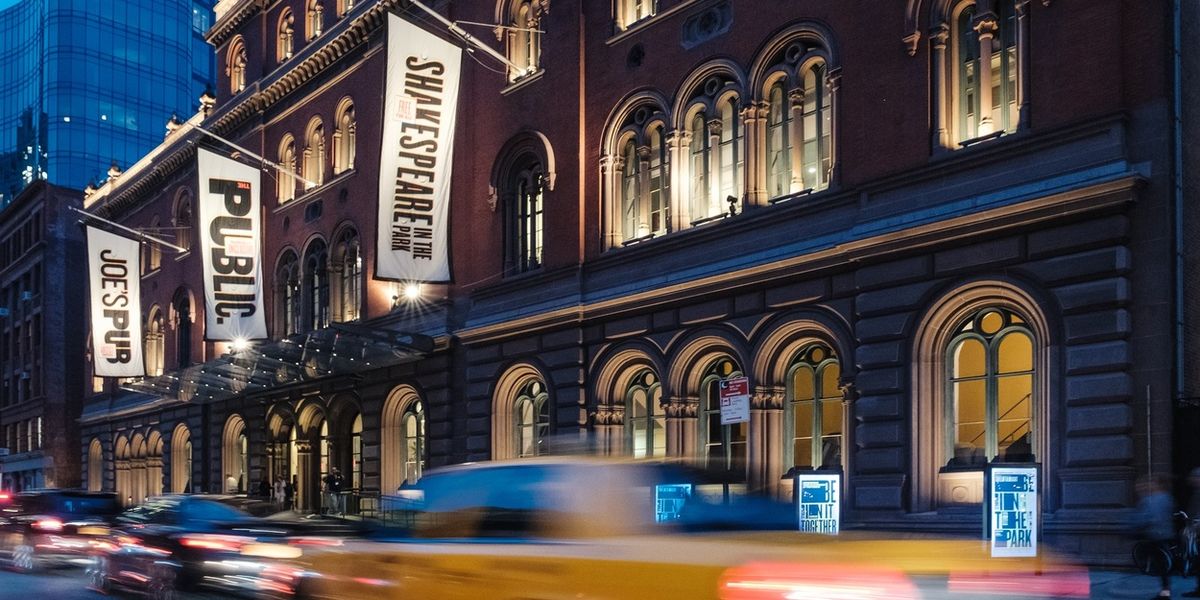
Off-Broadway theaters have popped up in former zipper factories and supermarket basements, meth clinics and tobacco warehouses. But one of the most extraordinary transformations into an off-Broadway hub belongs to the former Astor Library turned Hebrew Immigrant Aid Society, which is now The Public Theater. It’s fitting that the Public, one of the most prominent off-Broadway companies since the mid-20th century which champions theater access for all, found its long-time home at the Astor Library building. The Astor Library opened in its location on Lafayette Street in the 1850s and was historic for providing widespread library access. Most libraries at the time were private, only available to upper class citizens but the Astor Library was free for all. The popular library had to put in multiple expansions to its initial building and eventually merged with the New York Public Library. In 1920, the Astor Library started its second life as the Hebrew Immigrant Aid Society. 425 Lafayette Street welcomed Jewish immigrants from 1920 until the 1960s, providing dormitories, religious programs, and many other much-needed services to new Americans who had fled anti-Semitism and persecution in their home lands. This historic building was slated for demolition in 1965 until Joe Papp convinced the city it had to be saved and landmarked. The Public Theater moved in and has presented the New York premieres of hundreds of shows in the 60+ years since, converting the building into multiple theater spaces. Hair (1967), A Chorus Line (1975) and Hamilton (2015) are just a few of the beloved shows that have wowed audiences at the former Astor Library turned Hebrew Immigrant Aid Society. Many glorious original elements of the building are on display throughout the Public, and if theatergoers seeing Antigone (This Play I Read In High School), Ulysses, or one of the company’s other offerings this season look up and around them, they’ll glimpse fascinating pieces of the building’s storied past.
Prefer BroadwayWorld in Google Search?
Add us as a preferred source so our stories show up more often in Top Stories and Google’s AI answers — for you.
Sign up for all the news on the Fall season, discounts & more...
.jpg?format=auto&width=300)
.png?format=auto&width=365)





Comments
To post a comment, you must register and login.