


Review: ROMEO & JULIET, starring Sadie Sink & Noah Jupe, Harold Pinter Theatre
Robert Icke directs Sadie Sink and Noah Jupe in their West End debuts.
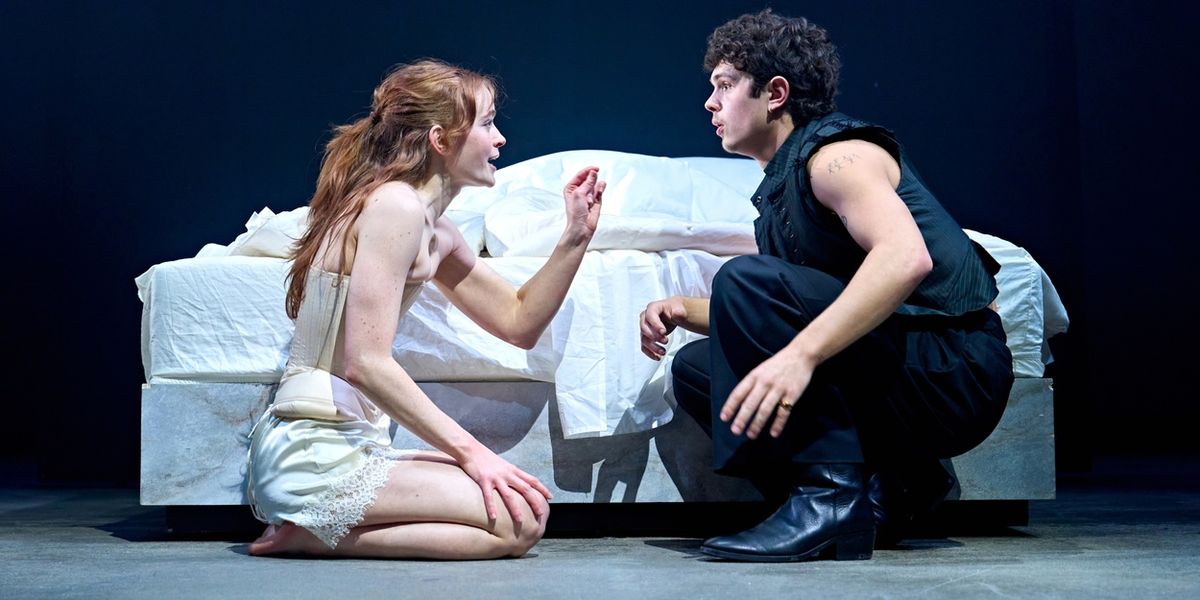
 Robert Icke is back in the West End with another star-studded classic in tow. After tackling Sophocles last year, he returns to Shakespeare, revisiting the Bard’s most misrepresented tragedy: Romeo and Juliet. Fourteen years after his directorial debut for Headlong with a radical rendition of the same play, Icke doesn’t have anything to prove - we already know he’s in a league of his own. Stylised with an ampersand like all the cool kids do these days, this production is slick, focused, and profoundly sincere.
Caught in a dream, Sadie Sink (Stranger Things) and Noah Jupe (Hamnet) take the lead with youthful flair as the troubled couple. This is an investigation of fate, and definitely not your traditional Romeo and Juliet. Though he punctuates the mise en scène with huge digital clocks that tick relentlessly towards the lovers’ demise, Icke feverishly tries to rewrite the narrative. Just as the story starts diverging from its natural path, blinding flashes à la Men in Black "Neuralyzer" rewind the scenes, bringing it back to its fatal route. It’s clever and original, making this an utterly thrilling vision.
-0583.jpg?format=auto&width=800)
Time is the anchor. It quickens and slows, swells and stops, becoming the impermanent concept that rules the characters. The continuous intervention of destiny works in tandem with these active fluctuations. It’s not a purist approach by any means, and it will alienate a certain part of the Bard’s audience, but this project is not for them. While he maintains a highbrow aura in his work, here Icke doubles down on the approachability of the piece by giving it a colloquial rhythm and adding an instinctive quality to the performances.
The feuding families plot may be largely discarded until it becomes absolutely necessary to drive in the relative absurdity of the situation, but it makes sense: this is an exquisite depiction of limerence, so infatuation takes over every aspect of the text. Icke delights in Shakespeare’s poetic riddles, playing around with the language and offering what could be only described as anti-declamation.
-0516.jpg?format=auto&width=800)
In line with the broader picture, the portrayals are modern and accessible. Sink and Jupe are simply tremendous. The Broadway veteran conquers her first Shakespeare with sophistication, introducing a Juliet who’s far from being a wilting flower. She’s in charge, bubbly, and headstrong; she knows what she wants and she knows how to get it. This Juliet bounds with joy, twirling and kicking her feet with abandon in a lifelike representation of teenage yearning.
Jupe’s stage debut is a Romeo who’s madly in love. He holds himself with charismatic confidence and owns the role with precision. The pair shares a sweet chemistry, plastering a goofy smile on their audience’s faces with how adorable they are. Icke's emphasis on time and juvenile reaction stresses how crazy it is to think of their liaison as the epitome of romance. The result is that we root for them with weary caution.
-0146.jpg?format=auto&width=800)
Sink and Jupe are joined by an equally strong cast. Clare Perkins steals the show as the Nurse. Empathetic, sassy, and protective, she is the closest thing Juliet has to a mother. Perkins is in direct opposition to Eden Epstein’s Lady Capulet. Distant and glacial to her own daughter, she resorts to summoning the Nurse whenever she needs to speak to Juliet, unable to bridge the gap alone.
As for Lord Capulet, Clark Gregg is an intimidating, tattooed individual whose relevance in Verona’s rule is quite obscure. His amiable side suddenly twists into a mean streak, edging into violence when he’s defied, going from loving father to cruel patriarch in the blink of an eye. Sticking to father figures, Romeo’s relationship with Friar Laurence (John Marquez) mirrors Juliet’s own with the Nurse.
-0458.jpg?format=auto&width=800)
Hid laddie Montague mates enliven the action. Kasper Hilton-Hille is a firecracker of a Mercutio; rudely phallocentric and - frankly - a little annoying, he’s an undeniable highlight. His explosiveness is thoroughly balanced by Dylan Corbett-Bader’s level-headed Benvolio, who acts as Mercutio’s handler and Romeo’s confidante.
Hildegard Bechtler’s stage is a greige liminal space. Tall panels and screens glide in a quasi-constant flow, revealing a handful of set pieces and adding an oneiric element to the design. A large bed is the centrepiece of most scenes. John Clark lights it with expressive intent while Giles Thomas’s soundscape sneaks in to manipulate our response. It’s an impressive collection of technical achievements.
-0090.jpg?format=auto&width=800)
This Romeo & Juliet is a dreamlike, young, and assuredly sophisticated production. With a cinematic emotional pull, the ghosts of potential haunt our star-crossed lovers mercilessly. Icke sets his aims on the tragedy of predetermination and melancholically mourns what could have been.
Romeo & Juliet runs at the Harold Pinter Theatre until 20 June.
Photo Credits: Manuel Harlan
Prefer BroadwayWorld in Google Search?
Add us as a preferred source so our stories show up more often in Top Stories and Google’s AI answers — for you.

Sign up for all the news on the Fall season, discounts & more...

|
Powered by

|
.jpg?format=auto&width=300)






Reader Reviews
To post a comment, you must register and login.