


Season 2, Episode 5: Behind every summer is a community that keeps Fire Island alive. This episode explores the history of the beloved Pines Pantry through the eyes of its iconic Pantry Girls, alongside the volunteer firefighters of The Pines and Cherry Grove who protect the island from fires, hurricanes, beach erosion, and an uncertain future.
Review: CARMEN, Royal Ballet & Opera
Is it third time lucky for Damiano Michieletto's tragedy?
By: Franco Milazzo


Third time is rarely the charm for a Carmen at Covent Garden. Damiano Michieletto’s production is now on its second revival, which is exactly where its predecessor got the push.
Perhaps appropriately enough for a work which is all about fidelity (or a lack thereof), RBO have yet to properly settle this century on a production of Bizet’s noirish tragedy. While the house have kept faith with David McVicar’s The Magic Flute for over two decades, a trio of Carmens have debuted in that time.
And none of the three productions has had much in common beyond the story and the score. Francesca Zambello’s concept was as Spanish as Spanish gets this far north of Seville: sun-baked arena walls, real horses, flamencos and high-energy choreography. Australian auteur Barrie Kosky came at the opera from a more controversial angle. His cabaret-vaudeville spectacle saw Carmen emerge in a giant gorilla suit to perform dance routines with the chorus; after a debut and two revivals (the last in 2019), Covent Garden quietly moved on.
It’s fair to say that Michieletto has gone in a different direction from Zambello and Kosky. He opens by having an older woman dressed all in black come to the front of the stage and show us what appears to be a card. Has she been inspired by the new Derren Brown show to perform a magic trick for us? Is she giving the orchestra a yellow card for some perceived foul? Or is this a tarot card foretelling the fate of someone in the front rows? Only they are likely to know what she was actually up to. Matters aren’t made any better by this woman being an invention of Michieletto whose role only becomes clearer later on.
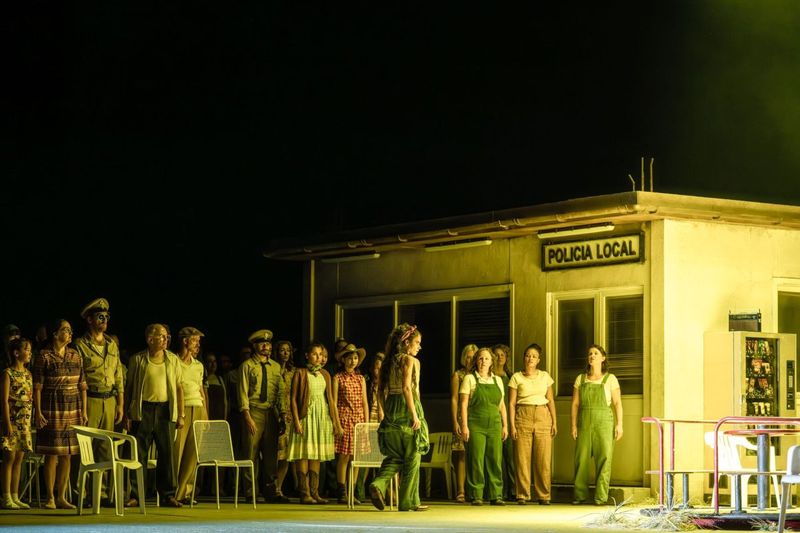
After that unintentionally bizarre start, it’s adios to Zambello’s picturesque Seville and hola to a remote Spanish town in the Seventies. Tumbleweeds have collected in the corners of this one-horse town with no hope and no horse. It’s what a London estate agent would euphemistically call an “up-and-coming” area because, frankly, it has fallen so far that it has nowhere else to go.
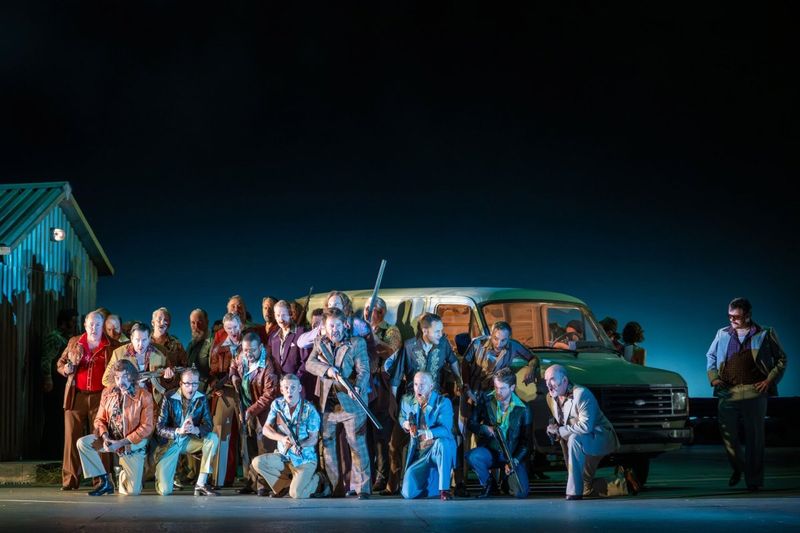
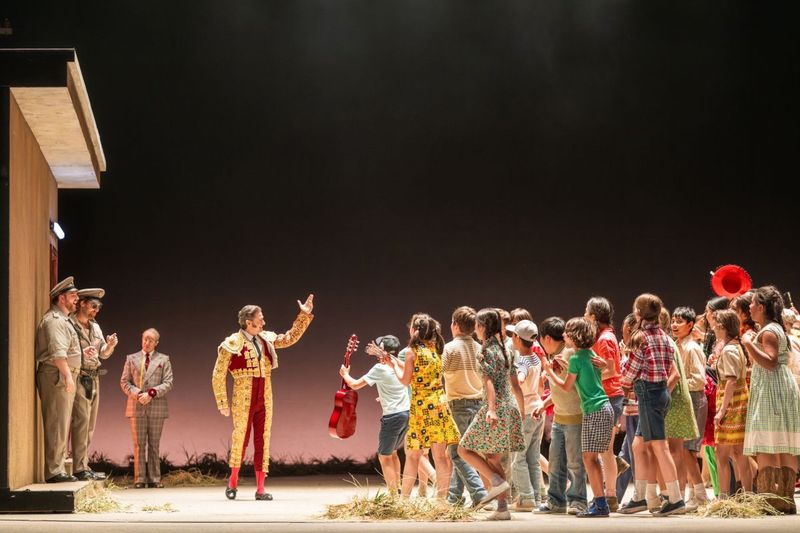
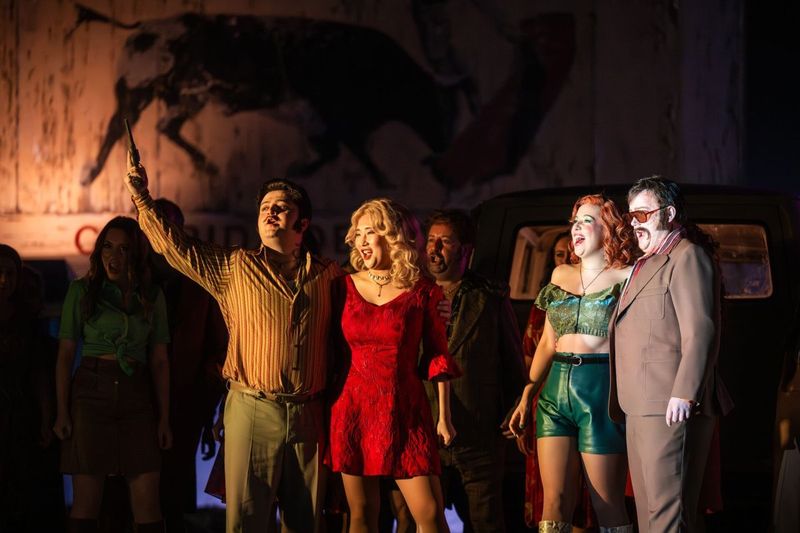
Men in sideburns, wide lapel shirts and flared suits take long, lusty looks at ladies leaning into the disco era with metallic crop tops, snakeskin knee boots and leather hot pants. Carmen's usual children’s chorus is less well-behaved school choir, more kids frenetically running around, full of life and character as if auditioning for the 1976 classic Bugsy Malone.
The scene is set, and the opera settles into a pattern with each act having a different building as its centrepiece. We open on a police station curiously close to a children’s roundabout — does this mean the cop shop is sited on a playground or that the plods like to go for a spin in between the doughnut runs? Later on, there’s a corrugated iron shed used by the smugglers with a Ford Econoline van parked outside, a hot pink nightclub stands in for Lillas Pastia’s tavern and, for the fourth act, Escamillo’s fancy house before the story finishes on a veritable coup de théâtre. But more on that later.
There’s a definite Italian flavour both off-stage and on for this co-production with Milan's La Scala and Madrid's Teatro Real. The director has retained the services of fellow Veneto native Paolo Fantin (set) as well as Carla Teti (costume) and Alessandro Carletti (lighting), all three veterans of his Olivier Award-winning Cavalleria rusticana/Pagliacci. In the pit, conductor Sesto Quatrini keeps a firm grip on the familiar score while on press night Palermo-born Ginger Costa-Jackson took on the title role.
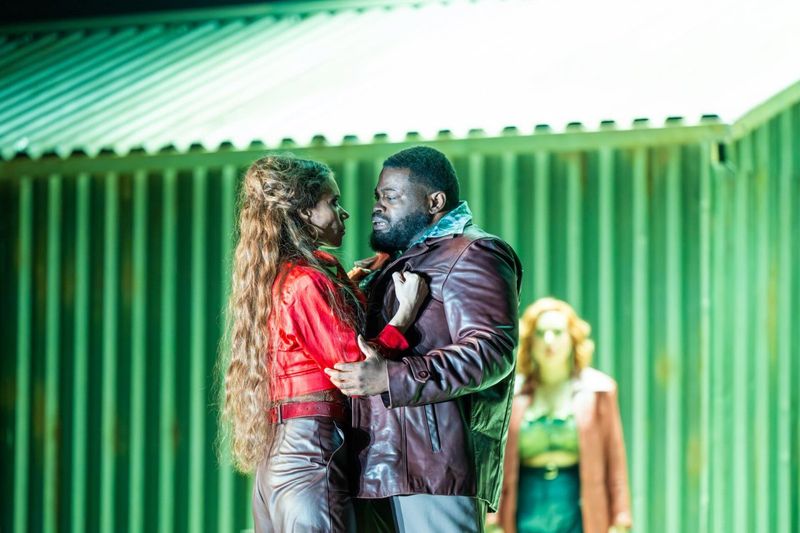
As Carmens go, Costa-Jackson has read the assignment and gets top marks. Her Habanera becomes a feisty dance number and she puts on a spirited display throughout, superbly portraying a woman doing all she can to own her destiny — right up until the moment when Don José throttles the life out of her.
Opposite her, American tenor Russell Thomas digs deep into the policeman’s tortured heart and convincingly shows the man’s conflicted state; however you want to characterise his situationship with Carmen, there’s no doubt who is chiefly at fault for its on/off nature. Saddled with a mustard-yellow lounge suit which shades towards a grim chartreuse under the stage lights, Alexander Vinogradov plays a sprightly matador Escamillo with a delightful display of verve.
Three of Michieletto’s bold additions diminish the overall quality: his signature revolve (seen before in Cavalleria/Pagliacci and Don Pasquale), his habit of a looming, silent mother figure, and a troupe of distracting urchins. Seeing the cast and set slowly moving in a circular motion does nothing to develop the core themes or add dramatic weight; an ever-downward Escher staircase would have been more appropriate for all concerned. Having a harbinger of doom appear on the fringes of the set adds little in the way of insight or impact. Then there are the urchins, brought on during every entr’acte for a mildly amusing comedy routine. Call them cute, call them funny but the opera would be better off if they were called away until the story begins again.
Those drawbacks don’t overshadow the successes of this Carmen. While some directors try their hardest to have their choruses act as aural wallpaper that look and move like an amorphous flock, Michieletto goes out of his way to give his own choruses real personality. The physically diverse groups of adults and children are dressed by Teti in a hugely varied assortment of period-accurate outfits that gives the whole town a lived-in quality.
Another triumph sees real intimacy and connection being created in an organic fashion. As other directors have found to their cost, the main stage at Covent Garden can be unforgivingly immense. In the wrong hands, it is more than capable of sucking the oxygen right out of key scenes. When setting the core two-handers inside the buildings, Michieletto places his characters mere feet apart in a natural way. It’s a smart move that adds real dramatic ballast to an opera propelled by its many duets.
Most memorable of all is how this production sticks the landing. In the final minutes, Carletti’s lighting rig is lowered from its location high overhead to a raked position metres behind a furious José and his ex-lover. Michieletto suggests that Carmen’s end is not so much a case of cruel fate as the brutal and inevitable result of her ex-lover’s possessive nature. As a consequence, he deploys the blazing yellow lights to cast harsh judgement on the man’s unforgivable violence. Whichever way one looks at it, it is impossible to tear your eyes from Costa-Jackson in that climactic scene.
Carmen continues at the Royal Opera House until 3 November.
Photo credit: Mihaela Bodlovic
Breaking Broadway alerts by text
Get the biggest stories sent straight to your phone.
Broadway news in your inbox
Weekly top stories - unsubscribe anytime.
Weekly top stories - unsubscribe anytime.
Popular episode




Tickets From $70

Tickets From $135

Tickets From $58

Tickets From $67
Reader Reviews
To post a comment, you must register and login.